Nestled within the rich, ecologically diverse landscape of north-central Florida, the Cuscowilla Nature and Retreat Center stands as a testament to successful community land acquisition, historical preservation, and environmental stewardship. Formerly known to generations as Camp McConnell, this 200-acre public facility takes its moniker from a historic Seminole community that once thrived in the immediate vicinity. When the property hit the commercial real estate market in 2017, Alachua County seized a rare conservation opportunity, purchasing the parcel to safeguard its natural integrity while simultaneously transitioning a previously private enclave into a publicly accessible recreational asset.
Today, the retreat center functions as a multifaceted outdoor destination. Managed meticulously by Alachua County, the property blends its rustic, institutional camp heritage with modern public park amenities. Visitors can access primitive campsites, fully equipped cabins, and a rentable day-use lodge suitable for gatherings and community events. Furthermore, the facility maintains its long-standing tradition of hosting children’s summer camp programs annually, ensuring that new generations forge connections with the Florida wilderness.
Beyond its overnight capabilities, the center serves as a vital recreational hub for day-trippers, featuring a weekend-accessible swimming pool (operational from Memorial Day to Labor Day), a disc golf course, and a signature 0.9-mile nature trail. This trail guides hikers through a dynamic cross-section of north Florida ecosystems, moving seamlessly from upland oak and palm hammocks to dense blackwater swamp forests. As urban development pressures continue to mount across Alachua County, Cuscowilla represents a critical green buffer—protecting vital watersheds, providing a sanctuary for native wildlife, and offering a tangible link to the region’s deep indigenous and pioneer history.
Detailed Chronology
The Indigenous Era and the Origins of "Cuscowilla"
Long before the establishment of formal park boundaries or timber operations, the lands surrounding modern-day Micanopy were integral to the ancestral homelands of Florida’s indigenous peoples. The name "Cuscowilla" is historically tied to a prominent Seminole town once located nearby. During the 18th and early 19th centuries, this region served as a major settlement area for Alachua Seminoles under the leadership of figures like Cowkeeper. These communities managed the landscape through traditional practices, living in harmony with the rich mosaic of hardwood hammocks, pine flats, and the expansive basin of what is now Paynes Prairie. The preservation of the name Cuscowilla at the nature and retreat center serves as an enduring acknowledgment of these first inhabitants and their profound, symbiotic relationship with the local ecosystem.
The Camp McConnell Era
For decades, the property operated privately as Camp McConnell, functioning primarily as a youth camp—most notably utilized by organizations such as the Boy Scouts of America. During this period, the land was defined by rustic infrastructure: wooden cabins, a communal lodge, an in-ground swimming pool, and dirt administrative roads crisscrossing the property. A historical marker once commemorated a log cabin moved to the site in 1998, reflecting decades of local youth programming, outdoor education, and community fellowship. While the original structures have evolved or been repurposed, the layout of Camp McConnell laid the physical groundwork for the retreat center layout seen today.
The 2017 Acquisition and Public Transformation
A major turning point in the property’s history occurred in 2017 when the parcel was listed for sale. Recognizing the irreplaceable ecological and recreational value of the land—particularly its proximity to Paynes Prairie—Alachua County stepped in. Utilizing public conservation funds, the county acquired the property, effectively rescuing it from potential commercial development or private subdivision.
The acquisition strategy focused on a dual mandate: conservation and public access. The county retained many of the historic camp features, such as the cabins and the lodge, while opening the gates to the general public. This transition transformed an exclusive institutional campground into a community-owned nature center. Infrastructure was updated to support day visitors, including the formalization of the 0.9-mile nature trail, installation of educational plant-identification signage, and the integration of low-impact recreational amenities like the disc golf course.
Supporting Context & Metrics
Trail and Facility Specifications
Location: Micanopy, Alachua County, Florida
Land Manager: Alachua County Parks and Open Spaces
Official Address: 210 SE 134 Ave, Micanopy, FL 32667
Trailhead Coordinates: 29.533917, -82.318139
Trail Length: 0.9 miles (loop configuration)
Admission Fees: Free to the public
Operating Hours: Daily, 8:00 AM to 5:00 PM
Pet Policy: Dogs are welcome, provided they remain on a physical leash at all times.
On-Site Amenities: Restrooms near the parking area, overnight cabins, primitive camping areas, day-use lodge rentals, a seasonal swimming pool (weekends, Memorial Day to Labor Day), and a disc golf course.
Contact Information: 352-574-2372
Step-by-Step Trail Navigation
The 0.9-mile nature trail at Cuscowilla offers an immersive, albeit occasionally subtle, navigational experience. The route begins at the northeastern end of the main parking area, where a wide dirt road crosses the boundary between an open grassy field and a dense, enclosing forest.
After passing the rustic camp cabins, hikers encounter a marked sign on the left indicating the entrance to the swamp boardwalk. The trail then plunges into a deeply shaded oak and palm hammock, characterized by a winding footpath. Because the trail intersects with portions of the facility’s disc golf course and features minimal directional blazes, visitors must pay close attention to their surroundings. Educational signs line this initial section, offering scientific and common names for native flora.
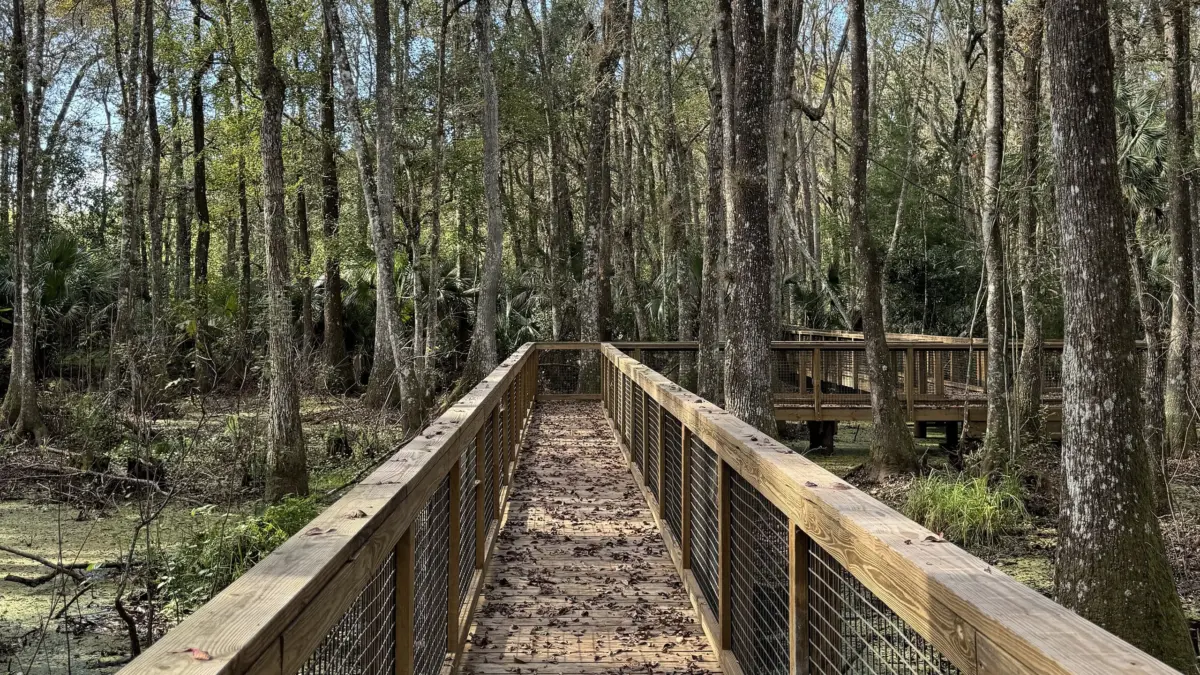
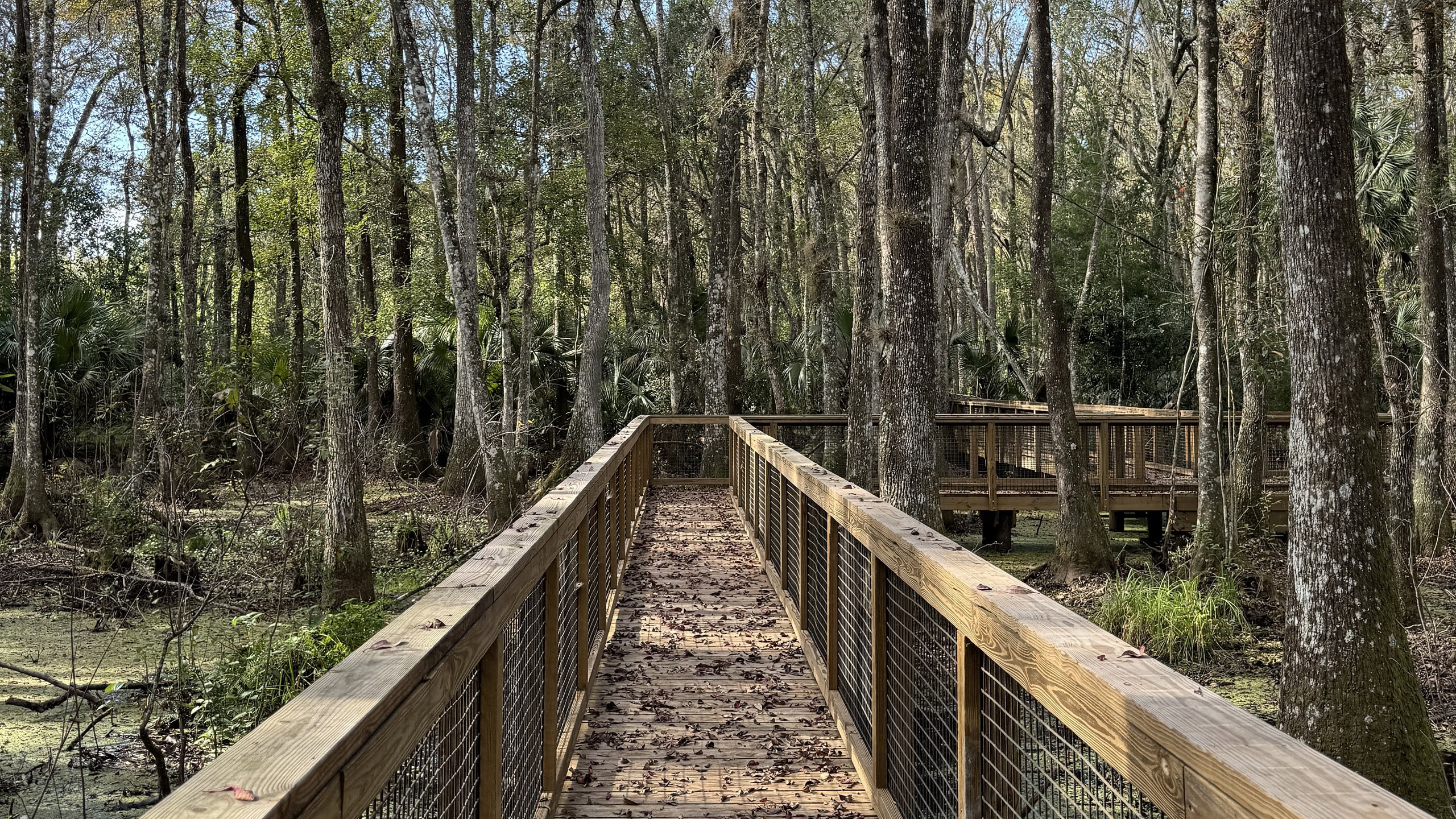
As the path pushes deeper into the hammock, the towering presence of hickory and loblolly pines signals a transition to a lower-elevation, wetter ecosystem. At approximately the 0.4-mile mark, hikers reach a substantial wooden boardwalk that spans a blackwater wetland dense with tupelo, red maple, sweet bay magnolia, and bald cypress trees. Near the midpoint of the boardwalk, an observation deck extends outward, equipped with an interpretive display detailing the hydrology and ecology of the swamp.
Upon reaching the far terminus of the boardwalk, hikers can choose their return route:
The Outer Loop: Turning right leads along a wide, two-track path that loops back toward the open field, returning to the trailhead within roughly half a mile. This path passes a historic marker detailing a former Boy Scout log cabin site.
The Elevated Causeway: Turning left directs visitors onto an elevated causeway flanked by water views on both sides. This corridor emerges from the dense floodplain forest just two hundred feet from the initial trailhead, concluding the 0.9-mile journey.
Official Statements
Local land managers, county officials, and regional conservationists have consistently highlighted the strategic importance of the Cuscowilla Nature and Retreat Center within Alachua County’s broader green infrastructure network.
Alachua County representatives emphasize that the acquisition of the property was driven by a commitment to equitable outdoor access and watershed protection. In public statements regarding the park’s management, county officials have noted:
"The conversion of Camp McConnell into Cuscowilla ensures that our rapidly growing region does not lose its connection to the wild interior. By blending active recreational spaces like the pool and disc golf course with deeply protected natural zones, we provide a gateway for environmental education that serves everyone from local school groups to weekend hikers."
Environmental advocates and regional trail groups, such as the Florida Trail Association, have similarly praised the preservation of Cuscowilla’s hammock and wetland habitats. Conservation leaders point out that properties bridging the gap between urban centers like Gainesville and rural enclaves like Micanopy are vital for wildlife migration and aquifer recharge. The integration of interpretive signage along the trails is viewed as an essential public outreach tool, fostering a conservation ethic among visitors by translating complex ecological concepts—such as blackwater hydrology and native plant taxonomy—into accessible, hands-on learning experiences.
Future Outlook
As the pressures of suburban sprawl and population growth continue to exert strain on north-central Florida’s ecosystems, the long-term outlook for the Cuscowilla Nature and Retreat Center remains focused on balanced, low-impact stewardship and community engagement.
Alachua County planners are exploring continuous improvements to the park’s infrastructure to enhance visitor experience without compromising ecological health. Future initiatives include ongoing maintenance of the boardwalk and trail systems, upgrades to the overnight cabins and primitive camping areas to meet modern sustainability standards, and expanded programming for the children’s summer camps. Furthermore, collaboration with regional conservation networks aims to better connect Cuscowilla with nearby public lands—such as Paynes Prairie Preserve State Park, Bolens Bluff, and the Serenola Forest Preserve—creating an interconnected ecological corridor.
Ultimately, Cuscowilla Nature and Retreat Center is positioned to serve as a model for adaptive reuse in public land management. By honoring its historical roots as a gathering place while aggressively protecting its native hammocks, wetlands, and wildlife habitats, the facility guarantees that future generations will have a tranquil, educational space to experience the authentic natural heritage of the Sunshine State.







0 Comments