

Executive Overview
For the casual sportfisherman, South Florida’s offshore calendar is often bookmarked by the iconic spring mahi-mahi migration. Beginning in earnest around April and May, a relentless procession of dolphin fish draws hundreds of boats out of Keys and mainland marinas, chasing schoolies and gaffers under the relentless tropical sun. By July, however, that peak tapers off. The fish have largely tracked north toward the Mid-Atlantic and Northeast, the tourist fleets disperse, and many anglers pull their lines, assuming the pelagic chapter is closed for the year.
They are missing out on one of the best-kept secrets in modern sportfishing.
Arriving predictably from mid-September through October, South Florida’s second mahi season materializes along the edges of the continental shelf and out over deep blue abysses. Far from being mere stragglers of the spring run, modern marine science and decades of on-the-water intelligence indicate that these autumn fish represent an entirely distinct migration—a fresh push riding warm currents straight up from the Caribbean.
Even better? While spring brings sheer numbers of smaller "schoolies," the fall run is characterized by larger, heavier fish. Anglers frequently encounter solid 20- to 30-pound bulls and cows that test tackle and surprise even seasoned veterans. Combined with thinner crowds on the water, calmer post-summer weather windows, and aggressive feeding habits, autumn mahi fishing offers an elite angling experience. To unlock this fishery, however, anglers must abandon outdated summer playbooks and adopt a precise, scientifically informed approach to reading currents, structure, and marine ecosystems.
Detailed Chronology: The Evolution of the Fall Run
The Shift from Summer Slump to Autumn Bonanza
Historically, local charter captains and recreational anglers noticed a brief lull in pelagic action mid-summer. Conventional wisdom once dictated that once the July heat set in, the deep-water grounds off Islamorada, Marathon, and Key West would go dormant until the winter sailfish run.
Yet, persistent captains pushing past the reef edge in September began discovering pockets of hyper-aggressive mahi holding near deep-water eddies. For years, these fish were mischaracterized as northern refugees turning back southward. Detailed analysis of commercial catch data, combined with advanced satellite oceanography over the last decade, has completely upended that narrative.
The fall run is now understood to be an independent, robust pulse of fish. Driven by seasonal shifts in Caribbean current loops and trade winds, these schools press northward along the western wall of the Gulf Stream. They arrive just as coastal boat traffic hits an annual low, transforming the waters off the Florida Keys into a pristine, uncrowded playground for offshore enthusiasts.
A Masterclass in the Marquesas: A Case Study
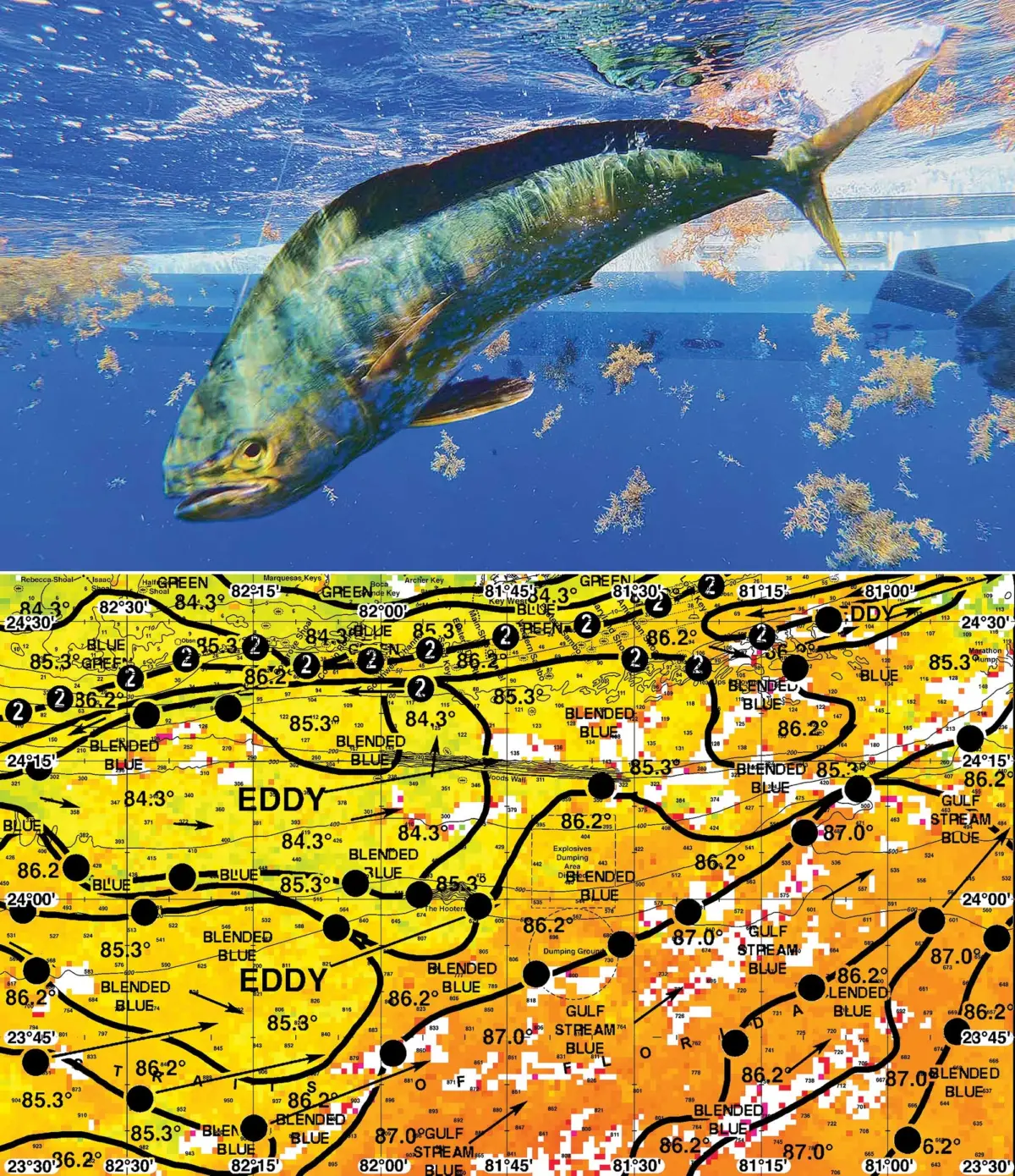
To understand how these migrations manifest in real-time, one need only look at the experiences of veteran anglers like George Poveromo. Operating off Cudjoe Key in late October during the filming of a World of Saltwater Fishing episode, Poveromo and his crew utilized satellite forecasting to track a massive oceanic eddy sitting over 800 to 900 feet of water due south of the Marquesas—roughly 60 miles out.
For the first several hours of the run, the ocean appeared entirely dead. The surface was totally void of weed lines, floating debris, flying fish, and diving frigate birds. It was an oceanic desert, until the vessel crossed the boundary of the thermal eddy.
Instantly, the environment transformed. The water color shifted to a rich, royal blue. Massive, mature weed lines materialized alongside swarms of flying fish, diving frigate birds, and ravenous mahi. Deploying a combination of flat-line trolling setups and spin tackle for surface schoolies, the crew boxed a heavy cooler of quality fish by mid-afternoon. This snapshot illustrates the primary rule of autumn mahi: success does not rely on searching every mile of blue water; it relies on locating the precise oceanic anomalies where these fish congregate.
Supporting Context & Metrics: Seven Keys to Autumn-Run Mahi
Succeeding in the fall fishery requires moving away from casual trolling and adopting a strategic framework. Because autumn fish behave differently than their spring counterparts—often tied closer to thermal boundaries, dynamic eddies, and specific forage—anglers must master seven distinct pillars of tactical execution.
[Satellite Analysis (Roffs/FishCast)]
       │
       ▼
[Locate Gulf Stream Edges & Eddies]
       │
       ▼
[Target Grown/Aged Flotsam & Lobster Floats]
       │
       ▼
[Spot Flying Fish & Plankton Concentrations]
       │
       ▼
[Radar & Binocular Bird Scouting]
       │
       ▼
[Active Trolling / Cover Water]
       │
       ▼
[Standby Heavy Gear (Marlin/Bonus Pelagics)]
1. Know and Leverage the Currents
The Gulf Stream does not flow in a straight, predictable line; it meanders like a massive, liquid snake. Utilizing professional marine forecasting services—such as Roffs, Simrad’s FishCast, or SiriusXM Fish Mapping—is non-negotiable for serious fall anglers.
Your objective is to identify the true shoreward edges of the Gulf Stream where it pushes tight against or intersects the continental shelf and prominent deep-water bottom structures. These violent intersections create localized upwellings. Nutrient-rich water is forced upward from the depths, triggering microscopic plankton blooms that draw baitfish, which in turn pull predatory mahi right to the edge.
2. Read Eddies, Fingers, and Thermal Breaks
Just as rivers throw off swirling eddies behind boulders, the Gulf Stream regularly calves off circular rotating water masses (eddies) or pushes elongated "fingers" outward before pulling them back in.
When an eddy or a thermal finger stalls over deep, aggressive bottom structure—such as ledges, drops, or seamounts—it acts as a natural retention basin for marine life. These areas form closed ecosystems where bait and pelagics circulate for days or weeks. Scouting for these circular thermal anomalies gives anglers a direct roadmap to hungry fish.
3. Seek Out Aged Flotsam
In spring, anglers often target fresh, clean debris or newly formed weed lines. In the fall, the exact opposite rule applies.
“Long in the tooth is much better than new, clean and mean,” notes expert offshore consensus. Debris that has spent months drifting at sea develops a thick micro-ecosystem of marine growth, barnacles, and micro-crustaceans. Baitfish gather en masse to forage on this living flotsam, and apex predators like mahi quickly follow. When scanning the horizon, prioritize dark, weed-choked, seasoned timber and Sargasso mats over pristine, newly detached branches.
4. Capitalize on Commercial Lobster Floats
From early August through March, the commercial spawner and lobster trap season is in full swing across South Florida, the Keys, and the Bahamas. Millions of brightly colored trap floats pepper the reef tracts and offshore zones.
While most offshore anglers blow past these shallower traps on their way to the deep blue, autumn mahi frequently hang tight to these vertical structures. Because the Gulf Stream often pushes close inshore during this season, baitfish congregate around the lines and traps, drawing in predatory dolphin. Always make it a point to slow down and inspect lobster float lines during your transit out and back.
5. Hunt for Flying Fish and Plankton Concentrations
Some of the most electrifying fall mahi sessions occur in water completely devoid of visible weeds or surface debris. In these scenarios, the ocean’s biological signature gives away the game.
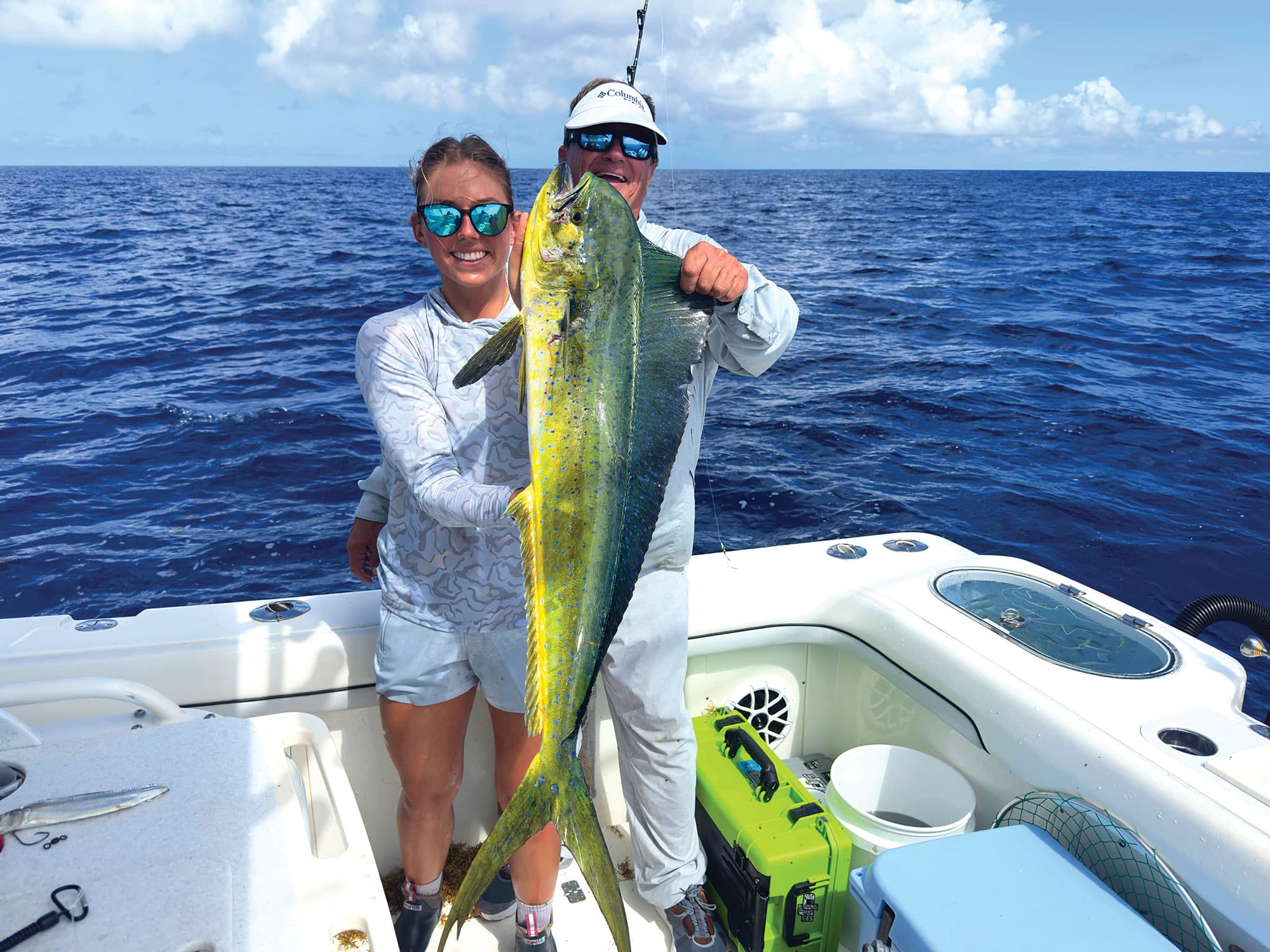
Keep your eyes peeled for flying fish scattering across the surface while cruising offshore. Flying fish are the primary forage species for autumn mahi; where the flyers are concentrated, the predators are usually lurking directly underneath. Satellite tools highlighting heavy chlorophyll and plankton concentrations will directly lead you to these flying fish concentrations.
6. Utilize Radar and Optics for Bird Scouting
Sea birds are notoriously less active or visible during the fall migration compared to the frantic surface displays of spring. Because of this, marine electronics and optics are critical.
High-end marine radar configured for bird-finding modes, paired with a quality pair of stabilized marine binoculars, will radically expand your search radius. The moment a distant frigate bird, tern, or shearwater dips toward the water, turn the helm. Dragging a pair of ballyhoo around the perimeter of the birds—or pitching live bait, squid, and chuggers directly into the zone—will yield immediate feedback on whether a school is present.
7. Cover Water and Prepare for Bycatch (Blue Marlin)
Because fall fish can be scattered across expansive oceanic zones rather than locked onto tight coastal weed lines, covering water via trolling is your most effective search strategy.
- Match the Hatch: Ensure your trolled baits or artificial lures match the size and coloration of the local flying fish to bypass selective feeding behaviors.
- The Marlin Contingency: Fall in South Florida is also prime time for blue marlin. Wherever concentrations of aggressive mahi are feeding, apex billfish are rarely far away. Keep a heavy 50-pound outfit rigged with a 300-pound fluorocarbon leader and a large circle hook ready in the rocket launchers. Should a billfish show up shadowing your mahi school—or if you want to free-line a fresh, live schoolie on speculation—you will be instantly prepared for the ultimate mixed-bag offshore encounter.
Official Statements & Industry Perspectives
The shift in perception regarding the autumn mahi run highlights a broader evolution in recreational fisheries management and marine science. Leading captains and oceanographers emphasize that understanding pelagic migrations requires looking beyond traditional seasonal calendars.
"For generations, anglers treated the ocean like a calendar book: spring meant mahi, summer meant a lull, and winter meant sails," notes one prominent South Florida charter captain and educator. "What satellite oceanography has taught us is that the ocean operates on thermal fronts, current loops, and productivity metrics, not human months. The fall mahi run isn’t an anomaly or an afterthought—it’s a distinct biological highway running straight up from the Caribbean, waiting for anyone willing to read the data and burn a little fuel."
Fisheries biologists echo this sentiment, pointing out that pelagic species are highly dynamic. As ocean temperatures fluctuate and baitfish populations shift in response to climate and current variations, anglers who leverage real-time oceanographic forecasting—such as satellite-derived sea surface temperature (SST) and altimetry data—will consistently outperform those relying solely on historical intuition.
Future Outlook: What Lies Ahead for South Florida Pelagic Anglers
As marine technology becomes increasingly sophisticated, the way anglers target species like autumn mahi is undergoing a quiet revolution. High-resolution satellite altimetry, real-time current vector modeling, and consumer-grade marine radar systems have democratized data that was once restricted to commercial fleets and oceanographic institutions.
Looking forward, the future of South Florida’s offshore fishery hinges on a delicate balance between technological advancement and proactive conservation. While bag limits and size regulations remain vital for protecting spawning stocks during peak pressures, the fall fishery continues to offer a welcome reprieve due to its lower fishing pressure.
For the dedicated angler, the directive is clear: pack the boat, upgrade your satellite subscription, and look past the summer slump. September and October are holding some of the heaviest, most aggressive mahi of the entire calendar year. Armed with the right tactical framework—reading the eddies, respecting the flotsam, and staying vigilant for flying fish—the autumn bull of a lifetime is just beyond the reef.

0 Comments