

Tucked discreetly away amidst the expansive ranchlands and moody swamps southeast of Sebring, Florida, lies Lake Istokpoga. Spanning a sprawling expanse of nearly 42 square miles of open water, this massive yet remarkably understated water body ranks as the fifth-largest natural lake in the Sunshine State. For generations, its aquatic boundaries have been the exclusive domain of dedicated anglers and roaring airboats, launched predominantly from private docks or a singular public access point: the unassuming, yet strategically vital, Lake Istokpoga Park.
Managed under the jurisdiction of Highlands County, Lake Istokpoga Park serves as a premier portal into an untamed wilderness that frequently escapes the radar of mainstream tourism. While the broader region is heavily characterized by agricultural tracts and dense rural marshlands, this localized park offers visitors a rare, highly accessible interface with the area’s delicate ecosystems. Featuring a meticulously engineered network of boardwalks, shaded picnic pavilions, and intimate nature trails, the destination bridges the gap between rugged outdoor recreation and family-friendly accessibility.

However, beneath its tranquil surface lies a delicate environmental balancing act. As recreational demands increase and regional ecosystems face ongoing pressures from development, agricultural runoff, and shifting climate patterns, understanding and preserving gems like Lake Istokpoga Park becomes paramount. This investigative report explores the logistical layout, ecological characteristics, and recreational significance of Lake Istokpoga Park, offering a comprehensive guide and critical look at one of South-Central Florida’s most prized natural assets.

Detailed Chronology & Trail Geography: Navigating Lake Istokpoga Park
For visitors setting out to explore the park on foot, the journey is an immersive micro-expedition through contrasting Florida landscapes. Spanning a brief yet intensely scenic 0.6-mile loop, the trail system seamlessly integrates elevated wooden boardwalks, earthen berms, and traditional dirt footpaths.

The Trailhead and Cypress Canopy Entry
The expedition officially begins adjacent to the park’s primary picnic grounds, where travelers must cross the boater parking area to access the trail’s mouth. Immediately, a sturdy boardwalk plunges pedestrians into a striking, cathedral-like stand of large bald cypress trees (Taxodium distichum). This initial section serves as an atmospheric transition zone. Emerging briefly within direct sight of the bustling boat ramps, hikers are directed to remain strictly behind the yellow posts defining the left edge of the launch infrastructure to ensure safety amid active towing and trailering operations.

Traversing the Seawall and Boater Channel
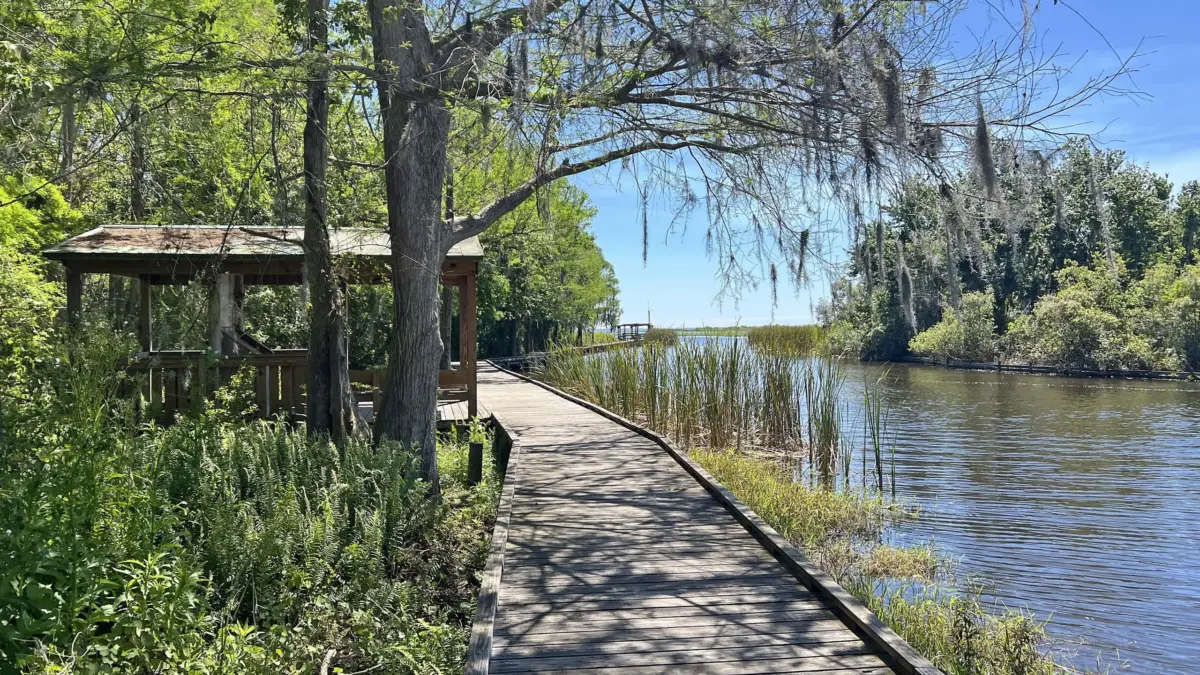
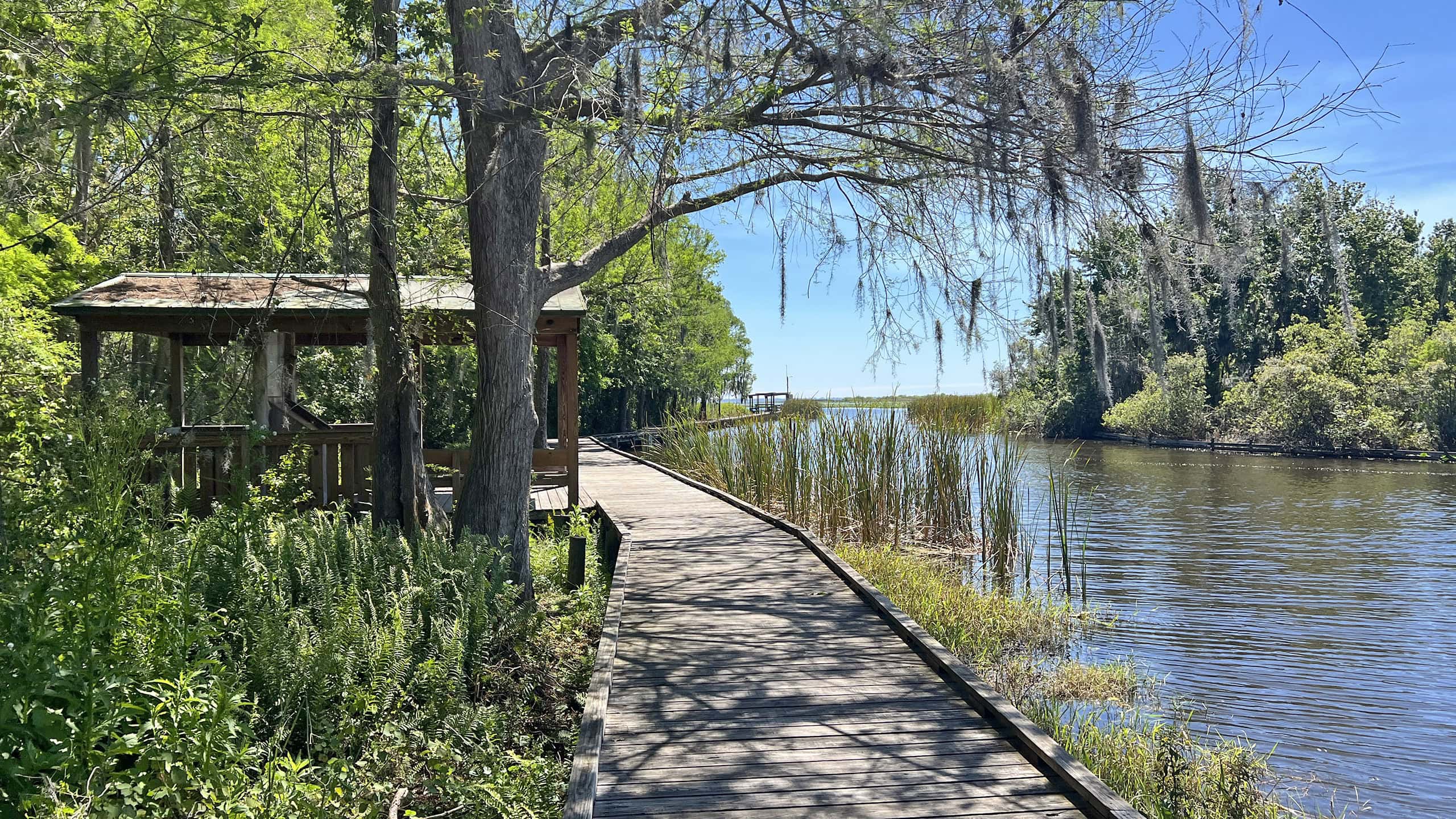
Reconnecting with a secondary boardwalk system that caps the property’s seawall, the trail mirrors the trajectory of the main boating channel. Here, the path hugs the near shore, canopied entirely by mature cypress branches that lean dramatically out over the dark water.

Strategically placed along this portion of the route is a roofed observation shelter. Complete with comfortable wooden benches, this structure doubles as an informal educational outpost, featuring localized signage detailing the prime fishing hotspots across the lake and broader Florida waters. Walking onward, the boardwalk provides unobstructed peeks into the dense, flooded timber of the floodplain forest.

Venturing into the Open Marsh and Lake Overlook
At a critical junction marked by a prominent lamppost, hikers encounter a split in the infrastructure. Continuing straight launches the traveler onto an extended boardwalk spanning the open lake environs.

Emerging from the deep shade of the cypress strand, the walkway suspends itself over a marshy, vibrant cove choked with an abundance of primrose willow (Ludwigia suffruticosa). A secondary roofed shelter sits perched here, serving as an ideal platform for avian observation—commonly referred to by local birders as an exceptional spot to catch glimpses of wading birds, ospreys, and migrating waterfowl.

As the boardwalk presses forward, the dense marsh transitions into open water choked with expansive fields of aquatic lilies. A third and final roofed shelter crowns this quarter-mile turnaround point, offering wide, unobstructed vistas of the massive horizon of Lake Istokpoga. Officials note a unique physical phenomenon at this terminus: when powerful watercraft speed through the adjacent channel, the resulting wakes can cause the water beneath the open boardwalk to undulate, offering a subtly disorienting yet thrilling experience for pedestrians crossing the span.

The Return Route: Earthen Berms and Floodplain Hammocks
Retracing their steps across the primrose-warmed cove, hikers return to the shoreline’s cypress canopy, this time veering right onto a spur boardwalk. This wooden pathway snakes over a fern-rich understory, eventually depositing travelers onto a grassy, fern-lined earthen berm.

This portion of the loop transitions from structured boardwalks to a more tactile ground-level footpath. The trail materializes as a gentle indentation woven beneath an overgrown canopy of ancient live oaks (Quercus virginiana), towering cypresses, and southern magnolias (Magnolia grandiflora). Along this stretch at approximately the 0.4-mile mark, visitors encounter a striking natural sculpture: a massive split live oak that has partially fallen, arching dramatically over a rustic trailside bench.

Eventually, the footpath pivots away from the lakefront edge, steering hikers back onto a specialized boardwalk that navigates a dense, flourishing floodplain forest bursting with native ferns. Emerging from this botanical sanctuary, the path straightens out between rows of young, fast-growing cypress trees.

Concluding the Loop
The final leg of the journey intersects with the eastern periphery of the park’s grassy lawn. By making a sharp left turn into an appealing corridor lined with deliberately planted oaks, visitors are guided smoothly back toward the primary parking infrastructure, successfully closing the loop on a pristine, highly diverse 0.6-mile ecological tour.

Supporting Context & Metrics
To fully appreciate the operational footprint of Lake Istokpoga Park, it is vital to examine the hard data, geographical parameters, and infrastructural metrics governing the site.

| Metric Category | Data Specification |
|---|---|
| Official Location | Lorida / Sebring, Highlands County, Florida |
| Total Trail Length | 0.6-mile looped configuration |
| Trailhead Coordinates | 27.443329, -81.285710 |
| Physical Address | 720 Istokpoga Park Access Rd, Sebring, FL |
| Admission Fees | Free to the public |
| Operating Hours | Sunrise to Sunset, Daily |
| Amenities Available | Restrooms (at picnic area), roofed pavilions, boat ramps, boardwalk shelters |
| Land Management Agency | Highlands County Board of County Commissioners |
| Contact Phone Number | 863-402-6783 |
| Pet Policy | Leashed dogs permitted (owners required to clean up waste) |
Getting There: Route Logistics
Accessing this remote recreational haven requires a brief journey through South-Central Florida’s agricultural heartland. Traveling south along US Highway 27 from Sebring, motorists must turn east onto US Highway 98 and proceed for approximately 8.2 miles. From there, a distinct right turn onto Istokpoga Park Access Road leads drivers 0.3 miles down the corridor before a final left turn deposits them directly into the paved parking lot. Signage thoughtfully distinguishes parking zones, with dedicated stalls prioritized for boat-trailer configurations closest to the ramp entry, and general vehicle parking situated adjacent to the picnic and trailhead grounds.

Official Statements & Environmental Perspectives
The administration and ecological stewardship of Lake Istokpoga Park reflect a cooperative approach between local governing bodies and regional conservationists.

According to regional land management statements issued by Highlands County officials, the primary directive of maintaining Lake Istokpoga Park is balancing intensive recreational utilization—such as bass fishing, airboating, and family gatherings—with the stringent preservation of sensitive shoreline ecologies. "Our goal is to provide safe, reliable public access to one of Florida’s premier hydrological features while ensuring that the native flora and fauna remain undisturbed by the footprint of modern visitation," noted a representative from the county’s parks and facilities division.

Environmental scientists and field researchers, including outdoor writers Sandra Friend and John Keatley, have frequently highlighted the park’s unique structural composition. In their regional assessments, they emphasize that while Lake Istokpoga is heavily ringed by private agricultural leases and cattle ranches, public pockets like Istokpoga Park act as critical ecological barometers. The convergence of ancient cypress swamps, floating aquatic vegetation, and hardwood hammocks within a sub-mile walking loop provides an concentrated microcosm of what much of rural peninsular Florida looked like prior to widespread commercial drainage and structural flood control initiatives.

Furthermore, county wildlife officers issue recurring advisories regarding the park’s local wildlife populations—most notably, the resident grey squirrel populations inhabiting the shaded picnic pavilions. Described colloquially as "aggressively interested" in human food handouts, park management strongly discourages wildlife feeding to maintain natural foraging behaviors and prevent habituation nuisances.

Future Outlook: Conservation and Sustainable Recreation
As Florida continues to experience rapid population growth and intense residential development pressures pushing inward from the coasts, inland ecosystems like Lake Istokpoga are under increasing scrutiny. The future outlook for Lake Istokpoga Park hinges heavily on proactive watershed management, invasive species mitigation, and sustainable infrastructure maintenance.

Water Quality and Hydrological Management
Lake Istokpoga is structurally tied to the Kissimmee River-Lake Okeechobee-Everglades watershed. Water levels are actively managed by the South Florida Water Management District (SFWMD) via the John Stretch Memorial Dam and associated control structures. Future projections emphasize the necessity of maintaining balanced lake stages that protect littoral vegetation zones—essential nurseries for the lake’s famed largemouth bass and black crappie fisheries—while simultaneously mitigating flood risks for surrounding ranchlands.

Infrastructure and Visitor Management
With eco-tourism on the rise across Highlands County, local planners are evaluating the long-term wear and tear on the park’s wooden boardwalk systems. Future capital improvement plans anticipate routine timber replacements using rot-resistant, sustainable composite materials to minimize future maintenance closures. Additionally, interpretive signage enhancements are slated to be installed within the trail shelters, providing visitors with deeper educational insights regarding the delicate balance of wetland habitats, water conservation, and native species identification.

By maintaining free public access, enforcing strict pet-waste and anti-litter policies, and fostering a deep appreciation for the natural world among casual visitors and seasoned hikers alike, Lake Istokpoga Park stands poised to remain a cherished sanctuary. It serves as a living testament to the enduring, wild beauty hidden just off the beaten path in the heart of the Sunshine State.

0 Comments