

Executive Overview
Nestled in the heart of Central Florida, the city of St. Cloud plays host to a hidden cultural and ecological sanctuary: Peghorn Nature Park and Trail. Spanning a modest yet remarkably diverse 1.2-mile footprint, this public green space offers far more than a simple walk in the woods. Named in honor of the historic Cracker cattle that historically roamed the landscape a century ago, the park merges regional pioneer heritage with pristine, carefully managed Florida ecosystems.
Operated under the stewardship of the City of St. Cloud, Peghorn Nature Park serves as a living museum. Visitors traversing its grounds are instantly transported to a 19th-century frontier outpost, complete with an authentic blacksmith forge, a traditional cannery, a historic log schoolhouse, and a functioning chicken coop. Beyond this historic enclave, a meticulously maintained trail network of crushed shell pathways, long boardwalks, and shaded footpaths winds through dense hardwood hammocks, quiet cypress swamps, and vibrant bayheads.

Designed to be accessible, educational, and restorative, the park operates Monday through Saturday from 8:00 AM to 6:00 PM, charging no admission fees for the public. Whether hikers are seeking a peaceful retreat into native Florida flora, an educational journey into late-1800s pioneer history, or a reflective moment along the park’s memorial trails, Peghorn Nature Park stands out as an exemplary model of municipal conservation and historical preservation.
Detailed Chronology: A Step-by-Step Hiking Guide
Navigating Peghorn Nature Park is a journey divided cleanly into two distinct experiences: an immersive walk through a reconstructed 19th-century settlement, and an expedition deep into the native Central Florida wilderness.

Phase 1: The Frontier Outpost and Trailhead Center
The journey begins at the Trailhead Center, a historic structure repurposed to welcome modern adventurers. Stepping inside, guests are immediately greeted by shelves lined with regional artifacts, historical books, and local memorabilia that set a reflective, educational tone for the trek ahead. For those requiring enhanced accessibility, a concrete sidewalk loops around the exterior of the building, leading to a smooth ramp that ascends to a rear entrance.
Just beyond the headquarters, the infrastructure splits to showcase the breadth of the pioneer village.

- To the East: The paved pathway leads visitors past a functioning nursery toward a traditional blacksmith forge and a charming, active chicken coop, offering a glimpse into the self-sustaining daily routines of early Florida settlers.
- To the West: The path guides travelers past a garden nursery and directly toward the iconic, historic log schoolhouse. Complete with a rustic wood-shingle exterior, an authentic school bell perched over the open doorway, and a fluttering flag, this structure captures the educational realities of rural 19th-century life.
Phase 2: Entering the Shaded Canopy (The Blue Trail)
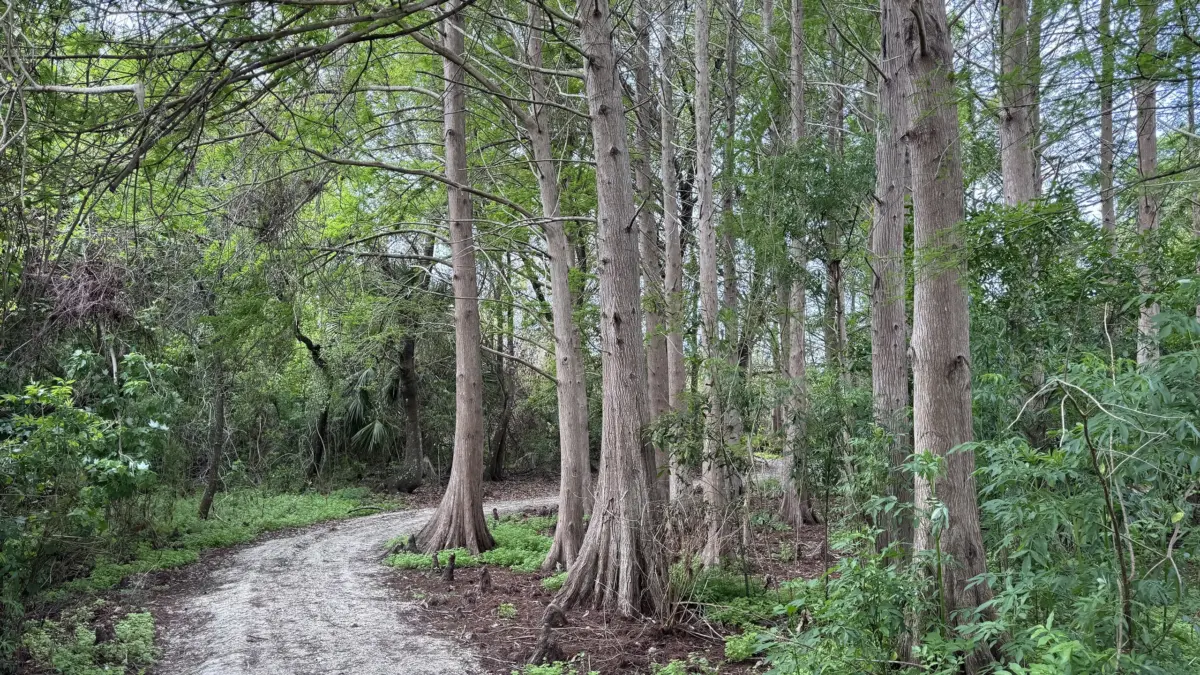
Commencing the hike in a counterclockwise direction from the west side of the schoolhouse, visitors pass a pair of rustic wooden benches before stepping off the pavement and onto the park’s signature crushed-shell corridor. This bright white path provides a sharp, clean contrast against the deep emerald greens of the surrounding forest canopy.
The trail plunges quickly into a dense, cool corridor overhung by towering bald cypress and ancient live oaks. At approximately the 0.25-mile mark, hikers reach a key navigational intersection where the Blue Trail meets the Orange Trail and a wooden boardwalk. Continuing straight on the Blue Trail leads deeper into the interior ecosystems.

Here, the landscape transforms into a classic Florida mix. Delicate ferns and sprawling blackberry brambles carpet the forest floor, while loblolly bay trees, lyonia, and twisting muscadine grapevines climb high into the canopy. The crushed-shell path provides a stable, highly breathable walking surface, ensuring that even after typical Florida rainstorms, the trail remains exceptionally navigable.
Phase 3: The Hardwood Hammock Loop and Wetland Boardwalk
At the 0.7-mile mark, observant hikers will notice a subtle side trail marked with distinct green arrows, inviting a brief detour into a rich hardwood hammock. This short loop offers an intimate look at the interior uplands, featuring low wooden benches tucked beneath the trees where visitors can pause to listen to native bird calls and observe the quiet understory.

Returning to the main path, hikers soon encounter the eastern junction of the Orange Trail. Turning right at this intersection directs travelers onto an extended boardwalk that spans a vibrant, water-rich wetland. This stretch of the trail is an ecological highlight, placing visitors eye-level with:
- Willows lining the shifting water channels
- Red maples displaying brilliant seasonal changes in foliage
- Sweetbay magnolias filling the humid air with their sweet, subtle fragrance
Phase 4: The Open Pond, Observation Deck, and Rainbow Bridge
Emerging from the long wetland boardwalk, the landscape opens dramatically into a wide freshwater pond. An elevated observation deck sits quietly at the water’s edge, offering panoramic views of the open aquatic habitat—an ideal spot for spotting wading birds, aquatic turtles, and local wildlife.

Near the pond, the trail network converges once more. While the Orange Trail splits off to cross a small, rustic bridge hugging the water’s edge, the primary Blue Trail leads hikers toward one of the park’s most touching human-interest features: the Rainbow Bridge. This brightly painted memorial bridge is dedicated to lost animal companions, serving as a peaceful space for reflection and remembrance.
Crossing the Rainbow Bridge brings hikers back onto the paved concrete sidewalk, which curves gracefully past a secure chicken run before returning directly to the Trailhead Center, successfully completing the 1.2-mile loop.

Supporting Context & Metrics
To fully appreciate Peghorn Nature Park, it is helpful to examine its operational statistics, geographical placement, and structural details within the broader landscape of Central Florida municipal parks.
Park Metrics and Logistics
- Official Name: Peghorn Nature Park and Trail
- Land Manager: City of St. Cloud Parks and Recreation Department
- Geographical Location: St. Cloud, Osceola County, Central Florida
- Trailhead Coordinates: 28.239417, -81.303250
- Physical Address: 2101 Peghorn Way, St. Cloud, FL 34769
- Total Trail Length: 1.2 miles (inclusive of main loops and side connectors)
- Admission Fees: Completely Free to the public
- Operating Hours: Monday through Saturday, 8:00 AM – 6:00 PM (Closed Sundays)
- Pet Policy: Leashed dogs are welcome throughout the park and trails
- Amenities: Restrooms located within the Trailhead Center, accessible parking directly in front of the main building, benches, educational signage, observation deck, and historical reconstructions.
Geographical Access and Driving Directions
Reaching Peghorn Nature Park is straightforward for travelers navigating the urban centers of Osceola County:

- From the central intersection of Florida Avenue and US-441 in downtown St. Cloud, head south on Florida Avenue for approximately 0.2 miles.
- Turn right onto 17th Street and proceed for 1.2 miles.
- Make a left onto Budinger Avenue, continuing for 0.2 miles.
- Take a right onto Peghorn Way.
- The park entrance will appear immediately, with the parking area and accessible trailhead spaces located just 0.1 miles down on the left.
Ecological Context
While urban growth has rapidly expanded across Central Florida, small municipal preserves like Peghorn act as vital ecological stepping stones and wildlife refuges. The park protects a fragile interface between upland hardwood hammocks and lowland wetland bayheads. The integration of elevated boardwalks ensures that human recreation exerts minimal physical impact on the sensitive hydrology of the cypress wetlands, maintaining natural water flow and protecting native root systems.
Official Statements and Community Impact
City officials and regional conservationists have long championed Peghorn Nature Park as a cornerstone of community identity in St. Cloud. By blending historical preservation with outdoor recreation, the park serves multiple generations of residents and visitors.

Local park management emphasizes that the preservation of the 19th-century structures—such as the working blacksmith forge and the pioneer schoolhouse—is essential for educational outreach. School groups, historical societies, and family visitors frequently utilize the park to experience firsthand what pioneer life entailed during Osceola County’s formative years.
Furthermore, local outdoor advocates, including regional trail experts and community leaders, frequently highlight Peghorn as an ideal introductory hike for novices and families. Because the total distance is a manageable 1.2 miles and the trail surfaces are carefully maintained (utilizing crushed shell, firm boardwalks, and concrete rather than rugged, root-choked dirt), the park successfully eliminates many traditional barriers to outdoor recreation.

Future Outlook
Looking ahead, the outlook for Peghorn Nature Park and Trail remains exceptionally bright, anchored by a strong municipal commitment to environmental education and historic preservation. As St. Cloud and the greater Orlando metropolitan area experience continuous population growth, urban green spaces face increasing pressure from development. However, the City of St. Cloud has maintained a clear mandate to protect Peghorn’s boundaries and sustain its unique dual-purpose mission.
Planned future initiatives focus on enhancing educational programming within the pioneer village, upgrading interpretive signage along the Blue and Orange trails, and maintaining the rigorous standards of accessibility that make the park inclusive for visitors of all physical abilities. Additionally, Peghorn acts as a natural gateway to nearby regional natural treasures, encouraging visitors to explore adjacent wilderness areas such as the Lake Runnymede Conservation Area, Lake Lizzie Conservation Area, Lake Jackson Tower Trail at Prairie Lakes, and Cherokee Point Conservation Area.

For hikers, historians, and nature lovers alike, Peghorn Nature Park and Trail remains a timeless destination—proving that even within an increasingly fast-paced world, quiet pathways and preserved histories can endure, offering education, healing, and peace just steps off the beaten path.

0 Comments