

Executive Overview
For the casual sportfisherman, the Atlantic mahi-mahi (dolphinfish) season in South Florida is inextricably tied to the heat of late spring and the sun-drenched months of May and June. During this peak period, charter fleets roar out of inlets from Miami to Key West, intercepting the massive, headline-grabbing migrations that define the sport. By July, however, the heavy tourist traffic thins, the charter boats pivot to other targets, and the general angling public assumes that the golden pelagics have long since abandoned the southern latitudes for the mid-Atlantic and northeastern coasts.
That assumption represents a costly oversight.
When the autumn equinox approaches and the coastal waters begin their subtle shift, South Florida and the Florida Keys quietly usher in a second, highly lucrative mahi migration. Materializing reliably from mid-September through October, this autumnal run offers a starkly different angling experience than its spring counterpart. Gone are the endless miles of tiny, undersized "schoolies." In their place are heavier, older, and wiser fish. Encounters with 20- to 30-pound specimens—and occasionally much larger—are remarkably common, capable of testing both tackle and the resolve of unsuspecting anglers.
Compounding the appeal of this lesser-known fishery is the atmosphere on the water. With the summer tourist throngs gone, the reef lines, weed lines, and deep-water drop-offs are remarkably uncrowded. Anglers who understand the oceanographic mechanics of the fall season find themselves sharing the deep blue with little more than diving frigatebirds and breaching flying fish. To unlock this fishery, however, one must discard the reactive tactics of the spring and adopt an authoritative, data-driven approach to offshore navigation.
Detailed Chronology: Unraveling the Fall Migration
For generations, conventional maritime wisdom dictated that the fish appearing off the Florida Keys in autumn were simply stragglers making their return journey south after spending the summer months in northern waters. Modern marine science and tracking data, however, have thoroughly debunked this theory.
The autumn mahi run is, in fact, an entirely distinct migration. These fish are fresh arrivals, riding the powerful, nutrient-dense conveyor belt of currents pushing up from the Caribbean Basin. As these dynamic water masses collide with the complex bottom topography of the Florida Straits and the continental shelf, they concentrate bait and create an offshore highway for pelagic predators.
The September-October Blitz
The migration does not trickle in uniformly; it announces itself with intent. Typically materializing around mid-September, the run builds toward a concentrated, high-intensity window during October. Within this six-week span, seasoned captains look for a solid two-week "blitz"—a period where the convergence of currents, bait concentrations, and water temperatures creates a feeding frenzy of epic proportions.
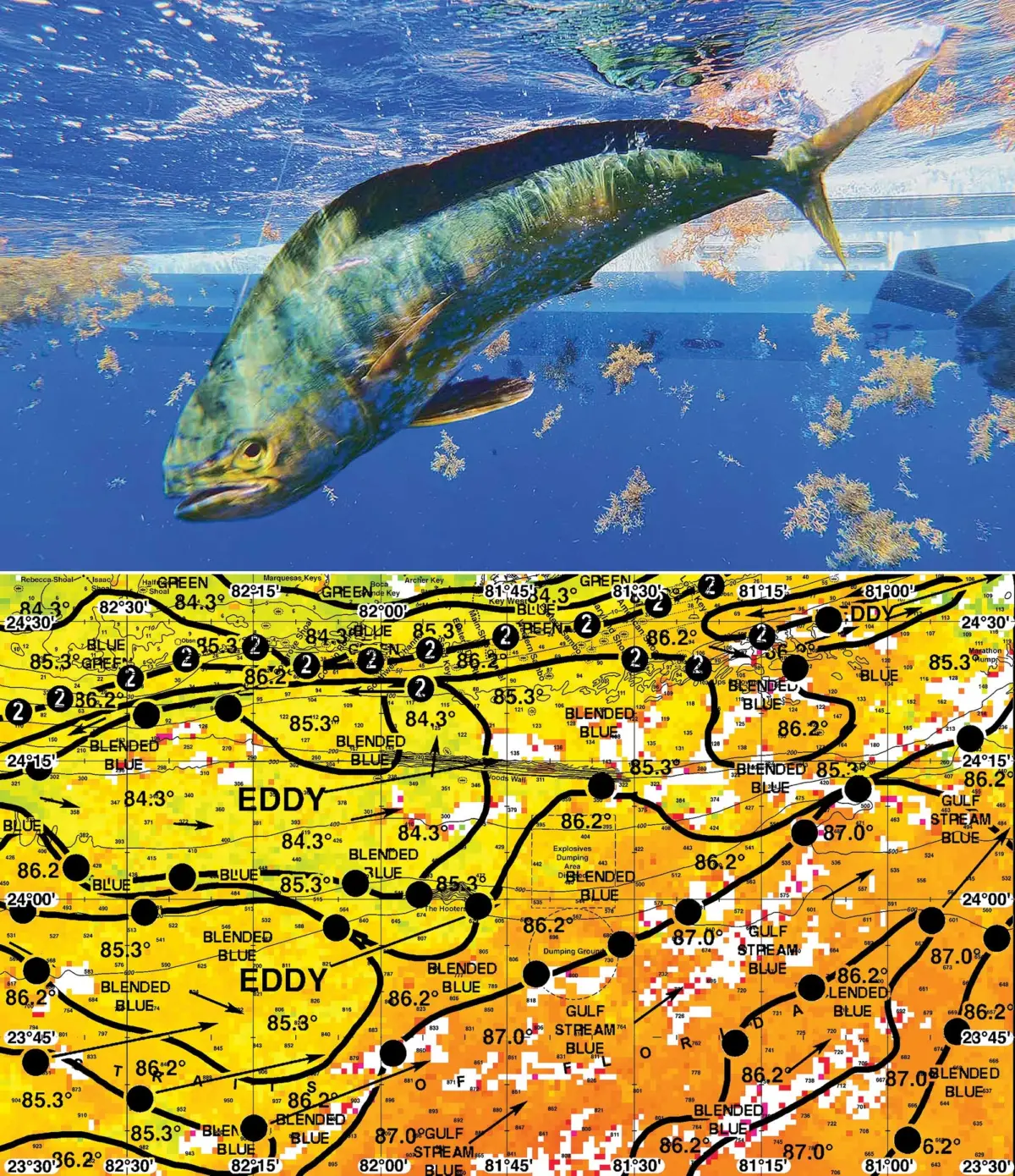
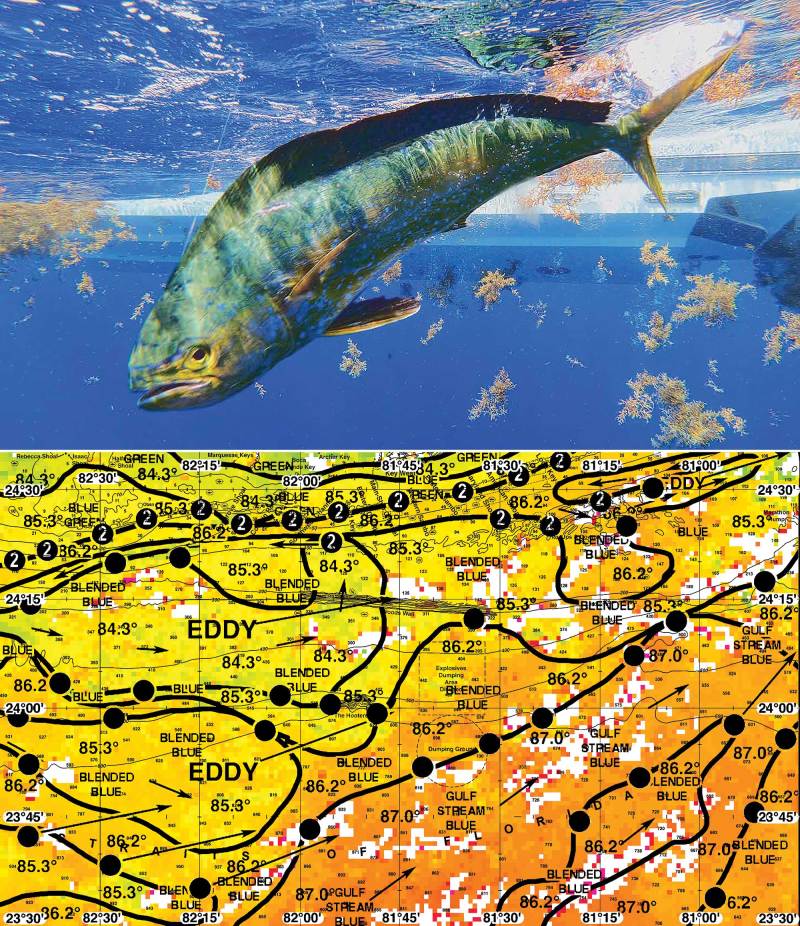
Consider a typical excursion documented by veteran angler and television host George Poveromo off Cudjoe Key. Working alongside researcher and angler Liane Lopez, Poveromo utilized satellite oceanography to locate a massive oceanic eddy situated over 800 to 900 feet of water due south of the Marquesas, roughly 60 miles out. For the first several miles, the ocean surface offered no encouragement: zero weed lines, no floating debris, no flying fish, and no birds. The water was a sterile, empty desert.
That all changed the moment the vessel crossed the boundary of the eddy.
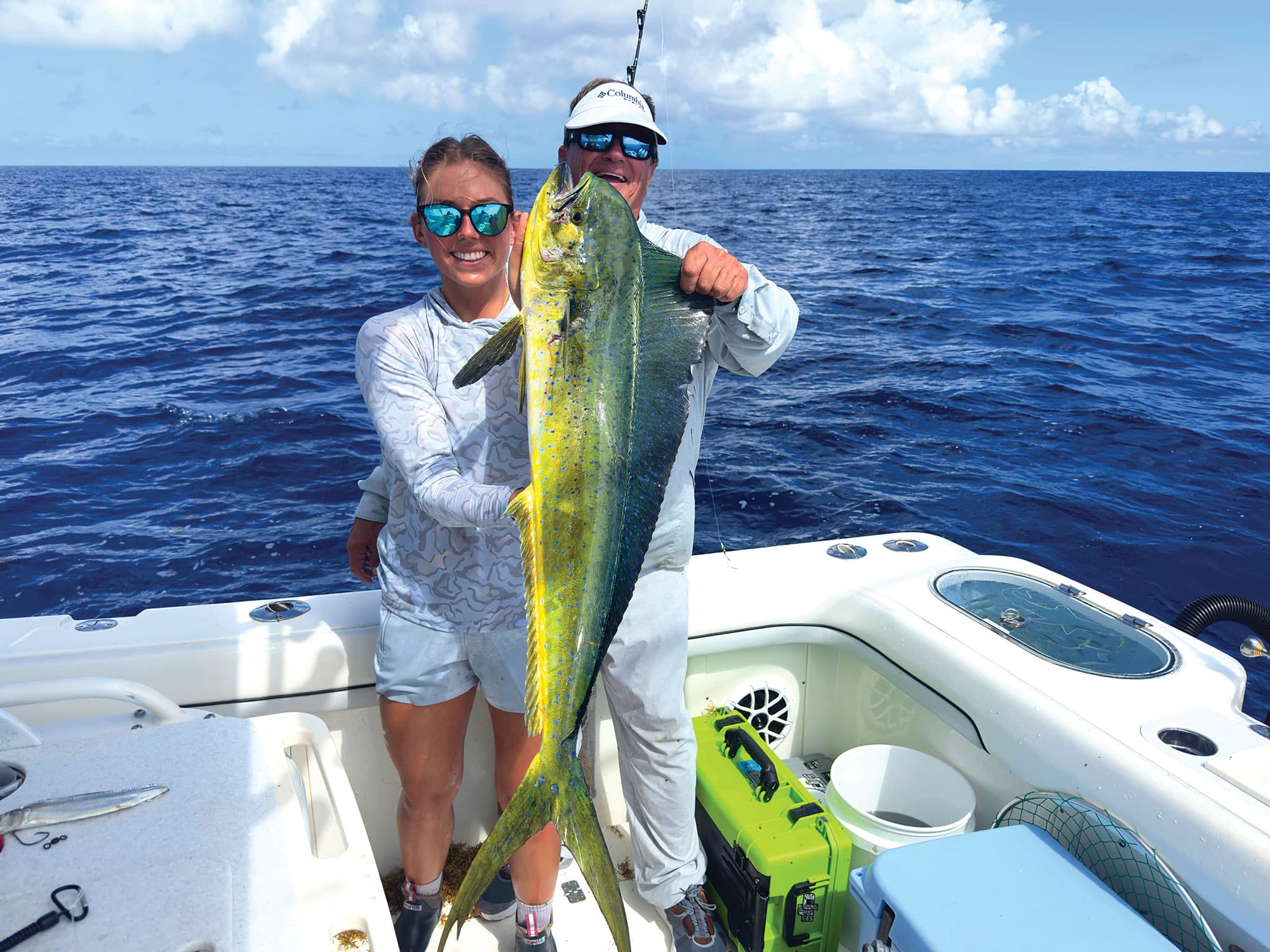
Instantly, the environment transformed into a vibrant ecosystem characterized by brilliant royal-blue water, expansive weed lines, diving frigatebirds, airborne flying fish, and ravenous schools of quality mahi. Deploying a strategic mix of trolled flat lines and spinning gear for the schoolies, the crew experienced the kind of world-class fishing that defines the absolute peak of the October run—wrapping up by mid-afternoon with fish boxes to spare. This is the authentic cadence of the autumn mahi season: long stretches of strategic navigation punctuated by explosive, high-reward encounters.
Supporting Context & Metrics: The Seven Pillars of Autumn Mahi Strategy
Success in the fall mahi fishery requires a departure from casual trolling. Because the fish are traveling along dynamic, shifting current boundaries rather than settling into predictable seasonal patterns, anglers must read the ocean like a roadmap. Below are the seven essential operational practices required to consistently locate and intercept autumn-run mahi.
+-------------------------------------------------------------------------+
|                  THE SEVEN PILLARS OF FALL MAHI FISHING                 |
+-------------------------------------------------------------------------+
| 1. Know the Currents        | Read the true edges of the Gulf Stream    |
| 2. Read Eddies & Fingers    | Target spin-off loops over deep bottom   |
| 3. Find the Flotsam         | Prioritize older, heavily grown debris    |
| 4. Check Lobster Floats     | Tap into near-reef commercial gear      |
| 5. Look for Flying Fish     | Spot primary forage via surface activity  |
| 6. Beeline to Birds         | Utilize radar and optics for frigates     |
| 7. Cover Water Effectively  | Troll matching baits to local forage      |
+-------------------------------------------------------------------------+
1. Know the Currents
The Gulf Stream does not flow in a straight line; it meanders in complex, snake-like configurations. To find fish, an angler must know where these currents push tightly against or intersect the continental shelf and prominent deep-water structures.
Advanced marine forecasting services—such as ROFFS, Simrad’s FishCast, and SiriusXM Fish Mapping—provide the high-resolution chlorophyll and thermal data needed to identify these convergence zones. Nutrient-rich upwellings occur at these structural intersects, drawing in micro-organisms, baitfish, and ultimately, hungry mahi.
2. Read Eddies and Fingers
Just as major rivers spin off quiet backwaters, the Gulf Stream regularly calves off circular eddies or pushes elongated "fingers" of water in opposing directions before reabsorbing them. These hydrodynamic features act as natural collection points for nutrients and pelagic life.
Captains should actively scan for the outer boundaries of these eddies, particularly where they interact with aggressive bottom contours, ledges, and deep-water reef systems.
3. Find the Flotsam
Weeds, logs, and artificial debris naturally accumulate along the velocity gradients of the Gulf Stream and its associated eddies. However, a common mistake made by novice anglers is targeting brand-new, pristine floating debris.
In the autumn fishery, older is better. Flotsam that has been at sea for weeks or months accumulates heavy marine growth, barnacles, and micro-ecosystems. These floating reefs attract small baitfish and crabs, which in turn signal an all-you-can-eat buffet for passing mahi.
4. Check Lobster Floats
From early August through March, the commercial lobster season in the Florida Keys and the Bahamas populates the coastal waters with thousands of trap floats. While most offshore anglers ignore these lines in favor of deep-water runs, failing to check them during the fall is a missed opportunity.
When a Gulf Stream-influenced current pushes tight to the reef line, mahi will frequently station themselves around these shallow-water lobster pots. Always give the line of floats a deliberate sweep on both your outbound and inbound transits.
5. Look for Flying Fish
An ocean devoid of surface weeds and floating debris does not automatically mean an absence of fish. The ultimate indicator of autumn mahi presence is the flying fish.
While cruising offshore, keep a vigilant watch for flying fish scattering across the surface of the water. When these primary forage species are spotted, immediately transition into trolling mode and thoroughly work the sector. Satellite tools mapping heavy plankton and chlorophyll concentrations will frequently highlight the exact areas sustaining these dense flying fish populations.
6. Beeline to Birds
Seabirds—particularly frigatebirds, terns, and shearwaters—are less prominent and aggressive during the autumn months compared to the height of summer. Consequently, relying solely on the naked eye is a recipe for missed opportunities.
Marine radar becomes an indispensable tool for spotting working birds from miles away. Paired with high-powered marine binoculars, radar allows an alert captain to spot distant bird activity, race to the sector, and deploy baits along the edges of the disturbance. Often, a well-placed live bait, rigged ballyhoo, squid, or chugger will draw a strike within seconds.
7. Cover Water Effectively
Because autumn fish are frequently spread across vast, dynamic expanses of deep water, trolling remains the single most productive tactic for locating active schools.
Anglers should carefully match the size and color of their trolled lures or natural baits (such as ballyhoo) to the specific profile of the local flying fish population, effectively countering selective feeding behaviors. Furthermore, autumn is prime time for encounters with majestic blue marlin, which routinely shadow schools of heavy mahi. Maintaining a heavy outfit—such as a 50-pound class reel spooled with strong line, a 300-pound fluorocarbon leader, and a large circle hook—ensures you are prepared if a apex predator crashes your spread.
Official Perspectives & Industry Insights
Marine biologists and veteran charter captains alike emphasize that the autumn fishery represents a vital, under-utilized segment of South Florida’s marine ecosystem.
Fisheries management specialists note that the biological health of the autumn mahi run mirrors broader oceanic cycles in the Caribbean Basin. As tropical weather patterns shift and water temperatures moderate in late September and October, pelagic species adjust their migratory pathways to exploit optimal feeding temperatures ranging from 75°F to 81°F.
"The prevailing myth that the Florida mahi fishery shuts down after July needs to be completely discarded," notes an advisory from coastal fisheries researchers. "The autumn migration is robust, scientifically distinct, and fundamentally tied to the offshore current dynamics of the Florida Straits. Captains who leverage satellite oceanography during these months are tapping into a remarkably consistent, high-yield resource."
Charter operators in the Keys echo these findings, pointing out that the average size of fish harvested during October frequently exceeds the summer average, offering clients an exceptional sportfishing experience without the congestion of peak-season maritime traffic.
Future Outlook: Protecting and Sustaining the Autumn Fishery
As satellite forecasting technology becomes increasingly sophisticated and accessible to recreational boaters, the secrets of the autumn mahi run are slowly coming to light. Tools that were once restricted to commercial fleets—such as real-time altimetry, high-resolution chlorophyll mapping, and advanced marine radar—are now standard equipment on modern center consoles.
This democratization of marine data places a heightened responsibility on the recreational angling community. Because autumn-run mahi often aggregate tightly within specific current eddies and around discrete flotsam, localized populations can be heavily pressured if conservation-minded practices are ignored.
Industry leaders advocate for strict adherence to size and bag limits, as well as the selective harvest of larger, mature fish while releasing juvenile schoolies when appropriate. By practicing responsible stewardship of these dynamic offshore ecosystems, anglers can ensure that South Florida’s secret second mahi season remains a productive, world-class fishery for generations to come.
As the calendar turns toward September and the summer crowds dissipate, the deep blue waters off the Florida Keys call out to those willing to look beyond conventional wisdom. Armed with modern forecasting tools, precise tackle, and an understanding of autumnal current mechanics, the modern angler is uniquely positioned to reap the rich rewards of the fall migration.

0 Comments