Amid the bustling urban sprawl, high-density residential developments, and commercial corridors of Delray Beach, Florida, lies a profound ecological time capsule. Spanning 25 protected acres, the Delray Oaks Natural Area serves as a vital window into a bygone era—a time when ancient, sprawling canopies of native trees and dynamic coastal ecosystems completely dominated South Florida’s landscape rather than concrete and asphalt.
Managed by Palm Beach County, this urban sanctuary preserves a mature, highly resilient xeric hammock anchored by magnificent, centuries-old live oaks (Quercus virginiana). Far from being merely a patch of green space, Delray Oaks is a complex, finely tuned web of biodiversity. It bridges the gap between ancient inland dune systems and seasonal wetland basins.
For local residents, naturalists, and outdoor enthusiasts seeking an accessible yet immersive escape, Delray Oaks offers a meticulously maintained trail network totaling approximately 0.8 miles. Combining a smoothly paved, accessible ribbon of sidewalk with an adventurous, quarter-mile yellow-blazed dirt footpath, the preserve invites visitors to traverse diverse microclimates. These range from deeply shaded, moss-draped oak cathedrals to sunlit borders of saw palmetto and a tranquil overlook perched above a vibrant strand swamp.
This report provides an authoritative, in-depth look at Delray Oaks Natural Area. It covers its precise geography, historical context, rich biodiversity, structural trail layout, and its broader role within the Palm Beach County natural areas network.
Detailed Chronology: Navigating the Trails of Delray Oaks
Stepping past the rustic split-rail fence at the trailhead immediately transports visitors away from the sounds of municipal traffic and into a tranquil, sheltered micro-ecosystem. The journey through Delray Oaks is structured as a dual experience, seamlessly integrating ADA-accessible pathways with rugged, organic footpaths that delve deeper into the hammock’s interior.
The Trailhead and the Accessible Corridor
The adventure begins at the wooded edge of the parking area, where a large, informative kiosk greets visitors with comprehensive trail maps, safety guidelines, and interpretive data. Tall, vibrant wild coffee shrubs punctuate the immediate surroundings, offering a preview of the dense, native understory to come.
Passing through the fence gap, hikers find themselves on a smooth concrete sidewalk that runs parallel to natural archways formed by massive live oak limbs. This portion of the trail is engineered for universal access, curving gently through a thriving stand of cabbage palms (Sabal palmetto). Interpretive signage along this route details ongoing conservation efforts, including targeted invasive fern removal projects aimed at protecting native ground cover from aggressive exotic species.
Overhead, the sky is quickly blotted out by a tightly knit, interwoven canopy of live oak branches heavily adorned with swaying curtains of Spanish moss (Tillandsia usneoides). This creates a perpetual state of dappled shade, even during the height of the South Florida sun.
The Yellow-Blazed Footpath Loop
Roughly a tenth of a mile into the walk, a broad, leafy opening on the left side of the sidewalk marks the intersection with the preserve’s interior footpath, designated by yellow blazes. Turning left at the marked post, hikers transition from concrete to a natural, organic floor composed of packed earth and rich leaf litter.
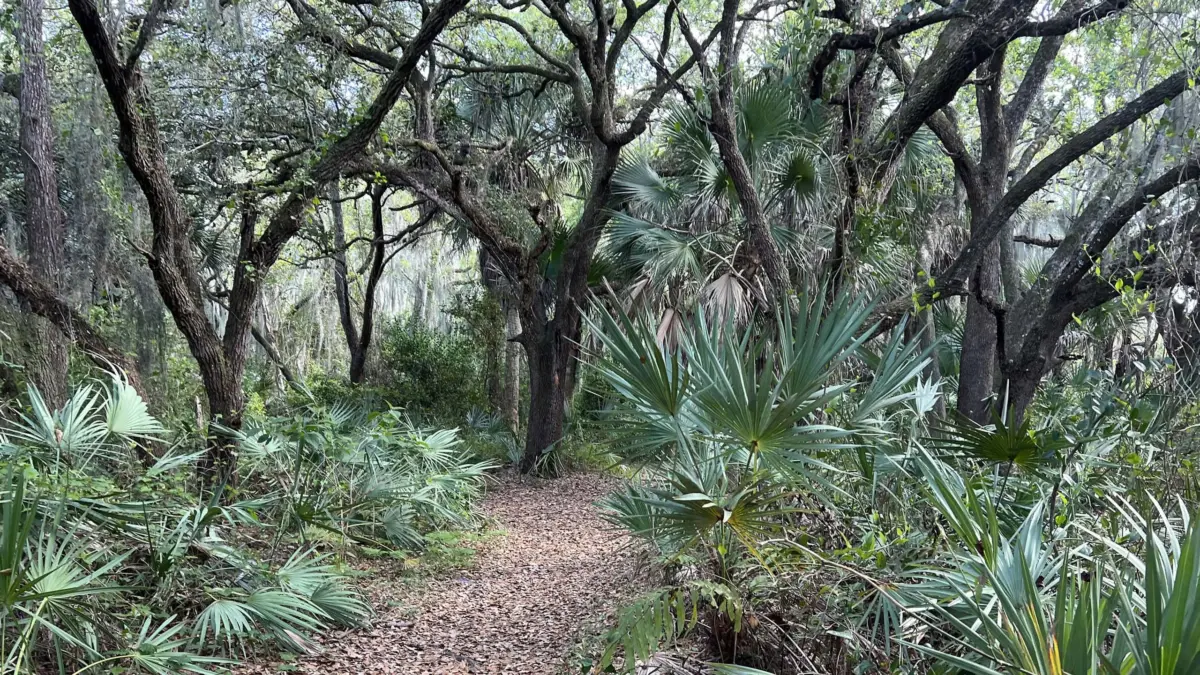
Navigating the Understory: The trail bends beneath a majestic live oak draped in thick layers of Spanish moss. Continuing past the next blaze post, the footpath narrows, hemmed in by towering wild coffee, expansive sword ferns (Nephrolepis exaltata), and carpets of delicate marsh ferns thriving in the damp, shaded micro-depressions of the soil.
Sunlit Clearings and Beautyberry: As the trail weaves deeper, it diverges briefly before reaching a drier section of the forest floor. Here, bracken fern and rambling smilax vines poke through the organic debris. The canopy opens slightly in a sun-drenched clearing, where native American beautyberry (Callicarpa americana) shrubs erupt with clusters of vivid, jewel-toned purple berries, providing a vital food source for local avian species.
The Urban Interface: Beyond a wide corridor flanked by dense walls of saw palmetto (Serenoa repens), the path loops toward the western boundary of the preserve. Here, a stark reminder of modern Florida’s rapid suburbanization comes into view: a residential condo complex sits immediately beyond the property line, highlighting the narrow margins that protect these urban wild spaces. A sharp right turn guides hikers parallel to the property fence before safely steering them back under the protective, timeless canopy of the oak hammock. Completing this quarter-mile loop brings hikers back to the main path via a welcoming T-junction featuring encouraging trail markers.
The Wetland Overlook and Strand Swamp
Rejoining the primary accessible sidewalk and turning left, visitors head deeper into the southern expanse of the preserve. The route meanders through another stunning oak archway where Spanish moss dances in the coastal breeze.
As the trail progresses, the dense oak canopy gives way to sunlit patches where silvery-blue saw palmetto lines the pathway, before plunging back into deep shade. The final stretch of the trail is outlined by a rustic split-rail fence that curves gracefully above a noticeable drop-off in elevation.
This drop leads directly to a seasonal strand swamp—a deeply recessed wetland basin carved between ancient, stabilized coastal sand dunes. The trail culminates at a sturdy wooden observation deck extending out over this rich ecological swale. Teeming with tangled vines, native palms, and specialized wetland vegetation, the swale provides an invaluable hydrological retention area and a haven for amphibians, wading birds, and small mammals. After taking in the peaceful views from the deck, visitors retrace their steps along the paved path, completing a fulfilling, highly diverse 0.8-mile excursion.
Supporting Context & Metrics
Understanding the ecological and structural significance of Delray Oaks requires analyzing its core logistical framework and environmental metrics:
Official Name: Delray Oaks Natural Area
Land Manager: Palm Beach County Department of Environmental Resources Management (ERM)
Total Acreage: 25 acres
Total Trail Length: 0.8 miles (combining a 0.5-mile accessible sidewalk loop and a 0.25-mile interior dirt footpath)
Geographic Location: Delray Beach, Palm Beach County, Florida
Street Address: 2021 SW 29th Street, Delray Beach, FL 33445
Trailhead Coordinates: 26.427132, -80.092739
Operating Hours: Sunrise to sunset, daily
Admission Fees: Free to the public
Restroom Facilities: None on-site
Pet Policy: No pets allowed (to protect sensitive native wildlife and ground-nesting species)
Dominant Ecosystems: Mature xeric hammock, coastal sand dune remnants, and a seasonal strand swamp.
Key Flora: Live oak (Quercus virginiana), cabbage palm (Sabal palmetto), wild coffee (Psychotria nervosa), saw palmetto (Serenoa repens), American beautyberry (Callicarpa americana), Spanish moss (Tillandsia usneoides), and sword fern (Nephrolepis exaltata).
Official Statements & Management Objectives
The preservation and ongoing maintenance of Delray Oaks Natural Area fall under the jurisdiction of Palm Beach County’s Department of Environmental Resources Management (ERM). County resource managers emphasize that urban natural areas like Delray Oaks perform functions that extend far beyond recreational hiking.
"Natural areas embedded within our urban centers are absolute ecological lifelines," notes a Palm Beach County ERM spokesperson. "While they provide human visitors with an immediate, restorative connection to nature, their biological purpose is profound. They act as stormwater filters, urban heat sinks, and irreplaceable reservoirs for native South Florida biodiversity that would otherwise be entirely displaced by development."
County management plans for Delray Oaks focus heavily on active habitat restoration. Because the 25-acre parcel is completely bounded by urban development—including residential neighborhoods and commercial zones—it is uniquely susceptible to ecological pressures such as invasive plant species encroachment, urban runoff, and habitat fragmentation.
ERM conservation crews routinely conduct targeted invasive species removal operations. These initiatives focus on eradicating aggressive non-native vines, ferns, and trees that threaten to choke out delicate understory species like the native wild coffee and sword ferns. Furthermore, the county maintains strict infrastructural boundaries—such as the perimeter fencing adjacent to neighboring residential properties—to prevent unauthorized dumping, pedestrian trampling of sensitive dune soils, and the introduction of domestic pets that could disrupt local fauna.
Future Outlook & Conservation Challenges
As South Florida continues to experience rapid population growth and intense real estate development, the long-term viability of pocket preserves like Delray Oaks Natural Area depends on proactive, community-backed stewardship.
Urban Encroachment and Habitat Isolation
The primary challenge facing Delray Oaks is its status as an ecological island. Surrounded on all sides by asphalt, concrete, and high-density housing, the 25-acre parcel cannot easily exchange genetic material with larger regional ecosystems. Wildlife movement into and out of the preserve is severely restricted, placing pressure on resident populations of small mammals, reptiles, and resident birds. To combat this isolation, county land managers utilize intensive management strategies to artificially maintain habitat health, mimicking natural processes like controlled nutrient cycling and continuous canopy preservation.
Climate Resilience and Hydrology
The seasonal strand swamp located at the terminus of the trail system plays a critical role in local climate resilience. As regional weather patterns shift and extreme precipitation events become more frequent across South Florida, these natural depression wetlands act as vital retention basins, absorbing excess stormwater and mitigating localized urban flooding. Protecting the hydrological integrity of the strand swamp from up-gradient pollution and runoff remains a top priority for county hydrologists.
Community Engagement and Ecotourism
Looking forward, Palm Beach County ERM aims to leverage sites like Delray Oaks for environmental education. By providing universally accessible infrastructure—such as the concrete sidewalk loop—alongside rugged natural footpaths, the preserve successfully engages a broad demographic, from school groups and casual walkers to dedicated botanical enthusiasts.
Ultimately, Delray Oaks Natural Area stands as a testament to successful municipal conservation. It proves that even within heavily urbanized coastal environments, careful planning and dedicated land management can successfully safeguard a living piece of Florida’s ancient, pristine heritage for generations to come.






0 Comments