

Executive Overview
Nestled within the vibrant, multi-recreational expanse of Chuck Lennon Park in De Leon Springs, Florida, lies a hidden gem for outdoor enthusiasts: the Chuck Lennon Hiking Trail. Opened in late 2022, this dedicated 1.1-mile pedestrian loop was meticulously engineered to complement the park’s famous singletrack mountain bike trails, which have long defined the site’s reputation among regional cyclists. Managed by Volusia County, the hiking loop offers a secluded, immersive nature walk beneath an old-growth forest canopy situated within the delicate floodplain of Spring Garden Lake.
While Chuck Lennon Park is widely celebrated as a premier Central Florida destination for mountain biking and serves as a vital northern trailhead for Volusia County’s expansive Spring-to-Spring Trail, the introduction of this pedestrian-exclusive path addressed a longstanding recreational gap. It carves out a tranquil niche for hikers, birdwatchers, and casual nature lovers seeking deep shade, diverse botanical communities, and a genuine escape into Florida’s native hydric hammocks.

This comprehensive report details the logistical framework, geographical context, step-by-step trail chronology, ecological significance, and future outlook of the Chuck Lennon Hiking Trail, providing an authoritative resource for both casual visitors and dedicated conservationists.

Detailed Chronology: Navigating the 1.1-Mile Loop
For those planning an excursion to the southwest corner of Chuck Lennon Park, understanding the layout and progression of the trail ensures a safe and deeply rewarding experience. Built years after the park’s initial mountain bike infrastructure, the hiking trail operates under strict single-use parameters to prevent user conflict.

Trailhead and Initial Approach
The adventure begins at the trail’s official coordinates (29.12191, -81.36471), located at 5000 Greenfield Dairy Rd, De Leon Springs. Reaching the trailhead requires a brief navigation through the park: motorists traveling from US 17 should follow Ponce De Leon Blvd west for approximately one mile. Immediately after crossing the railroad tracks—and bearing away from the state park entrance—visitors make a left onto Burt’s Park Road. Continuing a quarter-mile brings drivers to the park’s internal road network. Passing the parking lots designated for the bike trails and the athletic restrooms, hikers will find the trailhead parking situated on the right, just past the termination of a chain-link fence.

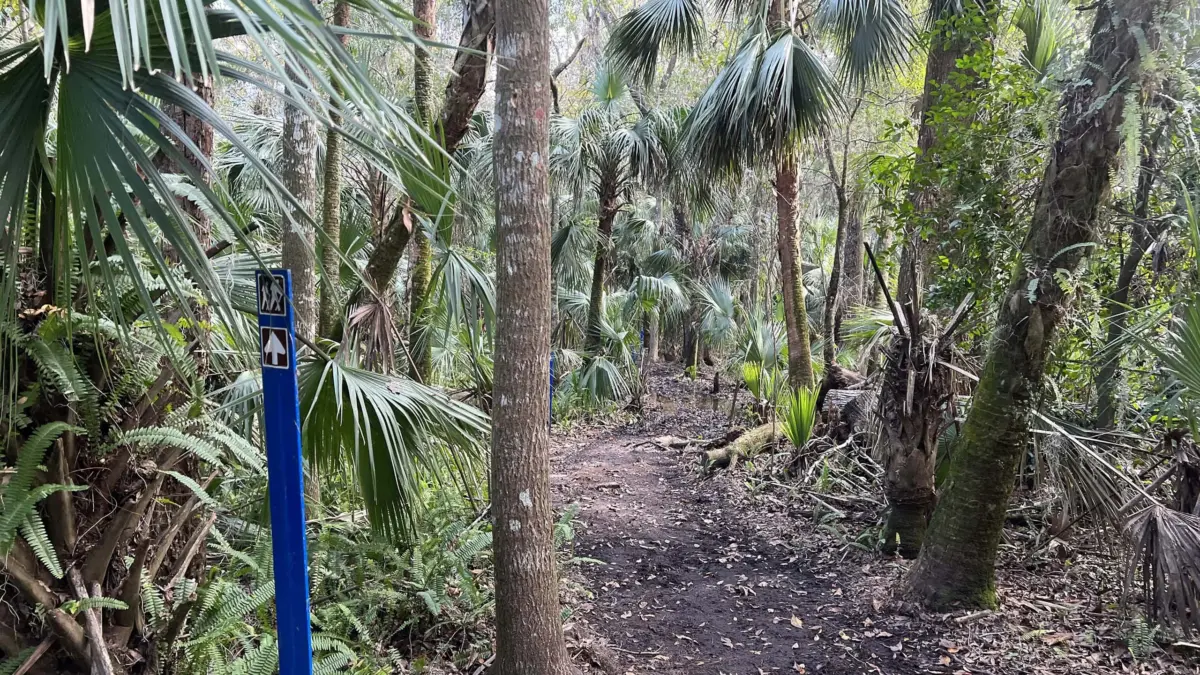
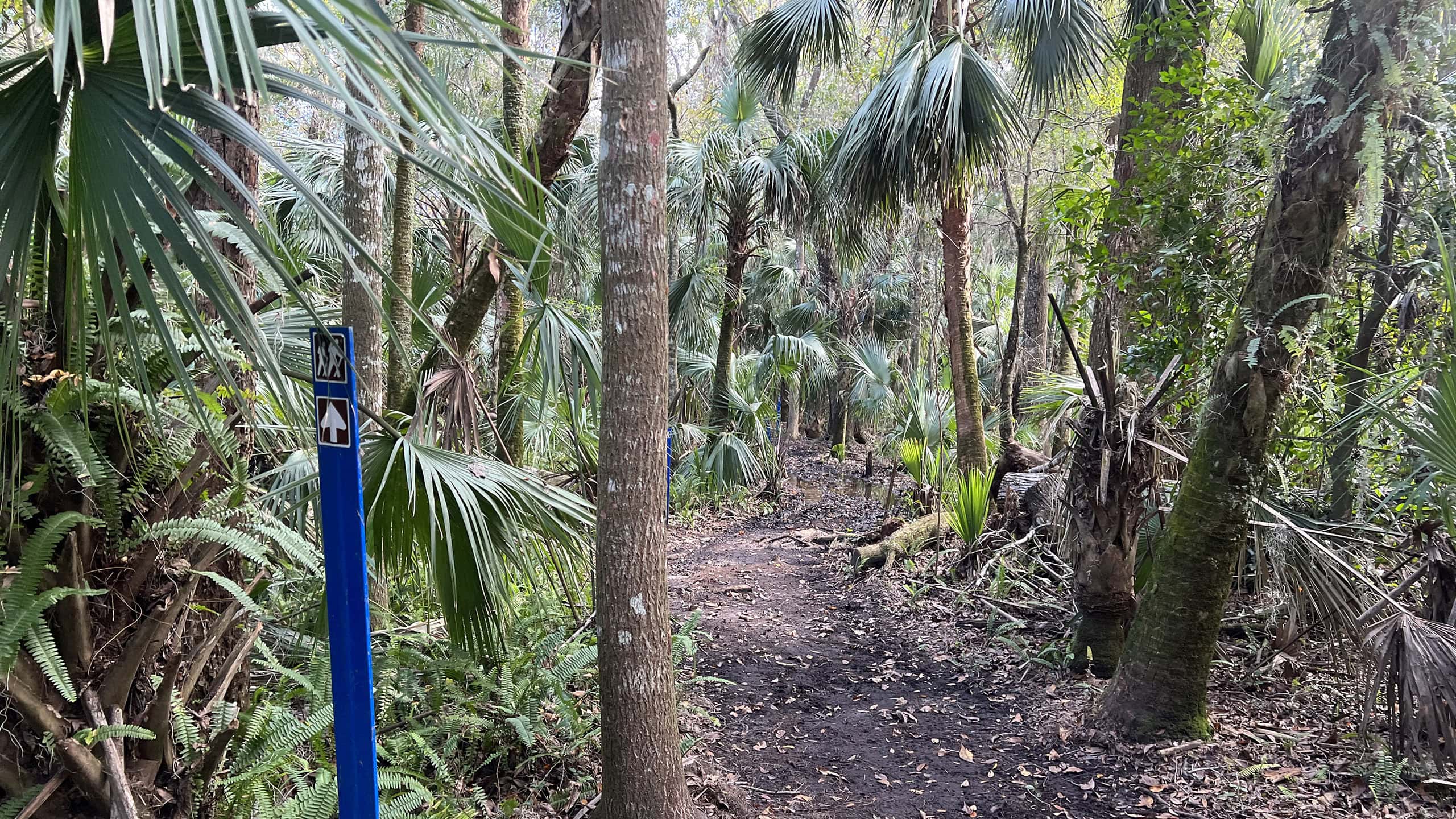
A traditional wooden baffle and stile mark the official gateway to the pedestrian path. The journey commences as a simple, sandy straightaway running parallel to a security fence. Blue Carsonite posts topped with a distinct hiker symbol guide the way, distinguishing this pedestrian corridor from the neighboring cycling paths visible through the fence line.

Entering the Hammock and Discovering "The Seep"
As the trail progresses past a scrubby understory of native oaks, it breaks away from the fence line and curves gracefully into a dense, shaded live oak hammock. Here, the canopy thickens, and the ground transforms into a lush palm hammock characterized by bulging roots and a rich organic scent.

At approximately the 0.25-mile mark, hikers encounter a rustic wooden bench accompanied by a prominent side-path sign reading “The Seep.” Venturing down this short boardwalk-style detour leads between tightly packed cabbage palms to an elevated overlook. Beneath a blanket of verdant aquatic ferns, a large, pristine pond reveals itself—maintained entirely by natural seepage springs. This hydrological feature underscores the park’s position within the Spring Garden Lake floodplain system.

Traversing the Hydric Hammock and Crossover
Returning to the main loop and continuing past the bench, hikers pass an informational kiosk featuring a "You Are Here" map. At the 0.5-mile mark, the trail reaches a crucial junction where the two sides of the loop closely approach one another, offering a convenient crossover option that can effectively cut the walk in half for those pressed for time.

Staying right to complete the full loop, the terrain transitions into a true hydric hammock. This section of the path is notably moist; during periods of seasonal rainfall, the forest floor becomes completely saturated, and shallow streams or standing puddles frequently cross the footpath. Waterproof footwear or an adventurous spirit is mandatory here.

The Southern Loop and Return
As the trail curves northward, the habitat subtly shifts once more. Towering oaks begin to outnumber the cabbage palms, and the squishy, dark earth beneathfoot gives way to dry, white sand. Walkers pass beneath a natural tunnel formed by a lower-stature canopy, where filtered light pierces the edges of the forest.

An enormous, ancient pine trunk marks the southern apex of the loop, standing sentinel near a secondary trail map and bench. While a minor maintenance two-track exits toward the nearby ballfields here, hikers should ignore it and stay on the primary blue-blazed path. By the 0.8-mile mark, the trail intersects the second leg of the crossover junction. Navigating the final dry woods brings hikers to a definitive T-junction with the initial fenceline path at the one-mile mark. A final right turn leads back through the wooden stile, depositing visitors safely back at the park road at precisely 1.1 miles.

Supporting Context & Metrics
To fully appreciate the scope of the Chuck Lennon Hiking Trail, it is necessary to examine the park’s broader logistical data, ecological environment, and regional positioning within Volusia County’s public lands network.

Key Trail Metrics and Information
- Official Name: Chuck Lennon Hiking Trail
- Land Manager: Volusia County Parks, Recreation and Culture
- Location: De Leon Springs, Florida
- Trailhead Coordinates: 29.12191, -81.36471
- Physical Address: 5000 Greenfield Dairy Rd, De Leon Springs, FL 32130
- Total Length: 1.1-mile loop (with an internal crossover allowing for a shortened route)
- Access Fees: Completely Free
- Operating Hours: Open daily from sunrise to sunset
- Pet Policy: Leashed dogs are welcome
- Amenities: Restrooms are available on-site between the athletic courts and near the ballfields. Parking is dedicated and free of charge.
- Contact Phone: 386-736-5953
Ecological Significance and Habitat Diversity
The Chuck Lennon Hiking Trail serves as a living laboratory for Central Florida’s transitional wetland and upland ecosystems. Situated within the Spring Garden Lake floodplain, the trail exposes visitors to three distinct ecological zones within a very short distance:

- Upland Oak Scrub: Dominated by mature live oaks and palmettos along the sandy margins of the park.
- Cabbage Palm Hammock: A dense, tropical-feeling environment featuring towering Sabal palms and heavy root systems.
- Hydric Hammock and Seepage Zones: Low-lying areas prone to seasonal saturation, supporting specialized hydrophytic vegetation, ferns, and spring-fed aquatic features like "The Seep."
Official Statements and Safety Guidelines
Volusia County land managers and local conservationists emphasize safety, multi-use cooperation, and environmental stewardship when promoting the Chuck Lennon Hiking Trail.

User Separation and Trail Etiquette
Because Chuck Lennon Park is internationally and regionally recognized for its premier singletrack mountain bike network, safety protocols between user groups are strictly enforced. Official signage and county guidelines outline clear boundaries:

- For Hikers: Pedestrians are strictly prohibited from utilizing the dedicated mountain bike singletracks. These paths are clearly posted with "No Hiking" warnings to prevent high-speed collisions with cyclists navigating tight turns and technical drops.
- For Cyclists: Mountain bikers are strictly prohibited from riding on the Chuck Lennon Hiking Trail. The pedestrian path’s soft sand, tree roots, and narrow wooden stiles make it entirely unsuitable for cycling.
- General Stewardship: Visitors are reminded to practice Leave No Trace principles, pack out all trash, keep pets securely leashed at all times, and respect the fragile flora and fauna inhabiting the Spring Garden Lake floodplain.
Future Outlook
As Central Florida experiences rapid population growth and suburban expansion, urban and suburban green spaces like Chuck Lennon Park play an increasingly vital role in regional conservation and public health. The addition of the Chuck Lennon Hiking Trail in 2022 represents a proactive shift by Volusia County toward diversifying park usage—ensuring that non-cyclists, families, and senior citizens have dedicated, low-impact access to natural areas.

Looking forward, county parks officials anticipate steady increases in eco-tourism and local foot traffic, particularly as awareness grows regarding the trail’s connection to broader regional initiatives like the Spring-to-Spring Trail. Future maintenance priorities will likely focus on boardwalk enhancements across the hydric hammock’s most flood-prone sections, invasive species management, and expanded interpretive signage detailing the region’s unique hydrogeology.

For travelers looking to expand their Central Florida itinerary, Chuck Lennon Park acts as an ideal basecamp. Nearby attractions include the historic De Leon Springs State Park—famous for its natural spring and the Old Spanish Sugar Mill Pancake House—as well as the wild expanses of the Wild Persimmon Trail, Lake Woodruff National Wildlife Refuge, and Tiger Bay State Forest. Together, these public lands form an interconnected natural sanctuary that preserves the wild heart of Volusia County for generations to come.

0 Comments