Tucked discreetly away within the urban sprawl of Sarasota, Florida, lies Pinecraft—a unique community that serves as the state’s only permanent Amish and Mennonite enclave. For decades, this pocket of modest homes, vibrant community spirit, and rich cultural heritage has operated as a beloved winter getaway for travelers seeking refuge from northern chills. At the beating heart of this enclave, hugging the winding, tannic waters of Phillippi Creek, sits Pinecraft Park. Originally established in the 1920s as a humble tourist camp, the park today functions as a vital social and recreational hub. Here, residents in distinctive plain attire gather for competitive matches of shuffleboard, families enjoy weekend picnics, and the air hums with the cadence of a traditional German dialect commonly shared among the community.
Beyond its cultural significance, Pinecraft Park offers an unexpected ecological refuge. Centered around a 1.1-mile multi-part walking route, the park features a paved levee trail alongside a more rugged, untamed interior: the Mesic Hammock Trail. Though severely impacted by the destructive winds of Hurricane Milton—leaving many of its grand oaks with shredded canopies and broken branches—the hammock remains a resilient ecosystem. It teems with native and invasive vegetation, serves as a vital wildlife corridor, and marks the southernmost natural range for the rare, ivory-green blooming Pigmy fringetree. This investigative review details the landscape, history, trail conditions, and management oversight of Pinecraft Park, offering both a logistical guide for visitors and an authoritative look at a treasured Florida micro-destination.
Detailed Chronology: Navigating the Trails of Pinecraft Park
A journey through Pinecraft Park is characterized by a distinct two-part transition: the open, manicured recreational spaces of the developed park and the wild, tangled seclusion of the Mesic Hammock Trail.
Part I: The Mesic Hammock Trail Loop
The adventure begins at the southern edge of the park property, where a signposted gateway introduces visitors to the Mesic Hammock Trail. Crossing a pedestrian bridge over the waterway, hikers immediately face a three-way junction. Turning left initiates a clockwise circuit beneath an oak canopy that, while previously dense, bears the lingering scars and sparse configurations left in the wake of severe hurricane activity.
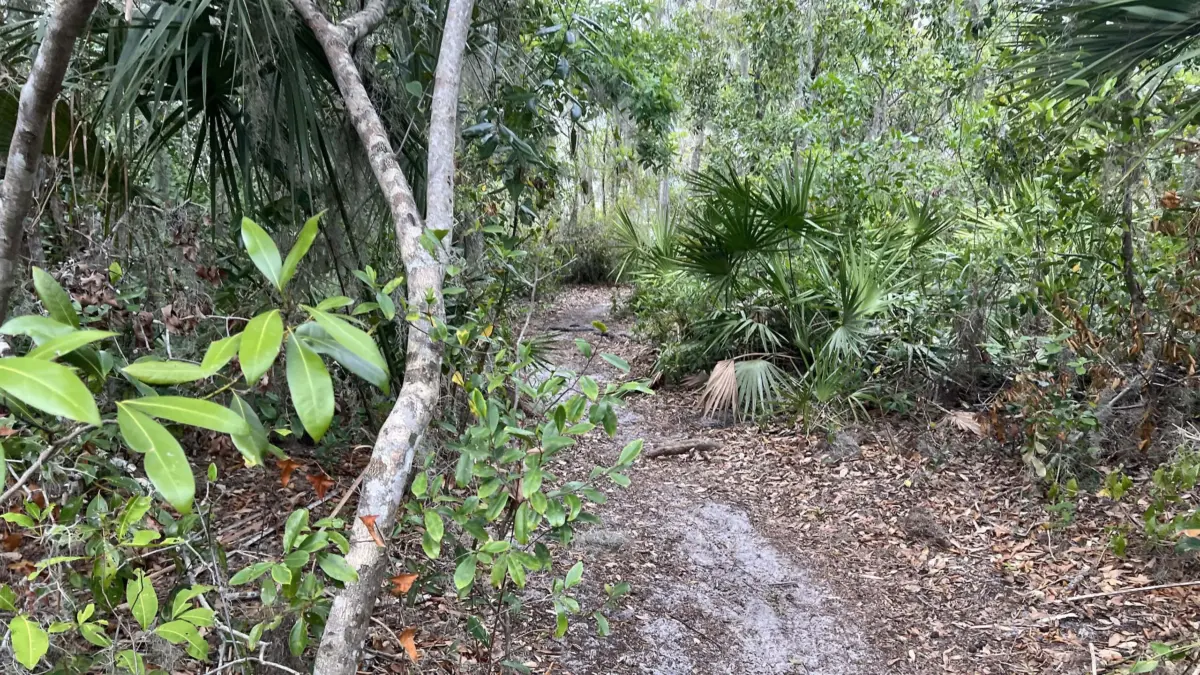
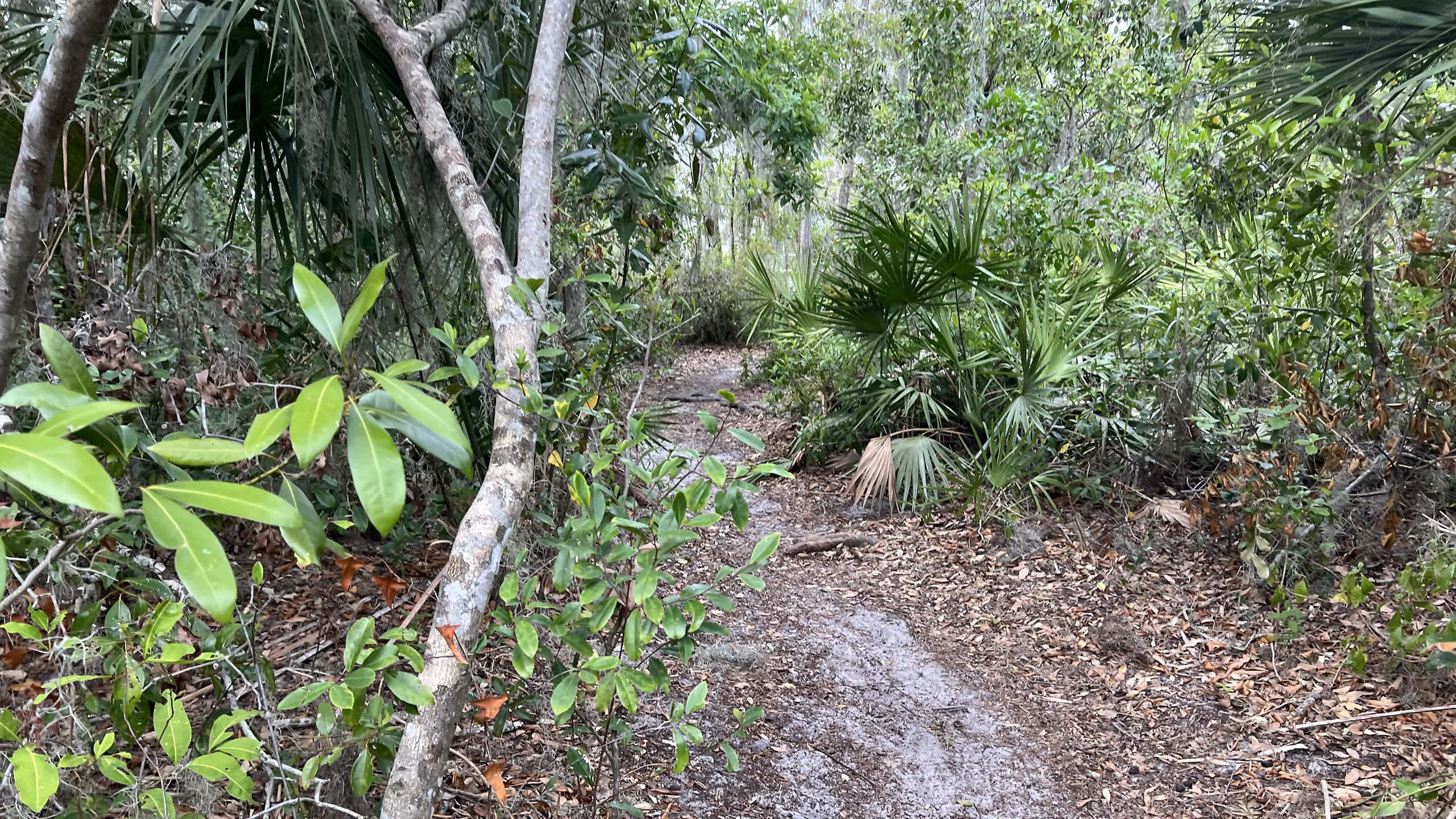
A narrow, winding footpath snakes directly into a thicket of dense understory. Here, aggressive grapevines swarm competing foliage, while native coral bean bushes display striking, spiky crimson blooms against the muted earth tones of the forest floor. Southern red cedar trees and patches of wild coffee emerge frequently from the deep leaf litter. Navigating further, hikers encounter a T-intersection; the left path terminates in a dead end, while the right path guides the route deeper into a tight corridor enclosed by lush vegetation.
As the path curves southward, visitors must duck beneath low-hanging branches of young saplings, climbing steadily past a towering hickory tree. Reaching a junction just beyond a thick stand of marlberry, a left turn leads down a sloping grade beneath towering live oaks, ultimately arriving at a back gate marking the park boundary. While this side excursion is brief, it affords a clear look at a swift stream vigorously flowing out of the adjacent neighborhood and spilling directly into the park ecosystem.
Returning to the main path, hikers parallel the stream along a wooded bluff. Here, a rare yellow blaze on a tree trunk provides a solitary marker of trail management. The path winds past an unusual, organic curlicue formed by the aerial roots of a strangler fig tree—an architectural marvel of nature whose twisting form bears a striking resemblance to a musical bass clef.
Part II: Ravine Bluffs, Confluences, and the Return
Continuing along the sandy route, hikers encounter a sudden descent into a low-lying hollow defined by saw palmetto. A sandy spur to the right ascends sharply to a high bluff overlooking the raw, unchannelized natural shoreline of Phillippi Creek—a rare perspective on a waterway heavily modified by urban development elsewhere.
Descending back to the primary path, the route navigates past cabbage palms before reaching a final T-junction near the confluence of the neighborhood stream and the broader expanse of Phillippi Creek. The adjacent spur offers a scenic overlook of the two waters meeting. Turning upstream, hikers face a steep, physically demanding ascent up a ridge paralleling the flow.
Near the 0.5-mile mark, a temporary warning sign alerts visitors to the presence of an active honeybee hive nearby. Pressing through a narrowing corridor of vegetation, the trail climbs its steepest incline, reconnecting with the path previously traveled away from the neighborhood waterway. Retracing steps past the strangler fig and across the footbridge at the 0.6-mile mark concludes the natural portion of the journey.
To complete the full 1.1-mile excursion, visitors transition to the developed northern section of the park. A quarter-mile linear paved walkway runs along a levee high above a ditched portion of Phillippi Creek. Looping past the children’s playground, open-air picnic pavilions, and bustling community shuffleboard courts ties the urban and natural elements of Pinecraft Park together into a cohesive, highly accessible outing.
Supporting Context & Metrics
Understanding Pinecraft Park requires examining its operational specifications, ecological markers, and geographic setting within Sarasota County.
Operational Metrics & Logistics
Official Location: Sarasota, Florida (1420 Gilbert Ave, Sarasota, FL 34239)
Coordinates (Trailhead): 27.319510, -82.503992
Total Trail Length: 1.1 miles (combining the nature loop and the paved levee walk)
Operating Hours: 6:00 AM to 10:00 PM daily
Admission Fees: Free to the public
Amenities: Restrooms at the trailhead, boat ramp for paddlers, picnic pavilions, playground, and dedicated shuffleboard courts.
Restrictions: Bicycles are strictly prohibited on the Mesic Hammock Trail (though unauthorized tire tracks indicate occasional infractions). County signage explicitly states that pets are not permitted within the park boundaries.
Botanical Highlights & Ecological Dynamics
While urban parks in Florida frequently struggle with invasive ornamental flora—a trend clearly visible along the margins of Pinecraft Park’s hammock—the site harbors exceptional botanical treasures. Most notable is the presence of the Pigmy fringetree (Chionanthus pygmaeus). Blooming in March with delicate, ivory-green flowers that stand out sharply against surrounding saw palmetto, these endangered or uncommon woody shrubs are rarely found outside the sand pine scrub of North and Central Florida. Pinecraft Park marks the absolute southernmost limit of their natural geographic range.
Additionally, the park’s hydrology is defined by Phillippi Creek, a vital drainage basin that carries stormwater runoff from urbanized Sarasota County into the Gulf of Mexico via Roberts Bay. The juxtaposition of manicured lawns, asphalt, and natural hammock creates a unique transitional ecotone where wildlife, including wading birds, migratory songbirds, and local pollinators, find vital urban sanctuary.
Official Statements & Land Management
Managed primarily by Sarasota County Parks and Recreation, Pinecraft Park represents an ongoing balancing act between active recreational needs and fragile urban conservation.
"County parks within densely populated residential matrices, such as Pinecraft, require rigorous oversight to protect fragile ecosystems while accommodating diverse community traditions," notes the Sarasota County Parks administration via public resources. "Our primary focus remains maintaining safe recreational corridors along Phillippi Creek, supporting infrastructure like boat launches and pavilions, and monitoring natural areas for recovery following severe weather events."
Local conservationists and municipal arborists have likewise emphasized the resilience of the park’s urban forest. Following the catastrophic landfall of Hurricane Milton, which tore through Sarasota County with destructive force, public land managers prioritized clearing obstructed pathways while preserving standing deadwood to naturally feed the forest floor’s nutrient cycle. Park authorities continue to urge visitors to respect posted signage—particularly regarding bicycle bans on the delicate interior dirt footpaths—to prevent soil compaction and root damage to rare species like the Pigmy fringetree.
Future Outlook
As Sarasota County continues to experience rapid residential growth and suburban densification, spaces like Pinecraft Park face mounting environmental pressures. The long-term viability of the Mesic Hammock Trail depends heavily on proactive invasive species removal, trail maintenance, and community cooperation.
Future initiatives by Sarasota County are expected to focus on climate resiliency along the Phillippi Creek corridor, specifically addressing urban runoff mitigation and bank stabilization. For the historic Amish and Mennonite community of Pinecraft, the park remains an irreplaceable communal backyard—a neutral ground where tradition meets the subtropical Florida landscape. By balancing ecological preservation with open public access, Pinecraft Park is well-positioned to remain a cherished, low-key sanctuary for generations of hikers, paddlers, and cultural explorers to come.







0 Comments