For more than three decades, the 90-acre South Tract of the LEAFS (Longleaf Ecology and Forestry Society) Preserve has stood as a beacon of ecological stewardship in north-central Florida. Situated just east of U.S. Route 301 on higher ground relative to its northern counterpart, this vital ecosystem serves as a living laboratory for the meticulous restoration and active management of longleaf pine flatwoods.
Originally established by the Longleaf Ecology and Forestry Society in 1993, the property represents a monumental achievement in grassroots conservation. In 2022, stewardship of this ecological crown jewel transitioned to the Alachua Conservation Trust (ACT), ensuring its permanent protection and continued professional oversight. Today, the South Tract welcomes nature enthusiasts, hikers, and researchers alike, offering an intimate look into a restored native landscape via the 1-mile Longleaf Trail—a carefully curated circuit of mowed footpaths and historic forest roads.
This comprehensive report examines the historical trajectory of the LEAFS Preserve South Tract, details the ecological mechanics of its ongoing restoration, provides practical navigation and trail data for visitors, and explores the broader conservation network safeguarded by the Alachua Conservation Trust in Waldo, Florida.
Detailed Chronology: The Evolution of LEAFS Preserve
The story of the LEAFS Preserve South Tract is one of unwavering dedication, scientific persistence, and institutional transition. To understand the current landscape of towering pines and thriving understories, one must trace the timeline of its protection and management.
1993: Foundation and Early Stewardship
In 1993, the Longleaf Ecology and Forestry Society was founded with a singular, ambitious vision: to halt the decline of the historic longleaf pine ecosystems that once dominated the American Southeast. Recognizing that private intervention was critical to preserving disappearing habitats, the society acquired the 90-acre parcel that would become the South Tract.
Upon acquisition, the land was far from the pristine wilderness seen today. Decades of fire suppression, commercial timber harvesting, and agricultural alterations had left the flatwoods degraded. The understory was choked, native groundcovers were suppressed, and the natural hydrological and fire cycles that longleaf pines depend upon had been severely disrupted. The society immediately set to work, implementing a rigorous regime of prescribed burns, selective thinning, and invasive species management.
1993–2022: Three Decades of Ecological Recovery
Throughout the late 20th and early 21st centuries, the South Tract transformed under the careful watch of LEAFS members and local volunteers. Through cyclical controlled burning—the single most important management tool for longleaf pine ecosystems—pioneering conservationists cleared out dense, woody midstories and stimulated the return of native fire-adapted grasses and wildflowers.
The strategy yielded remarkable results. Younger longleaf pines began to flourish, establishing a healthy age distribution across the 90-acre expanse. Botanical surveys over the years documented the return of rare and endemic plant species, transforming a neglected timber tract into an ecologically rich showcase of restored Florida flatwoods.
2022: Transition to the Alachua Conservation Trust
As the scope of land management expanded and the need for long-term legal and financial security became paramount, the Longleaf Ecology and Forestry Society orchestrated a pivotal transition. In 2022, ownership and stewardship of the South Tract were formally donated to the Alachua Conservation Trust (ACT), a premier regional land trust with a proven track record of safeguarding North Florida’s natural resources.
This transition guaranteed that the property would remain permanently protected from commercial development while benefiting from ACT’s professional staff, community outreach networks, and specialized conservation resources. Today, ACT maintains the trail systems, coordinates volunteer workdays, and continues the essential cycle of prescribed burning required to keep the flatwoods healthy.
Supporting Context & Metrics: Navigating the South Tract
For visitors planning an excursion to the LEAFS Preserve South Tract, understanding the physical layout, logistical details, and botanical features of the property ensures a safe and deeply rewarding experience.
Quick Facts and Logistics
Location: Waldo, Florida (Alachua County)
Land Manager: Alachua Conservation Trust (Phone: 352-373-1078)
Total Acreage: 90 acres (South Tract)
Trail Length: 1-mile loop (The Longleaf Trail)
Trailhead Coordinates: 29.76513, -82.13623
Physical Address: 11985 NE CR 1471, Waldo, FL
Operating Hours: Sunrise to sunset, daily
Cost: Free admission
Amenities: None (No restrooms on-site; visitors should plan accordingly)
Pet Policy: Leashed dogs are welcome
Driving Directions
From Hawthorne: From the State Road 26 interchange, travel north on U.S. Route 301 for approximately 3 miles to County Road 1471. Turn right, and the trailhead parking area will be located on the right side of the road in roughly half a mile.
From Waldo: From the State Road 24 junction, head south on U.S. Route 301 for 2.5 miles. Make a turnoff onto NE 114th Ave, take a quick left onto County Road 1471, and proceed for half a mile to locate the trailhead on your right.
The Hiking Experience: Mile-by-Mile Breakdown
Upon arriving at the trailhead kiosk, visitors are encouraged to review the trail map or photograph it for reference. An interpretive guide keyed to numbered posts along the route offers insight into the ecology of the restoration site.
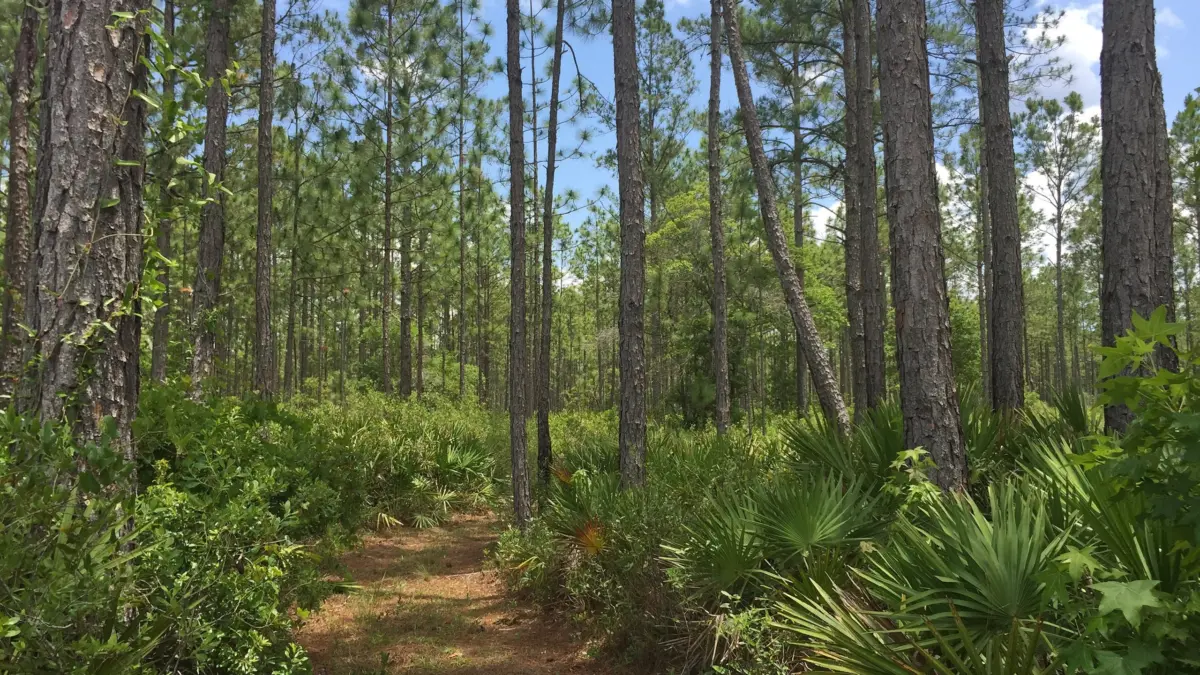
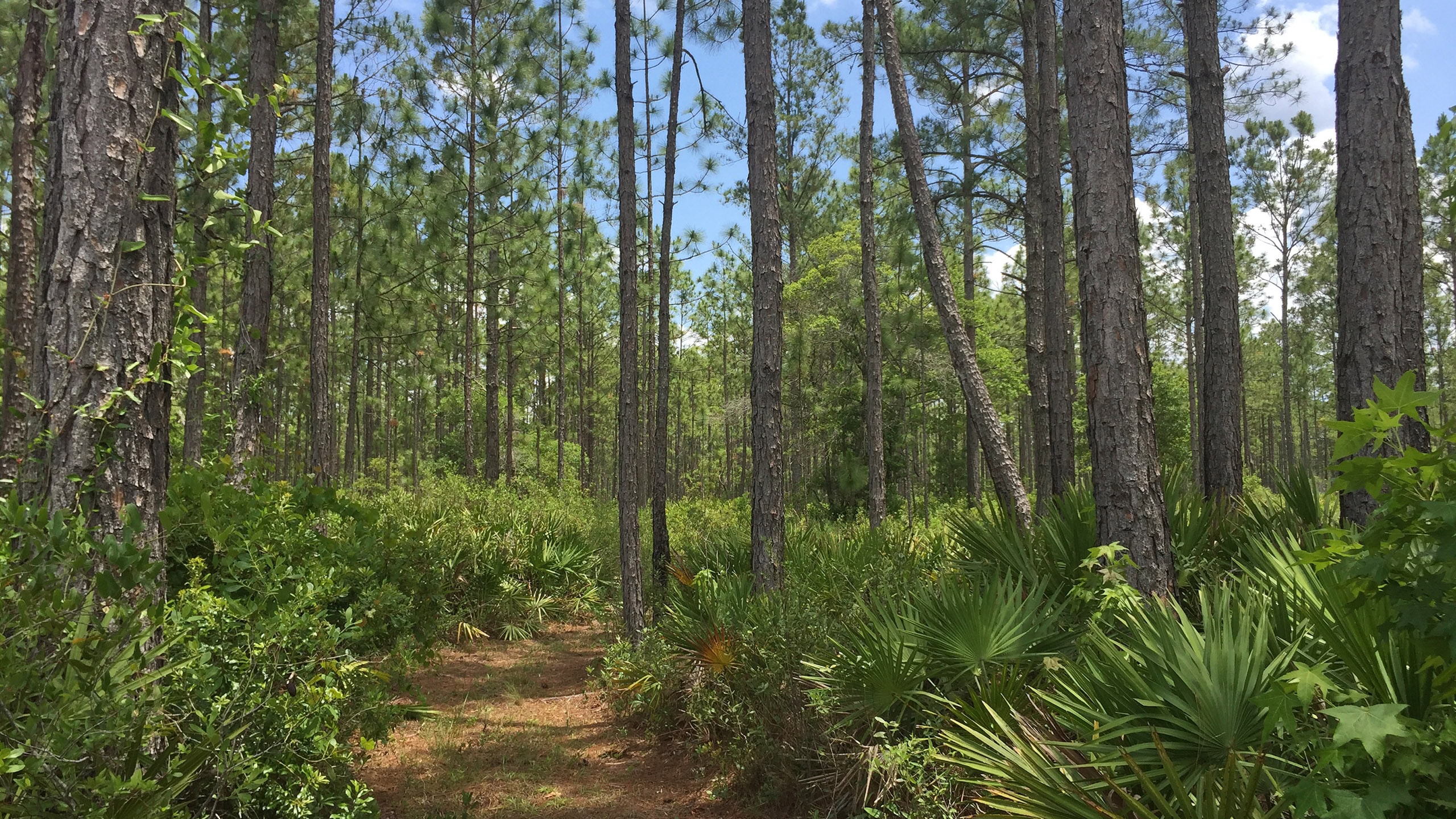
The Approach (0.0 to 0.1 miles): The trail initiates through an open forest of younger longleaf pines (Pinus palustris). Here, the dense understory gradually yields to open patches of pine duff speckled with seasonal wildflowers. At approximately one-tenth of a mile, hikers reach Marker 3, which marks the beginning of the loop. Opting for a counterclockwise journey, hikers bear right.
The Palmetto Thicket (0.1 to 0.5 miles): The path winds through an understory dominated by sprawling saw palmetto (Serenoa repens) interlaced with glossy gallberry (Ilex glabra). Emerging "candle-stage" longleaf pines—resembling large, vibrant green bottlebrushes—poke upward through the scrub. The path transitions between soft pine duff and grassy trail segments, with clearly marked arrows guiding hikers across intersecting fire lines. Seasonal highlights include the delicate blossoms of dwarf pawpaw rising from sandy clearings.
The Firebreak Crossing (0.5 to 0.7 miles): Past Marker 7, an arrow directs the trail across a strategically placed firebreak. In these drier zones, the flatwoods become a thicket of pine trunks where saw palmetto reasserts dominance, accompanied by low-bush blueberry growing directly along the trailside. Between Markers 9 and 11, the trail provides an immersive experience within the heart of the restored forest, surrounded by a sea of saw palmetto punctuated by chalky bluestem grass.
The Return (0.7 to 1.0 miles): At 0.7 miles, hikers reach a T-intersection and make a sharp left turn. To the north, a subtle drop in elevation is signaled by the appearance of sweetbay and loblolly bay trees among the pines. The loop closes shortly thereafter, leading hikers straight ahead past the trailhead kiosk to complete the 1-mile trek.
Official Statements & Ecological Insights
The restoration success at LEAFS Preserve is rooted in a deep understanding of fire ecology. Historically, lightning-ignited fires swept across Florida’s flatwoods every few years, clearing out competing hardwoods, returning nutrients to the soil, and preparing a clean seedbed for longleaf pine seeds to germinate.
When fire is suppressed, woody shrubs like saw palmetto and gallberry overtake the understory, choking out the herbaceous plants that support hundreds of native insect, bird, and reptile species. Conservation scientists emphasize that human intervention through prescribed burning is non-negotiable for these ecosystems to survive.
"The longleaf pine flatwoods are among the most biodiverse ecosystems in North America, yet they are also among the most imperiled," notes conservation literature from the Alachua Conservation Trust. "Through careful, science-based management—including controlled burns and active habitat restoration—parcels like the LEAFS Preserve South Tract transition from degraded, overgrown timberlands back into vibrant, resilient natural communities."
Land managers routinely urge the public to check the official ACT website prior to visiting. Because prescribed burns are vital to maintaining the health of the preserve, temporary closures are occasionally necessary to ensure public safety during active burn operations.
Future Outlook & Regional Conservation Network
As the LEAFS Preserve South Tract looks toward the future under the stewardship of the Alachua Conservation Trust, its role as an educational and ecological anchor in Alachua County remains secure. The ongoing management plan focuses on adaptive forestry practices, monitoring biodiversity recovery, and engaging the local community through volunteer stewardship programs.
Furthermore, the South Tract does not exist in isolation. It forms a crucial node within a broader network of protected public lands in the Waldo and greater Gainesville region. Hikers and conservationists exploring the South Tract can easily expand their itineraries to include several nearby ecological treasures managed by ACT and partner organizations:
LEAFS Preserve North Tract: Located just north of the South Tract, this sister property features a well-defined loop trail winding through an ongoing longleaf pine restoration area, culminating in scenic, panoramic views overlooking Lake Alto.
Little Lake Santa Fe Preserve: Situated nearby, this preserve invites visitors to meander across upland pine forests that transition into cypress-filled wetlands along the shores of Little Lake Santa Fe.
Lake Alto Preserve North: A sophisticated, well-marked trail system weaving around complex wetlands and upland pine forests, leading adventurous hikers to a dedicated observation dock overlooking scenic Lake Alto.
Little Orange Creek Preserve: A sprawling expanse where protected uplands and extensive wetlands converge, featuring trail networks and elevated observation platforms that offer sweeping vistas of the Little Orange Creek watershed.
Through the dedication of organizations like the Longleaf Ecology and Forestry Society, the Alachua Conservation Trust, and the countless citizen scientists and hikers who walk these trails, the LEAFS Preserve South Tract will continue to serve as a living testament to ecological renewal for generations to come.






0 Comments