

Executive Overview
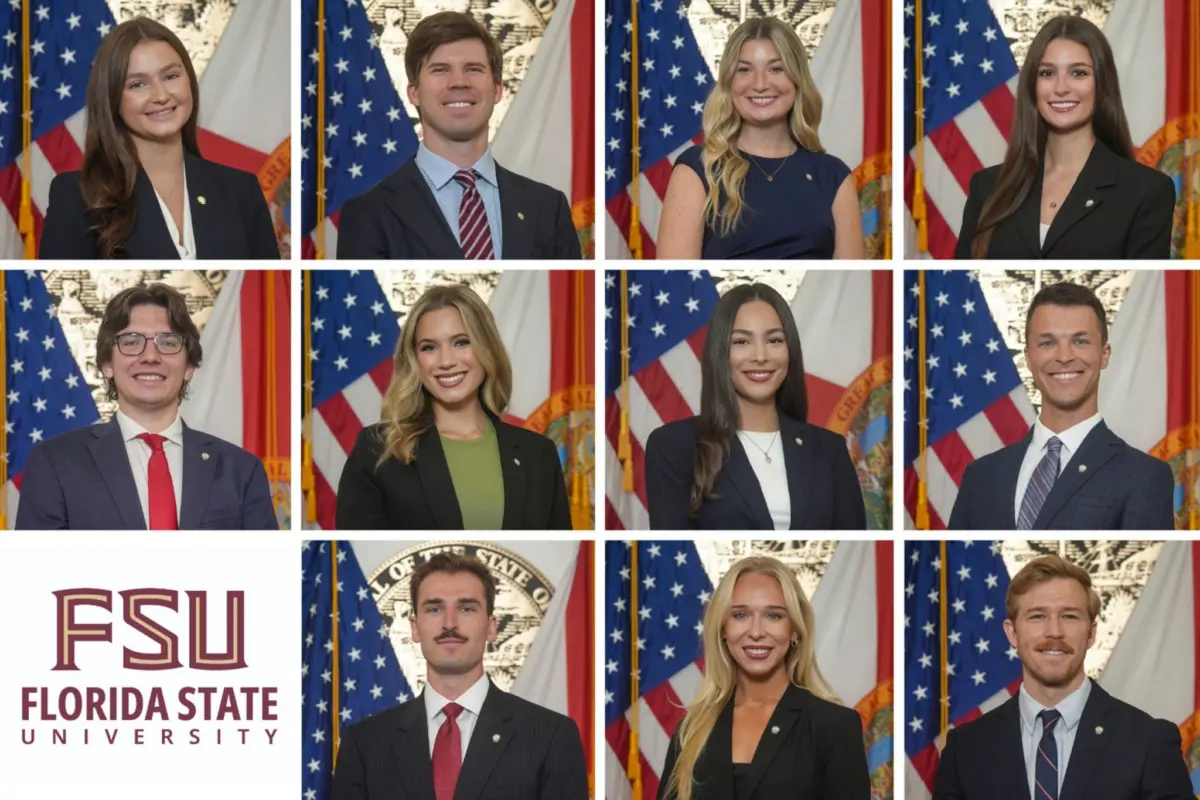
In a powerful testament to academic rigor and professional preparedness, eleven Florida State University (FSU) students have officially been selected for the prestigious Florida Gubernatorial Fellowship Class XXII. This elite, highly competitive, nonpartisan statewide program offers a select group of exceptional scholars an immersive, hands-on masterclass in public administration, policymaking, and state government operations.
Situated in the heart of Florida’s capital, FSU continues to leverage its unique geographic advantage to bridge the gap between higher education and public service. For nine intensive months, these eleven fellows will step away from traditional lecture halls and onto the front lines of state governance. Working side-by-side with senior agency leaders, participating in policy excursions across the state, and undertaking a week-long leadership immersion in Washington, D.C., the cohort will gain an insider’s perspective on how legislative and executive decisions shape the lives of millions of Floridians.
This year’s selection not only highlights the individual brilliance of the chosen scholars but also reinforces FSU’s enduring reputation as a premier incubator for public leadership. As state agencies grapple with complex administrative challenges, infrastructure demands, and educational transformations, the infusion of young, driven academic talent promises to inject fresh perspectives into the machinery of Florida’s state government.
Detailed Chronology & Program Structure
The journey from campus scholar to gubernatorial fellow is rigorous, highly selective, and designed to test the limits of academic and professional adaptability. The evolution of a Gubernatorial Fellow follows a carefully orchestrated timeline over the course of an academic and professional year:
1. The Application and Selection Phase (Spring)
The pathway to Class XXII began months prior to the official announcement, as hundreds of graduate and upper-level undergraduate students from universities across Florida vied for a handful of coveted spots. Candidates submitted extensive portfolios, academic transcripts, letters of recommendation, and comprehensive essays detailing their vision for public service. A rigorous screening committee evaluated applicants on leadership potential, analytical capabilities, academic excellence, and a demonstrated commitment to civic engagement.
2. Placement and Onboarding (Summer)
Upon acceptance, fellows are carefully matched with major state agencies aligning with their career trajectories and academic specializations. This year’s FSU cohort secured placements across a diverse spectrum of government bodies, ranging from the Florida Department of Education (FDOE) to the Florida Department of Transportation (FDOT). The onboarding process introduces fellows to high-level agency executives, operational frameworks, and the intricate statutory guidelines that govern state administration.
3. Immersive Agency Work and Mentorship (Fall – Winter)
Once embedded within their respective agencies, fellows transition from observers to active contributors. Unlike standard administrative internships, the Gubernatorial Fellowship empowers participants to work directly alongside senior leaders. Fellows participate in high-level executive meetings, review policy drafts, analyze budgetary impacts, and contribute to agency initiatives. During this phase, they are paired with seasoned mentors who provide invaluable professional guidance and career counseling.
4. Statewide Policy Trips and the D.C. Immersion (Winter – Spring)
Beyond their daily agency responsibilities, Class XXII fellows embark on a series of educational excursions. These policy trips take students outside the capital city to explore regional economic drivers, agricultural hubs, environmental conservation projects, and major infrastructure installations throughout Florida. Additionally, the cohort travels to Washington, D.C., for a week of intensive briefings with federal officials, policy think tanks, and national leaders, providing a macro-level view of how state and federal governments intersect.
5. Independent Policy Case Study and Capstone Presentation (Spring)
The culmination of the nine-month fellowship is the independent policy case study. Each fellow is tasked with identifying a pressing challenge within state government, conducting rigorous empirical research, and developing actionable, evidence-based policy recommendations. At the conclusion of the program, fellows present their findings to top state officials, cabinet members, and agency heads, offering tangible solutions that can influence future legislative agendas.
Supporting Context & Metrics: The FSU Capital Advantage
The success of FSU students in securing nearly a dozen spots in Class XXII is no accident. It is the direct result of a deliberate institutional strategy that capitalizes on Tallahassee’s unique status as the seat of state government.
The Strategic Value of Proximity
While universities across the Sunshine State produce top-tier talent, Florida State University enjoys an unmatched logistical advantage. Located mere blocks from the Florida State Capitol, the Supreme Court, and dozens of state agency headquarters, FSU provides its student body with organic access to the centers of political power.
According to institutional metrics, hundreds of FSU students engage in legislative internships, executive branch fellowships, and policy advocacy roles each academic year. This proximity allows academic theory to be tested immediately in real-world professional environments. Students do not have to wait until graduation to engage with policymakers; they can attend committee hearings between morning lectures and intern with state senators in the afternoon.
Cultivating Interdisciplinary Excellence
The eleven FSU students chosen for Class XXII represent a diverse array of academic disciplines, including public administration, political science, economics, and specialized graduate programs like the Master of Applied American Politics and Policy (MAAPP) and FSU’s combined pathways programs. This multidisciplinary representation ensures that the cohort brings a holistic toolkit to state agencies, combining quantitative data analysis, qualitative research methodologies, and strong communication skills.
The financial and professional investment yielded by the fellowship is substantial. Historically, a significant percentage of gubernatorial fellows transition directly into full-time leadership roles within Florida state government, private sector public affairs firms, or national policy organizations upon graduation. By bridging the gap between higher education and state administration, the program serves as a vital talent pipeline for Florida’s workforce development.
Official Statements and Leadership Perspectives
The announcement of Class XXII drew enthusiastic praise from university leadership and state officials alike, who emphasized the symbiotic relationship between FSU and the Florida Capitol.
Clay Ingram, FSU Chief Legislative Affairs Officer, highlighted how the university’s geographic location fundamentally shapes the student experience and attracts high-achieving scholars from around the nation.
"FSU’s proximity to the capital is a very big deal and something that I think our students recognize and take advantage of," Ingram said. "I think it’s one of the things that attracts students to FSU, to want to come here and to be a part of the governmental process, learn about politics and about government. It’s great to see the capital recognizing the excellence of our students and their interest and desire to learn and be a part of government."
Ingram’s sentiments are echoed by the fellows themselves, who view the program as the ultimate launchpad for careers dedicated to public service.
Annabella Dlugos: Shaping the Future of Education
Among the standout FSU selections is Annabella Dlugos, a graduate student in public administration whose passion for educational equity led her to a prestigious placement at the Florida Department of Education (FDOE). Having previously earned her undergraduate degree in political science, Dlugos credits FSU’s combined pathways program and robust campus leadership opportunities with giving her the competitive edge necessary to secure the fellowship.
"FSU pushed me a lot academically," Dlugos reflected. "I think the combined pathways program set me apart and prepared me for the fellowship. FSU pushed me to be involved, and I’ve taken all of my leadership journeys that I have had and applied that throughout the fellowship."
In her role at FDOE, Dlugos is not merely observing administrative processes; she is actively engaging with policy frameworks that impact students and educators statewide.
"I am very passionate about education, students, and teachers," Dlugos noted. "I am excited to learn leadership skills and qualities from these senior-level staff members who have been doing it. I’m excited to meet people, whether that’s at the Department of Education or whoever else I meet throughout the fellowship."
Jake Suggs: Navigating Infrastructure and Economic Policy
Another prominent member of the FSU cohort is Jake Suggs, a political science graduate student enrolled in the specialized MAAPP program. Suggs is completing his fellowship at the Florida Department of Transportation (FDOT), a massive agency responsible for maintaining and expanding the state’s critical infrastructure.
Suggs, who earned his undergraduate degree at the University of Central Florida (UCF), deliberately chose FSU for his graduate studies because he recognized that Tallahassee was the epicenter of state-level political engagement.
"I interned with Sen. Keith Truenow, and that experience just solidified what I wanted to do, and that was to be here in Tallahassee," Suggs explained. "I love FSU and I love the town of Tallahassee. If you want to do state politics, Tallahassee is the place to be."
At FDOT, Suggs is gaining exposure to the multifaceted nature of transportation administration—ranging from modal development and public transit systems to the aerospace and maritime sectors that drive Florida’s robust economy.
"Learning all of the different roles and jobs that people are doing, from modal development to public transit, spaceports, seaports, there’s all sorts of stuff that transportation does," Suggs said. "I’m excited to learn about those, because it’s such an important part of Florida and Florida’s economy."
Future Outlook: The Enduring Legacy of Class XXII
As the eleven FSU students embark on their nine-month tenure with Florida Gubernatorial Fellowship Class XXII, the broader implications of their work extend far beyond individual career milestones. In an era characterized by complex socio-economic challenges, rapid technological advancements, and shifting demographic landscapes, the need for visionary, competent, and ethical public administrators has never been greater.
The institutional partnership between Florida State University and the Florida Gubernatorial Fellowship program exemplifies how higher education can directly serve the public good. By equipping students with real-world administrative experience, rigorous analytical training, and direct mentorship from senior government officials, the program ensures that Florida’s governance remains innovative and responsive to the needs of its citizens.
For Dlugos, Suggs, and their nine fellow FSU scholars, the next nine months represent a transformative chapter. Armed with academic excellence and practical governance experience, these emerging leaders are poised to leave an indelible mark on Florida’s policy landscape—proving once again that when it comes to shaping the future of public service, Florida State University stands firmly at the vanguard.
For more information regarding the application process, program requirements, and historical achievements of past cohorts, visit the official Florida Gubernatorial Fellowship website.

0 Comments