

Executive Overview
Nestled within the densely developed expanse of Palm Beach County, Florida, lies a remarkably resilient ecological time capsule known as the Lantana Scrub Natural Area. Spanning a modest yet vital 0.5-mile loop, this protected public space offers a rare glimpse into the ancient Florida landscape that existed long before urban sprawl, coastal engineering, and agricultural transformation reshaped the region. Positioned strategically on ancient, elevated coastal dunes sandwiched between former inland marshlands and the expansive Lake Worth Lagoon, the preserve serves as an essential ecological buffer and a living museum of native biodiversity.
Managed by the Palm Beach County Department of Environmental Resources Management (ERM), Lantana Scrub is a testament to urban conservation. While its geographic footprint is small—encompassing just a sliver of preserved land—its biological significance is immense. The property protects endangered sand pine scrub and Atlantic Coastal Ridge ecosystems, environments that are increasingly rare due to high-value real estate development.

This comprehensive report examines the infrastructural layout, chronological trail experience, unique flora and fauna, and broader conservation efforts surrounding the Lantana Scrub Natural Area. Designed for nature enthusiasts, botanists, and casual hikers alike, this guide provides an authoritative look at one of South Florida’s most precious remaining pockets of wild terrain.
Detailed Chronology of the Trail Experience
The Approach and Access Points
The Lantana Scrub Natural Area is intentionally designed to integrate seamlessly into the surrounding community while maintaining strict ecological boundaries. Located at 1259 Southwinds Dr, Lantana, FL, the site features three distinct entry points: two pedestrian walk-thru gates strategically placed at the northeastern and southeastern corners of the property, and a primary trailhead on the southwestern side equipped with a dedicated parking area.

For visitors arriving by vehicle from Interstate 95, the journey involves heading east on West Lantana Boulevard, executing a left turn onto Andrew Redding Road, and making a subsequent right onto Southwinds Drive. The road terminates directly at the gravel-and-paved parking enclave adjacent to the trailhead kiosk.
Stepping Through the Portal: The Trailhead and Initial Corridor
Upon parking, hikers encounter a secure boundary fence punctuated by a walk-thru gap. Here, an interpretive kiosk immediately anchors the visitor experience, presenting a detailed trail map alongside educational literature detailing the fragile, endemic flora and fauna harbored within the preserve.

Upon passing through the gate, hikers look to the left to find a clearly defined pathway leading directly into the canopy. The trail is meticulously blazed, utilizing wooden posts marked with prominent yellow circles to guide travelers safely through the ecosystem without trampling sensitive undergrowth.
The initial leg of the journey heads due north along a wide, sunlit corridor. This sector is characterized by a mix of early-successional vegetation, including hardy grasses, towering cabbage palms, and diminutive scrub oaks entwined with delicate strands of love vine (Cassytha filiformis). According to Palm Beach County land managers, active ecological restoration efforts are ongoing in this specific zone to roll back decades of invasive species encroachment and restore a pristine, historical baseline state.

Deep into the Canopy: Sand Pines and Stark White Soils
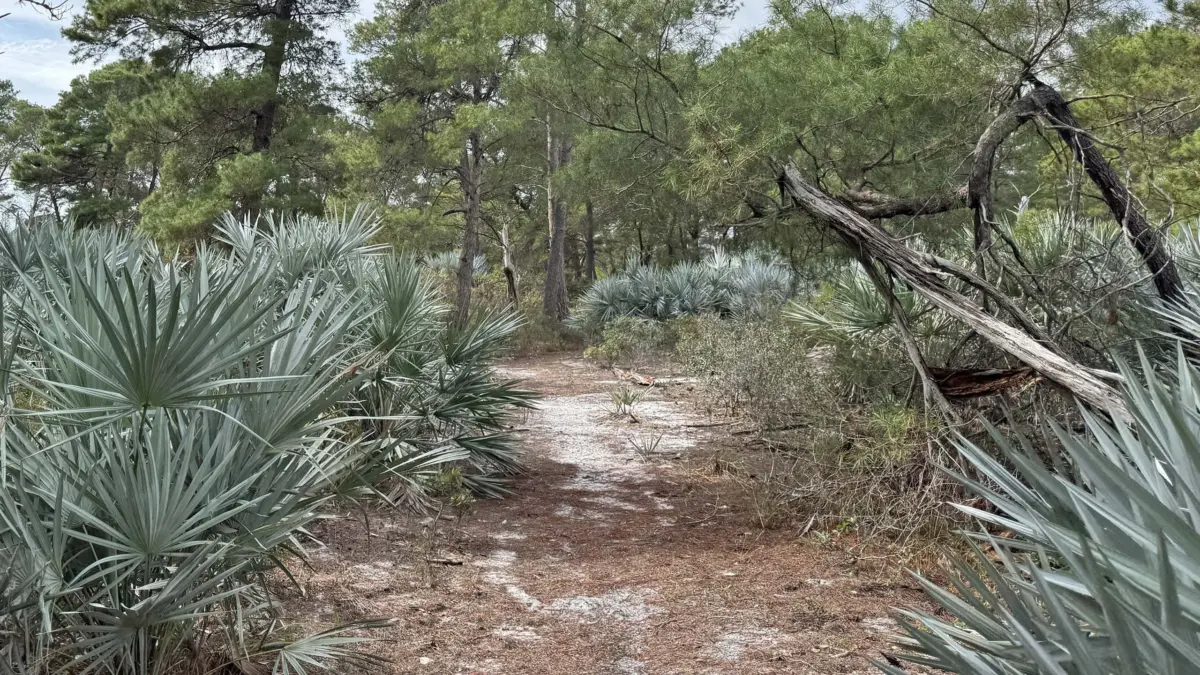
As the route cuts deeper into the interior, the corridor narrows, and the landscape shifts dramatically. Slender sand pines (Pinus clausa) rise vertically above a dense, shrubby underbrush, creating a dappled microclimate overhead. Beneath these trees lies the hallmark of the ancient dune system: stark, bleached white quartz sand.
This nutrient-poor, highly drained soil supports specialized plant communities that can withstand intense drought and blistering heat. Carpeting the bright white earth are dense mats of sand spikemoss (Selaginella arenicola), growing alongside delicate clusters of silkgrass and palafox.

As the path begins its transition toward the eastern boundary, the increasing density of the overhead canopy provides welcome partial shade. Here, the ground is thickly carpeted with a rustling layer of fallen pine needles, dampening footsteps and adding to the serene, secluded atmosphere of the preserve.
Seasonal Blossoms and the Heart of the Scrub
The ecological calendar at Lantana Scrub offers dynamic visual shifts depending on the time of year. In the vibrant spring months, hikers are greeted by the striking purple blossoms of the largeflower false rosemary (Conradina grandiflora). By the time autumn arrives, the landscape undergoes another chromatic shift as the vibrant yellow blooms of coastal honeycombhead (Balduina angustifolia) burst forth, creating striking botanical contrasts against the neutral tones of the sand.

At approximately the 0.1-mile mark, the trail departs from the wide, open firebreak, narrowing considerably as it steers participants directly into the heart of the dense scrub. This is arguably the most immersive portion of the entire trek. Expansive patches of silver saw palmettos (Serenoa repens) flank the footpath, their striking metallic-silvery fronds catching the tropical sunlight and contrasting sharply with the myriad shades of verdant green surrounding them.
Where the overhead canopy thickens sufficiently, large native airplants (Tillandsia species) can be observed clinging tenaciously to the crooked, weathered branches of aging scrub oaks and pines. These epiphytes draw moisture and nutrients entirely from the humid South Florida air rather than the soil below.

The Return Journey: Southbound and Westward
At the 0.3-mile mark, the trail executes a sharp turn to the south. For a brief interval, it tracks along a secondary management firebreak before smoothly curving back toward the west, initiating the final leg through the rolling sand pine forest.
The forest floor here is rich with botanical variety. Pungent Florida rosemary bushes (Ceratiola ericoides) release aromatic scents when brushed by a passing breeze, standing shoulder-to-shoulder with low-growing clusters of gopher apple (Licania michauxii)—a critical food source for local wildlife, including the imperiled gopher tortoise. Interspersed among the shrubs are resilient patches of sage-tinted deer moss, completing a complex matrix of groundcover adapted specifically to relict dune ecosystems.

As the odometer ticks past the 0.5-mile mark, the dense canopy slowly recedes. The loop successfully emerges from the shaded interior woods, depositing hikers safely back where they began: directly in front of the educational trailhead kiosk.
Supporting Context & Metrics
To assist visitors, researchers, and urban planners, the core operational parameters of the Lantana Scrub Natural Area are detailed below:

- Official Name: Lantana Scrub Natural Area
- Geographic Location: Lantana, Palm Beach County, Florida
- Total Trail Length: Approximately 0.5 miles (Loop configuration)
- Coordinates (Trailhead): 26.592639, -80.063194
- Physical Address: 1259 Southwinds Dr, Lantana, FL
- Admission Fees: Free and open to the public
- Operational Hours: Sunrise to Sunset, 365 days a year
- Restroom Facilities: None available on-site
- Prohibited Uses: Pets and bicycles are strictly prohibited to protect fragile ground-nesting wildlife and sensitive native plant roots.
- Primary Land Manager: Palm Beach County Department of Environmental Resources Management (ERM)
- Contact Information: 561-233-2400
Official Statements & Management Perspectives
The preservation of microscopic natural areas like Lantana Scrub represents a calculated philosophy within modern urban planning in South Florida. Urban conservationists and county officials emphasize that safeguarding small, isolated parcels of public land is just as crucial as protecting vast wilderness tracts.
In public outreach materials released by the Palm Beach County Department of Environmental Resources Management, representatives frequently highlight the necessity of active habitat management. Because these natural areas are completely surrounded by commercial and residential development, natural ecological reset mechanisms—most notably, periodic wildfires—cannot be allowed to burn uncontrolled.

Consequently, land managers employ sophisticated controlled burns, mechanical thinning, and targeted invasive species removal programs. These interventions mimic natural disturbances, ensuring that sunlight continues to reach the forest floor, thereby allowing sun-loving endemic species like the Florida rosemary and sand spikemoss to thrive without being choked out by aggressive, non-native vines or over-maturing hardwoods.
Future Outlook
As Palm Beach County continues to experience steady demographic growth and residential densification, natural preserves face mounting pressures from edge effects, stormwater runoff, and invasive species introduction. However, the outlook for the Lantana Scrub Natural Area remains remarkably positive due to strict county-level protections and active community stewardship.

Future initiatives by county environmental departments are expected to focus on enhanced educational programming, digital interpretive signage linked via QR codes at the trailhead kiosk, and continued botanical monitoring to track population health among rare and endemic species. Furthermore, Lantana Scrub serves as a shining anchor within a regional network of preserved green spaces, working in tandem with nearby natural gems such as the Lantana Nature Preserve, Hypoluxo Scrub, Rosemary Scrub, and High Ridge Scrub.
For residents and travelers seeking a quiet, immersive connection with untouched Florida history, Lantana Scrub stands ready. In just half a mile of walking, visitors step backward through centuries of geological and ecological evolution, experiencing firsthand the fragile, breathtaking beauty of Florida’s ancient dunes.

0 Comments