

Executive Overview
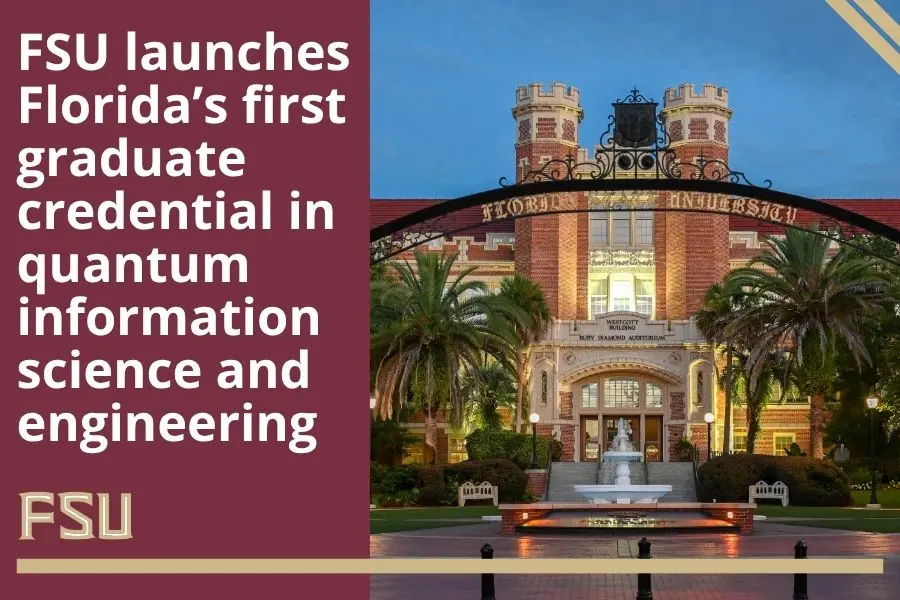
As the global technological landscape shifts toward unprecedented frontiers in computing, cryptography, materials discovery, and secure communications, Florida State University (FSU) is cementing its role as a national pioneer in high-tech education. FSU has officially announced the launch of Florida’s first formal graduate-level credential dedicated entirely to quantum information science and engineering (QISE).
Administered by the cross-disciplinary FSU Quantum Initiative, the newly established Graduate Certificate in Quantum Science & Technology is designed to bridge a critical skills gap in the global economy. By offering rigorous, multi-departmental training that spans quantum physics, theoretical chemistry, computer science, materials science, and advanced engineering, the program addresses the urgent demand for a specialized, highly skilled quantum workforce.
Applications for the inaugural Spring 2027 cohort are officially open, targeting both currently enrolled graduate students within science, technology, engineering, and mathematics (STEM) fields and working industry professionals eager to pivot or upskill into one of the 21st century’s most rapidly expanding commercial and strategic sectors.
The launch of this credential is far more than an academic milestone for the university; it represents a strategic alignment of regional educational assets, federal security priorities, and private-sector innovation. With institutional access to world-class facilities—including the renowned National High Magnetic Field Laboratory (MagLab) and the state-of-the-art Interdisciplinary Research & Commercialization Building—FSU is positioning itself at the epicenter of quantum development in the American Southeast.
Detailed Chronology: Building the Quantum Foundation at FSU
The creation of the Graduate Certificate in Quantum Science & Technology did not happen in a vacuum. It represents the culmination of a multi-year, highly calculated institutional strategy to pivot FSU into a powerhouse of quantum research and education.
Phase 1: Institutional Alignment and Infrastructure Growth
Over the past several years, FSU leadership recognized that traditional academic silos would be wholly inadequate for tackling the challenges of quantum mechanics and quantum engineering. The phenomenon of quantum superposition and entanglement transcends traditional boundaries, requiring physicists, chemists, materials scientists, and computer engineers to work in lockstep.
To address this, the university established the FSU Quantum Initiative, a cross-departmental hub designed to consolidate resources, foster interdisciplinary collaboration, and streamline grant acquisition. The initiative spans key departments, including Physics, Chemistry & Biochemistry, Computer Science, Mathematics, Materials Science & Engineering, Electrical & Computer Engineering, and Mechanical & Aerospace Engineering.
Phase 2: Strategic Faculty Expansion
Recognizing that cutting-edge curriculum requires cutting-edge minds, FSU leadership initiated a bold recruitment campaign. The university invested heavily in academic infrastructure, successfully hiring ten new faculty members specializing in various facets of quantum science and engineering. These scholars were strategically brought on board not only to bolster FSU’s research output but also to design and deliver pioneering courses capable of bridging multiple academic disciplines.
Phase 3: Facilities Integration
A premier quantum education program requires hardware capable of supporting low-temperature physics, nanofabrication, and precision measurement. FSU leveraged its existing world-class infrastructure to support the new certificate. Students in the program will gain direct access to:
- The National High Magnetic Field Laboratory (MagLab): The world’s premier high-magnetic-field laboratory, providing unparalleled environments for studying quantum materials under extreme magnetic conditions.
- The Interdisciplinary Research & Commercialization Building (IRCB): A cutting-edge facility equipped with advanced cleanrooms, nanofabrication suites, and specialized dilution refrigerators necessary for conducting foundational low-temperature quantum experiments.
Phase 4: Program Approval and Market Rollout
Following months of curriculum development—drawing courses from both the FSU College of Arts and Sciences and the FAMU-FSU College of Engineering—the program received official clearance. In late 2026, the university opened the application portal for the Spring 2027 semester, establishing an initial application deadline of October 1, 2026, for prospective students and industry professionals.
Supporting Context & Metrics: The Imperative for a Quantum Workforce
To understand the profound significance of FSU’s new graduate certificate, one must examine the broader macroeconomic and geopolitical landscape governing quantum technologies today.
The Economic Horizon of the 21st Century
Quantum information science is rapidly transitioning from theoretical physics to applied industrial engineering. Major global technology firms, defense contractors, and specialized startups are investing billions of dollars into developing quantum computers capable of solving complex problems in seconds—tasks that would take classical supercomputers thousands of years.
Beyond computing, quantum technologies are revolutionizing:
- Quantum Sensing: Enabling ultra-precise gravitational, magnetic, and inertial navigation systems independent of GPS.
- Quantum Communication: Delivering unhackable encryption protocols via Quantum Key Distribution (QKD) to secure national defense and financial infrastructure.
- Quantum Materials: Accelerating the discovery of novel pharmaceuticals, superconductors, and high-efficiency catalysts through quantum-level chemical simulation.
The Global Talent Shortage
Despite exponential capital injection into the quantum sector, industry leaders consistently cite a single, crippling bottleneck: workforce scarcity. There are simply not enough graduates trained in the cross-disciplinary realities of quantum control, cryogenics, quantum error correction, and quantum algorithm design.
By launching a credential that accepts both traditional graduate students and external post-baccalaureate industry professionals, FSU is directly addressing this talent drought. The program offers a pragmatic, rigorous pathway for software engineers, traditional physicists, and corporate technologists to retool their skills without necessarily committing to a multi-year doctoral program.
A Comprehensive Educational Pipeline
FSU’s vision extends beyond the graduate level. University leadership has articulated a long-term strategy that builds a comprehensive "quantum pipeline." While the new graduate certificate serves the immediate high-end workforce demand, FSU already offers introductory quantum computing coursework tailored for undergraduate students and advanced high schoolers. Future plans include formalizing undergraduate and pre-college programs, ensuring that Florida fosters homegrown technical talent from an early age.
Official Statements: Leadership Perspectives
The announcement has drawn praise from across the university administration, highlighting the collaborative ethos required to build a modern STEM program.
"Quantum science is reshaping the future of computing, communication, materials, and national security, and Florida State University is positioning itself at the forefront of that transformation," said Stacey S. Patterson, FSU Vice President for Research. "This new graduate certificate reflects the strength of our research enterprise and our commitment to preparing students for the high-demand careers that will drive the next generation of discovery and innovation."
The interdisciplinary nature of the certificate relies heavily on the bridge between the liberal arts/sciences and technical engineering—a partnership championed by the deans of both participating colleges.
"Florida State University is an ideal place for students to pursue training in quantum science and technology because of the extraordinary breadth of expertise across our campus," noted Sam Huckaba, Dean of the FSU College of Arts and Sciences. "Students in this program will learn from faculty working at the cutting edge of physics, chemistry, materials science, mathematics, computer science, and related fields, while also benefiting from access to world-class research facilities. That combination of talent, infrastructure, and opportunity will prepare them to make meaningful contributions in a rapidly evolving field."
Echoing these sentiments, engineering leadership emphasized the impossibility of isolating quantum engineering within traditional academic boundaries.
"The most important challenges in emerging technologies cannot be solved within the boundaries of a single discipline," stated Suvranu De, Dean of the FAMU-FSU College of Engineering. "This certificate reflects the strength of the partnership between the College of Arts and Sciences and the FAMU-FSU College of Engineering, bringing together complementary expertise to prepare students for a future where quantum information science and engineering is transforming computing, sensing, communications, and enabling new approaches to materials discovery. It is exactly the kind of interdisciplinary collaboration needed to tackle fundamental scientific challenges and develop the quantum technologies of tomorrow."
Dr. Michael Shatruk, Professor of Chemistry and Biochemistry and Director of the FSU Quantum Initiative, underscored the practical urgency driving the initiative.
"Quantum information science is not just a frontier for research; it is becoming a foundation for the economy of the 21st century," said Shatruk. "With this certificate program, we are giving students in Florida the tools to be part of that future. And by reaching students at the undergraduate and high school levels, we will be planting those seeds early."
Future Outlook: What Lies Ahead for FSU and the Quantum Sector
As FSU prepares to welcome its first cohort for the Spring 2027 semester, the university is actively expanding its external partnerships. The FSU Quantum Initiative is currently forging direct relationships with leading quantum technology corporations, national laboratories, and federal research centers. These partnerships are designed to establish a robust internship and employment pipeline, ensuring that certificate recipients transition smoothly from academia into high-impact industry roles.
Furthermore, as federal funding for quantum initiatives continues to expand under national security and technological competitiveness legislation, FSU’s early entry into formal credentialing positions the institution to secure major multi-institutional research grants.
For students and professionals considering enrollment, the message is clear: the quantum revolution is no longer a distant theoretical horizon—it is an active commercial and industrial reality. Through this new graduate certificate, Florida State University is ensuring that the workforce of tomorrow is educated, equipped, and ready today.
Program Quick Facts:
- Credential: Graduate Certificate in Quantum Science & Technology
- Administering Body: FSU Quantum Initiative
- Participating Colleges: FSU College of Arts and Sciences & FAMU-FSU College of Engineering
- Target Audience: Current STEM graduate students and external post-baccalaureate professionals
- Upcoming Cohort: Spring 2027
- Application Deadline: October 1, 2026
- Official Website & Applications: FSU QIST Program Portal

0 Comments