
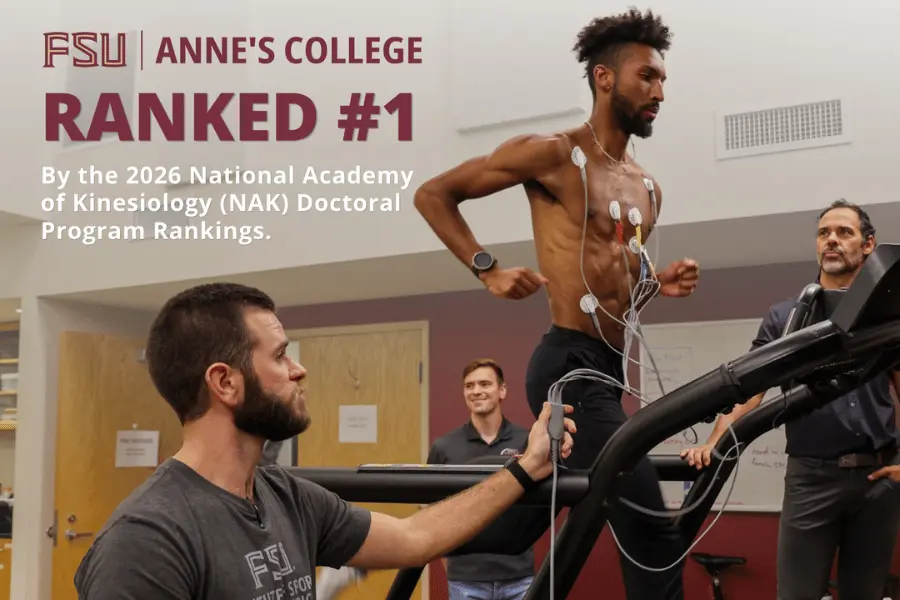

TALLAHASSEE, Fla. — In the fiercely competitive landscape of higher education and advanced scientific inquiry, few milestones carry as much institutional prestige as a consensus national ranking of excellence. For Florida State University (FSU), that milestone has officially been realized.
Rising steadily from the No. 3 spot in the 2023 evaluations, FSU’s doctoral program in kinesiology has claimed the No. 1 ranking nationwide in the latest National Academy of Kinesiology (NAK) report. Housed within the Anne Spencer Daves College of Education, Health, and Human Sciences—affectionately and colloquially known as "Anne’s College"—the program’s ascent is more than just a victory for a single academic department. It represents a watershed moment for the university’s broader health sciences infrastructure, marking the first time a program associated with the ambitious FSU Health initiative has captured the top spot in the country since the initiative’s inception.
The triennial NAK evaluation, which scrutinized performance data spanning from 2023 through 2025 across 39 participating tier-one research universities, paints a portrait of an academic powerhouse operating at the absolute zenith of its capabilities. Far from a marginal victory, FSU achieved staggering marks in multiple categories, placing in the 100th percentile nationally for doctoral student publications, full financial support for students, graduates securing coveted tenure-track faculty positions, and faculty-authored books.
Executive Overview: A Paradigm Shift in Human Performance Research
The field of kinesiology—broadly defined as the scientific study of human movement, physical activity, and its impact on health, society, and quality of life—has evolved far beyond traditional notions of physical education and athletic training. Today, it stands at the intersection of molecular biology, neuroscience, biomechanics, public health, and clinical medicine.
FSU’s doctoral program has positioned itself at the vanguard of this evolution. By fostering an ecosystem where rigorous theoretical research meets pragmatic, real-world application, the department has managed to outpace historical institutional heavyweights in the NAK index.
The report measures a comprehensive suite of key performance indicators, including:
- Total and per-capita research expenditures.
- Faculty publication productivity and citation impact.
- Leadership roles held by faculty within national and international professional organizations.
- The prevalence of esteemed NAK Fellows among the teaching and research faculty.
- Student-led research output and post-graduation career placement trajectories.
By excelling across virtually every metric, FSU demonstrated that its rise to the top was not the result of a single anomalous breakthrough, but rather the manifestation of a deeply embedded, sustainable culture of institutional excellence.
Detailed Chronology: The Asccent to the Top
To understand how FSU achieved the No. 1 ranking, one must look at the deliberate trajectory of growth and strategic investment that characterized the years leading up to the 2026 NAK report.
The 2023 Baseline: Laying the Groundwork
When the NAK released its previous rankings in 2023, FSU’s kinesiology doctoral program secured a formidable No. 3 spot. While this position affirmed the university’s status as a top-tier research institution, university leadership—including Dean Damon Andrew and departmental chairs—recognized that breaking into the top two or claiming the top spot entirely would require scaling up research infrastructure, enhancing recruitment pipelines for elite doctoral candidates, and increasing federal grant acquisitions.
The 2023–2025 Reporting Window: Accelerating Output
During the three-year evaluation window that followed, the department entered a period of unprecedented academic productivity. Faculty and students alike capitalized on newly expanded laboratory spaces, advanced biomechanical capture technologies, and cross-disciplinary collaborations facilitated by the launch of FSU Health in 2022.
Key milestones during this window included:
- The Surge in External Funding: Kinesiology faculty successfully secured upwards of $21.6 million in federal research funding, enabling deep dives into areas ranging from muscular adaptation and aging to neuro-rehabilitation and sports-related concussions.
- Prolific Publishing: Doctoral students alone produced 105 peer-reviewed journal articles, while faculty members contributed an additional 336 publications to top-tier scientific journals.
- Exceptional Mentorship & Placement: The program maintained a relentless focus on professional development, ensuring that graduates were not only well-versed researchers but also premier candidates for academia. This strategy paid massive dividends, with 14 graduates securing tenure-track faculty positions during the reporting period alone—a feat that placed FSU in the 100th percentile nationally for academic job placement.
Supporting Context & Metrics: Breaking Down the Numbers
The raw data compiled in the 2026 NAK report underscores the depth of FSU’s dominance. In higher education rankings, institutions frequently trade strengths—one university might boast high funding while struggling with student placement, or vice versa. FSU, however, demonstrated across-the-board superiority.
The 100th Percentile Pillars
- Doctoral Student Publications: FSU doctoral candidates operate less like traditional students and more like junior scientists. Their collective output of 105 peer-reviewed articles during the evaluation cycle propelled the program into the 100th percentile for student publishing productivity.
- Full Financial Support: Recognizing that top-tier talent requires financial stability to thrive, FSU ensured that 100% of its doctoral students received full financial support (including tuition waivers and competitive stipends). This eliminated economic barriers to entry and allowed students to dedicate themselves fully to their dissertations and research projects.
- Tenure-Track Placement: The ultimate test of a doctoral program is the professional success of its alumni. FSU’s placement rate for tenure-track positions sat comfortably in the 100th percentile, proving that institutions across the country actively seek out FSU graduates to lead their own academic departments.
- Faculty-Authored Books: Beyond journal articles, FSU faculty members were prolific contributors to foundational academic literature, placing in the 100th percentile for published books that shape curricula worldwide.
Research Productivity and Leadership
In addition to these top-percentile markers, FSU established itself as a national leader in several other heavily weighted NAK categories:
- Postdoctoral Placements: Graduates frequently earned prestigious postdoctoral fellowships at premier medical centers and research universities.
- Keynote Presentations: Faculty members were regularly invited to deliver keynote addresses at international scientific congresses, cementing FSU’s reputation as a global thought leader in human movement science.
Official Statements: Perspectives from University Leadership
The announcement of the No. 1 ranking reverberated through the halls of Anne’s College and across FSU’s main campus in Tallahassee, drawing praise from top administrators who viewed the achievement as validation of a shared vision.
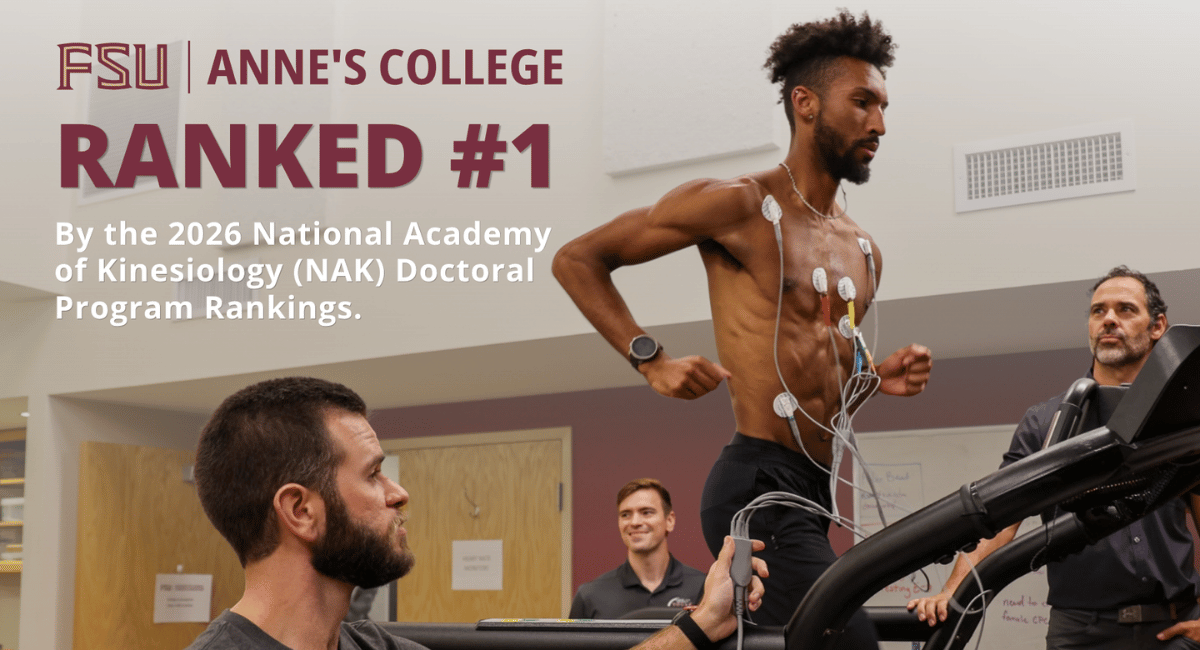
Damon Andrew, dean of the Anne Spencer Daves College of Education, Health, and Human Sciences, expressed profound pride in the community that built the program.
"We are incredibly proud to be recognized as the nation’s top kinesiology doctoral program," Dean Andrew stated. "This ranking reflects the outstanding work of our faculty and students and the culture of excellence that defines our program. Together, they are advancing research, shaping the future of the field, and strengthening the FSU Health initiative through leadership in the field of kinesiology."
Andrew emphasized that the program’s success is cyclical, driven by a self-sustaining ecosystem of talent and mentorship:
"This recognition reflects the strength of the people who make our program exceptional. Our faculty attract talented students who want to work alongside leaders in the field, and those students go on to make meaningful contributions through their research, scholarship, and professional success. That cycle continues to strengthen our program."
The Broader Impact: Propelling the FSU Health Initiative
To view the kinesiology department’s achievement in a vacuum would be to miss the broader strategic puzzle of Florida State University’s evolution.
Launched in 2022, FSU Health was conceived as an integrated academic health system designed to bridge the gaps between hospitals, practicing physicians, regional clinics, and university-level scientific research. The initiative represents a generational investment in Florida’s healthcare infrastructure and economic viability, aiming to translate laboratory discoveries into direct clinical treatments and community wellness programs.
Because kinesiology directly addresses chronic disease prevention, rehabilitation, physical therapy, and the physiological impacts of aging, it serves as a cornerstone of the FSU Health portfolio. Claiming the No. 1 national ranking provides the initiative with immediate national credibility, proving that FSU is not merely planning for a healthier future—it is already home to the premier intellectual capital leading the charge.
Inside Anne’s College and the Institute of Sports Sciences and Medicine
The institutional home of this academic triumph, the Anne Spencer Daves College of Education, Health, and Human Sciences, is a multidisciplinary hub housing world-renowned scholars across a vast spectrum of human performance disciplines.
Faculty expertise within the college spans:
- Athletic Training & Coaching
- Exercise Physiology
- Sports Nutrition and Dietetics
- Sport Sciences & Biomechanics
- Sport Management
- Sport Psychology
A significant driver of the doctoral program’s research output is the FSU Institute of Sports Sciences and Medicine (ISSM). Housed within the college, the ISSM brings together interdisciplinary researchers who study everything from cellular adaptations to high-intensity training to the prevention of metabolic diseases. By granting doctoral students unfettered access to the ISSM’s state-of-the-art laboratories, FSU ensures that its graduates possess hands-on, translational research experience that sets them apart in the global job market.
Future Outlook: Sustaining the Gold Standard
Reaching the summit of the National Academy of Kinesiology rankings is a monumental achievement; however, the greater challenge facing Florida State University now lies in sustaining that position.
In higher education, rival institutions—many of them multi-billion-dollar endowment holders in the Association of American Universities (AAU)—will inevitably look to restructure their own programs to challenge FSU’s supremacy in the next triennial evaluation cycle. Yet, university leadership remains confident.
With the ongoing expansion of FSU Health, sustained federal grant funding exceeding $21.6 million, and a continuous influx of top-tier doctoral applicants drawn to work with the nation’s leading faculty, FSU’s kinesiology department is well-positioned to defend its crown.
As the boundaries between exercise science, preventive medicine, and human longevity continue to blur, Florida State University has firmly established itself not just as a participant in the conversation, but as the institution writing the textbook for the future of human movement.

0 Comments