

Executive Overview
For most recreational anglers along the Atlantic seaboard, the peak of the mahi-mahi (dolphinfish, or Coryphaena hippurus) season is inextricably linked to the heat of the summer. Springtime brings the widely anticipated northward migration, drawing thousands of boats offshore from Palm Beach down through the Florida Keys. However, as July rolls around, these massive schools push past the Mid-Atlantic and Northeast, leaving many South Florida marinas quiet and local anglers hanging up their offshore gear for the year.
Yet, those who stay on the water—and those willing to brave the cooler, less crowded seas of autumn—are treated to one of the region’s best-kept secrets: South Florida’s second mahi season. Materializing reliably around mid-September and running strong through October, this fall run offers a completely different dynamic than its spring counterpart.
Rather than chasing frantic, highly pressured fingerling schoolies, autumn anglers frequently encounter larger, heavier fish. It is not uncommon for a 20- to 30-pound bull or cow to surprise an unsuspecting angler during this window. Coupled with a significant drop in recreational boat traffic, particularly throughout the Florida Keys, the fall mahi fishery provides a world-class angling experience defined by solitude, productivity, and oversized fish.
Maximizing this season requires more than just pointing a bow offshore and hoping for the best. Success demands a sophisticated understanding of oceanographic currents, satellite forecasting tools, and localized tactical adjustments tailored specifically to the unique behavior of autumn-run pelagics.
Detailed Chronology: Unraveling the Autumn Migration
Dispelling the Return-Migration Myth
For generations, conventional wisdom among South Florida captains suggested that the mahi caught in September and October were simply stragglers or returning schools making their way back south after their summer up north.
Recent oceanographic and biological indicators, however, have largely debunked this theory. Modern data points toward an entirely separate migration of fish pushing up from the Caribbean, riding the powerful, meandering highway of the Gulf Stream. Within the broader September-through-October window, the fishery typically features a high-intensity, two-week blitz of exceptional fishing, flanked by weeks of fair-to-good consistent action.
A Masterclass in the Marquesas
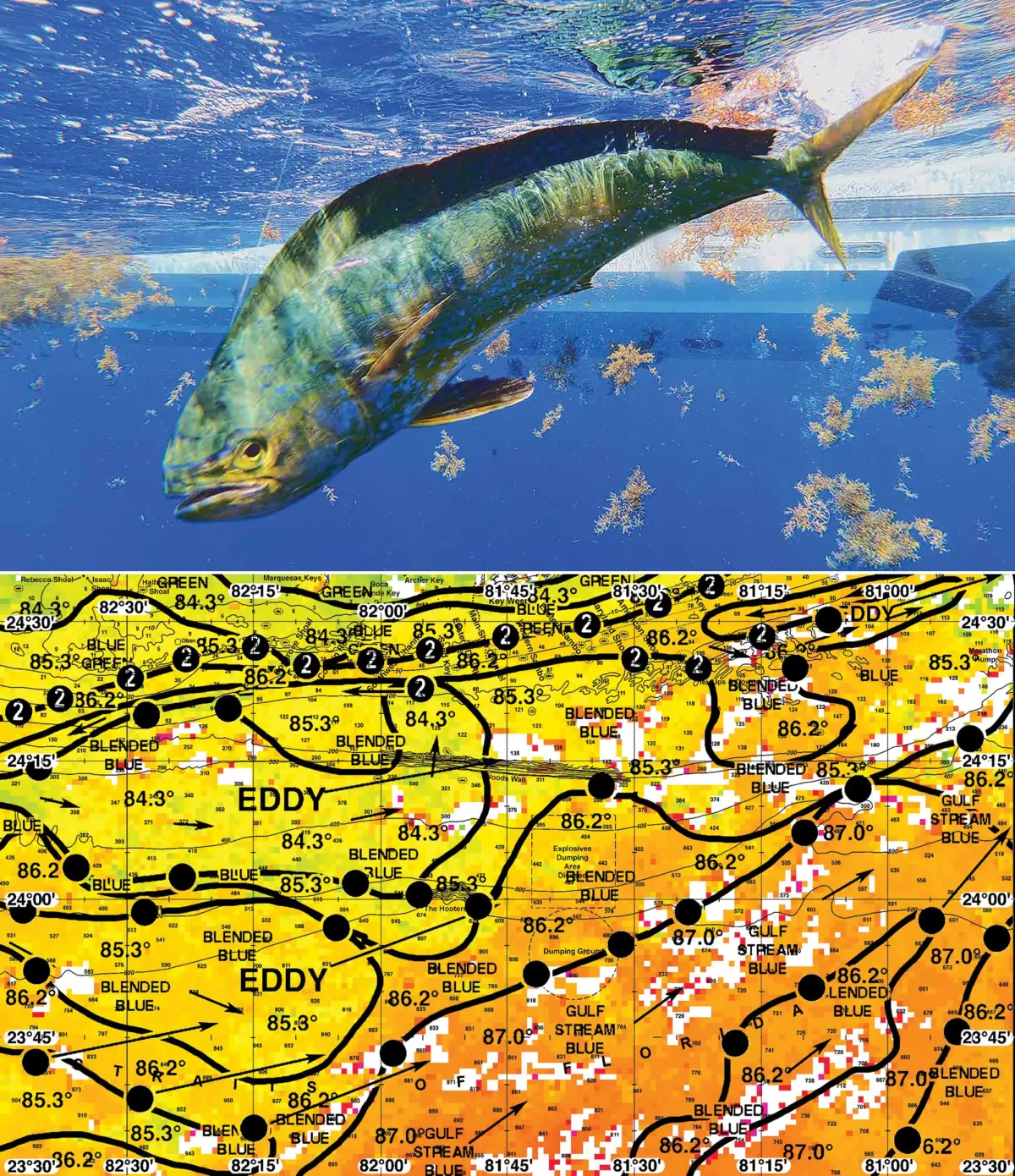
To understand how dynamic this fishery can be, one only has to look at accounts from seasoned professionals like legendary angler and TV host George Poveromo. Operating out of Cudjoe Key during an October shoot for World of Saltwater Fishing, Poveromo and his crew utilized advanced oceanographic forecasting to intercept a massive, productive eddy located 60 miles due south of the Marquesas in 800 to 900 feet of water.
Running west through an ocean that was otherwise devoid of life—showing zero weeds, flying fish, or diving birds—the vessel suddenly broke into an entirely different marine ecosystem upon reaching the outer perimeter of the eddy. The water shifted to a brilliant royal blue, flanked by massive weed lines, swarming flying fish, diving frigate birds, and aggressively feeding mahi.
Employing a combination of flat-line trolling and light-spin tackle cast directly to schoolies, the crew boxed a heavy cooler of quality fish well before the mid-afternoon mark. This expedition serves as a definitive blueprint for what October offshore fishing can yield when anglers align their efforts with precise oceanographic data.
Supporting Context & Metrics: Seven Keys to Autumn-Run Mahi Success
To replicate the success found in deep-water eddies and reef-line drop-offs, anglers must adhere to a strict tactical framework. The following seven strategies form the foundational playbook for conquering the autumn mahi run.
1. Master the Currents with Satellite Forecasters
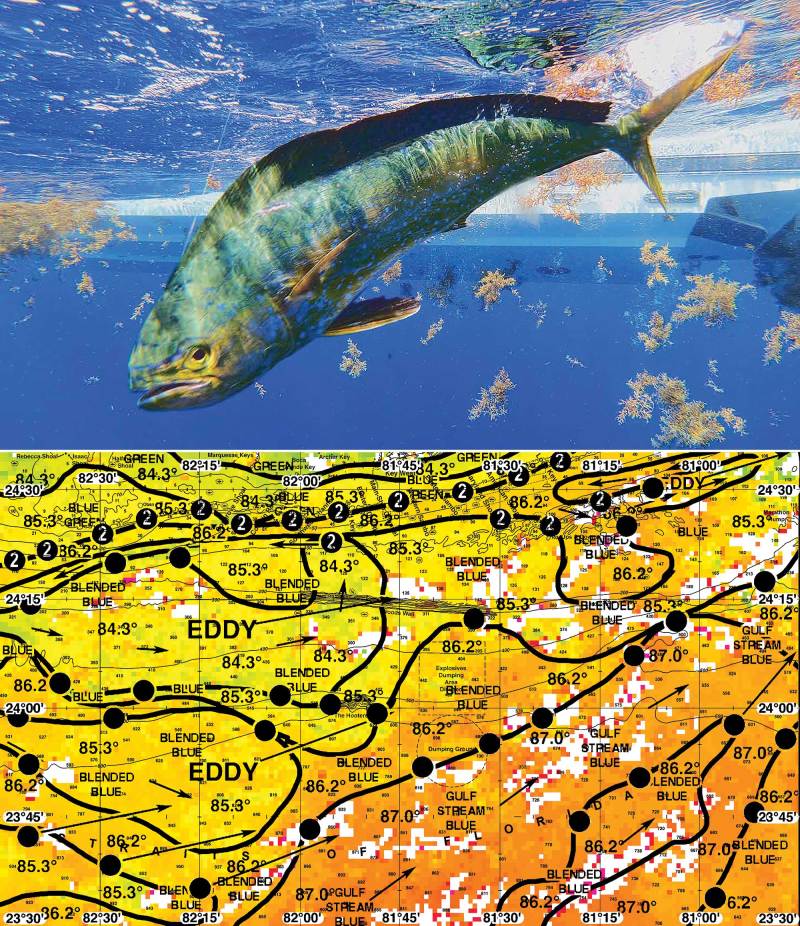
Fall mahi do not distribute themselves randomly across the Atlantic; they are tethered to the shifting boundaries of the Gulf Stream. Utilizing commercial fishing forecast services—such as ROFFS, Simrad’s FishCast, or SiriusXM Fish Mapping—is paramount.
These platforms reveal the true shoreward edges of the Gulf Stream as it snakes northward. Pay close attention to where the Stream pushes tight against or intersects the continental shelf and prominent deep-water bottom structures. These high-energy intersects trigger nutrient-rich upwellings that concentrate baitfish, which in turn draw hungry pelagics.
2. Read Eddies and Finger Projections
Just as a river bends and creates back-eddies, the Gulf Stream frequently calves off circular current features or pushes elongated "fingers" outward against the prevailing flow. These localized anomalies can park over deep water for days or weeks.
When an eddy or finger interacts with aggressive, irregular bottom topography, it creates a convergence zone that acts as a magnet for marine life. Targeting the outer edges and temperature breaks of these features is one of the fastest ways to locate unexploited schools of fall fish.
3. Seek Out Aged Flotsam
In the world of offshore fishing, the prevailing instinct is often to seek out clean, new weed lines. For autumn mahi, however, older, seasoned flotsam is vastly superior.
Debris that has spent weeks or months at sea accumulates a dense micro-ecosystem of marine growth, barnacles, and small crustaceans. This underwater growth serves as an all-you-can-eat buffet for micro-baitfish, which subsequently draws in predatory forage like flying fish and squids—and ultimately, cruising mahi.
4. Leverage Commercial Lobster Floats
From early August through March, the commercial lobster season in Florida, the Keys, and the Bahamas is in full swing. Countless thousands of trap floats mark the reef tracts and offshore ledges.
While dedicated offshore anglers typically ignore these inshore structures in favor of deep water, fall mahi frequently congregate around these very traps as the Gulf Stream-influenced currents push tight to the reef line. Running a spread past or closely examining these lobster floats during your transit out or back in can yield surprise catches of quality fish in relatively shallow water.
5. Hunt for Flying Fish and Plankton Concentrations
An ocean devoid of surface weeds and floating debris does not necessarily mean an ocean devoid of fish. Autumn anglers must train their eyes to spot flying fish scurrying across the surface while cruising offshore.
Because flying fish are a primary dietary staple for mahi, their presence is a definitive indicator of an active food web. When flying fish are sighted scatter-gunning across the surface, immediately transition into trolling mode and dedicate several hours to working that specific water. Additionally, look for heavy concentrations of plankton and high chlorophyll indices on satellite maps, as these nutrient soups sustain the forage base that apex predators hunt.
6. Utilize Radar and Binoculars for Bird-Tracking
Because active frigate birds, terns, and shearwaters are noticeably less abundant during the fall months compared to the height of summer, locating them visually requires extra effort.
Marine radar becomes an indispensable tool for identifying distant flocks of working birds long before they are visible to the naked eye. Coupled with high-end, image-stabilized marine binoculars, radar allows captains to spot the subtle dips and dives of feeding birds across vast expanses of water. When working birds are spotted, a rapid response—dragging ballyhoo around the fringes or pitching live baits, squid, and chuggers—will often yield strikes within seconds.
7. Cover Water Efficiently and Mind the Bycatch
Trolling remains the single most effective tactic for covering the vast stretches of water required to locate dispersed autumn mahi. When selecting your spread, match the size and color of your lures or rigged ballyhoo to the local flying fish population to counter any selective feeding behaviors exhibited by wary fish.
Furthermore, anglers must remain conscious of seasonal bycatch. Autumn in South Florida is prime time for blue marlin. Wherever concentrations of mahi are found feeding aggressively, apex predators like marlin are rarely far behind.
Captains are strongly advised to keep a heavy outfit—such as a 50-pound conventional setup rigged with a 300-pound fluorocarbon leader and a large circle hook—primed and ready on the bridge. Should a marlin materialize around a school of mahi, or if an angler wishes to free-line a fresh, live mahi as a pitch bait, the opportunity of a lifetime is only a cast away.
Official Insights & Expert Perspectives
Marine biologists and veteran charter captains alike emphasize that the autumn fishery represents a distinct ecological shift rather than a mere continuation of the summer run.
According to fisheries analysts tracking pelagic movements along the Florida Straits, the autumn influx is heavily dictated by shifting meteorological fronts. As the first strong cold fronts of September and October sweep down the peninsula, they compress coastal waters, alter wind directions, and push warm, nutrient-dense Caribbean water masses directly against the Florida reef tract.
Capt. George Poveromo highlights the human element of this seasonal transition:
"I love fall mahi fishing, especially throughout the Florida Keys. Fewer tourists and boats visit then, leaving more fish for the taking, and the sheer average size of the fish we see in September and October often rivals what we pull from offshore waters during the peak spring months."
This sentiment is echoed by marine forecasters who note that while the density of fish (the sheer number of schoolies) may occasionally be lower in the fall than in May, the quality—measured in pounds per fish—makes the autumn run a preferred window for serious meat-fish anglers and tournament competitors alike.
Future Outlook
Looking ahead, the management and preservation of South Florida’s pelagic fisheries remain subjects of ongoing discussion among conservationists and recreational stakeholders. While mahi stocks have historically experienced natural fluctuations driven by environmental conditions, shifting water temperatures, and bait availability, the autumn run continues to demonstrate remarkable resilience.
Advancements in marine electronics and satellite forecasting—such as real-time chlorophyl-a imaging, high-resolution altimetry, and advanced marine radar arrays—are giving modern anglers an unprecedented ability to read offshore habitats with surgical precision. As these technologies become more accessible to the recreational fleet, the mystique surrounding the open ocean is gradually being replaced by data-driven targeting.
For the modern South Florida angler, the message is clear: do not put your offshore gear away when the summer crowds dissipate. Mid-September through October unlocks a quiet, highly productive chapter on the water. By reading the currents, tracking the flotsam, and respecting the oceanographic nuances of the autumn Gulf Stream, anglers can secure not only a full cooler of prime fillets, but an unforgettable offshore experience.

0 Comments