

By Derrick Conover | Published: November 21, 2025
Categories: Agriculture, Crops, Horticulture | Tags: Agriculture, SV Ag Update
Executive Overview
As small- and medium-scale agricultural producers across North Florida increasingly seek viable avenues for crop diversification, blueberries have emerged as one of the region’s most promising specialty crops. Benefiting from a combination of mild regional winters, naturally acidic soils, and robust, expanding local markets, Columbia County is exceptionally well-positioned to support profitable commercial blueberry production.
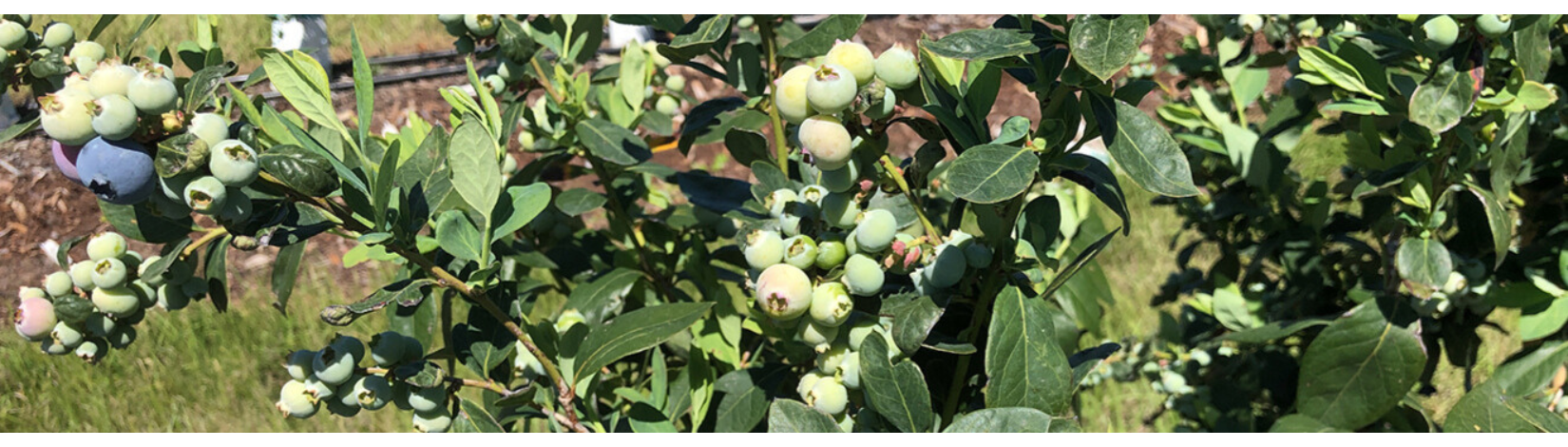
Whether an agricultural entrepreneur is looking to establish a single experimental acre or scale up an existing multi-acre farming operation, understanding the foundational requirements of this perennial crop is paramount. From selecting the right cultivars—such as Southern Highbush or Rabbiteye varieties—to mastering precision irrigation layouts, optimal plant spacing, and localized pest management, establishing a thriving blueberry patch demands careful, data-driven planning.
This guide provides Columbia County growers with a comprehensive, actionable roadmap for establishing, managing, and sustaining a productive and financially rewarding blueberry enterprise.
Detailed Chronology & Regional Advantage
Why Blueberries Thrive in North Florida
The historical and geographical profile of Columbia County makes it a natural sanctuary for the Vaccinium genus (blueberries). Over generations, local geological and climatic conditions have aligned to create an environment where these specialty crops can flourish with minimal synthetic soil modification.
- Soil Composition and pH Levels: Much of Columbia County features naturally sandy, organic-rich, and acidic soils. Blueberries require a distinctively low soil pH to efficiently uptake iron and other vital micronutrients. With local soil pH levels naturally hovering between 4.5 and 5.5, growers enjoy a distinct economic advantage, bypassing the extensive and costly soil acidification processes required in other regions.
- Favorable Chill Hours: Fruit tree and berry crop success heavily depends on satisfying winter chilling requirements to break dormancy and trigger uniform spring blooming. Columbia County generally records between 300 and 500 chill hours annually. This specific window is optimal for low-chill Southern Highbush cultivars and safely falls within the operational range for hardy Rabbiteye varieties, ensuring dependable seasonal cycles year after year.
- Robust Localized Markets: Proximity to direct-to-consumer avenues—ranging from the Lake City Farmers Market to thriving regional U-pick agritourism operations—provides growers with short supply chains and high profit margins. Consumers increasingly recognize and value fresh, locally grown berries, resulting in more reliable revenue streams compared to lesser-known or exotic specialty fruits.
- Scalability for New Growers: Depending on the chosen agronomic system and plant spacing, a single acre in Columbia County can successfully support anywhere from 600 to 1,500 blueberry plants. Consequently, many beginning producers choose to break ground with a manageable one-acre plot, refining their management techniques before scaling operations outward.
Supporting Context & Metrics: Variety Selection & Agronomic Systems
Choosing the correct blueberry variety is arguably the most critical decision a grower will make. Cultivar selection dictates harvest timing, target market pricing, labor requirements, and irrigation demands. Below is an in-depth breakdown of the primary varieties suited for Columbia County.
1. Southern Highbush Blueberries (Standard Production)
- Best For: Targeting early-season fruit production to capture premium market prices before the national supply glut hits.
- Popular Cultivars: ‘Emerald’, ‘Jewel’, ‘Meadowlark’, and ‘Suziblue’.
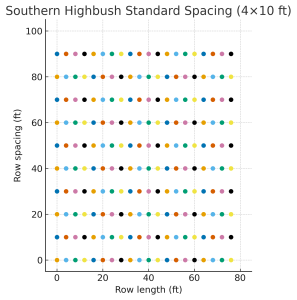
- Agronomic Profile: These cultivars have been bred specifically for low-chill environments like North Florida. They yield high-quality, large-sized berries that ripen early in the spring.
- Operational Challenges: Because of their shallow root systems and early bloom times, they are sensitive to late winter frosts and require rigorous, consistent moisture management.
2. High-Density Southern Highbush Systems
- Best For: Intensive, highly mechanized, and meticulously managed irrigated acreage aiming for maximum early yields per square foot.
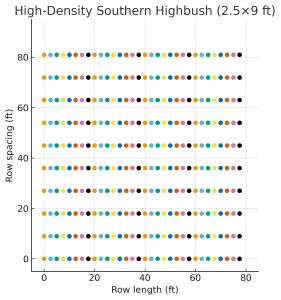
- Recommended Spacing: 2.5 feet × 9 feet.
- Operational Challenges: This high-density architecture accelerates early return on investment, but it leaves zero margin for error. Success relies entirely on uncompromised irrigation, aggressive weed control, and precision fertigation programs.
3. Rabbiteye Blueberries (Vaccinium virgatum)
- Best For: Low-input agricultural operations, organic growers, or farm sites lacking robust, permanent irrigation infrastructure.
- Popular Cultivars: ‘Climax’, ‘Brightwell’, and ‘Powderblue’.
- Agronomic Profile: Native to the American Southeast, Rabbiteyes are exceptionally vigorous, larger bushes that tolerate heavier soils and exhibit strong natural resistance to many common pests and diseases. Once established, they possess remarkable drought tolerance.
- Operational Challenges: They fruit later in the season when market prices typically trend lower, and the berries feature a slightly thicker skin and larger seeds than Southern Highbush varieties.
Irrigation Considerations & Infrastructure Management
Water management represents the lifeblood of any commercial blueberry operation in Columbia County. Given the region’s propensity for unpredictable dry spring spells—coupled with changing precipitation patterns observed over recent growing seasons—relying solely on natural rainfall is a high-risk gamble.
- Microjet and Drip Systems: For Southern Highbush plantings, microjet or advanced drip irrigation systems are strongly recommended. Drip lines ensure uniform moisture delivery directly to the root zone, drastically reducing weed growth between rows while conserving water resources.
- Fertigation Integration: Utilizing advanced irrigation infrastructure allows growers to implement fertigation—the practice of injecting water-soluble nutrients directly through the irrigation system. This ensures that nitrogen, phosphorus, potassium, and micronutrients are delivered precisely when the plants demand them during vegetative flush and fruit development stages.
- Rabbiteye Resilience: While established Rabbiteye varieties can survive on natural rainfall during normal years, integrating supplemental irrigation lines remains best practice. Consistent watering during fruit sizing phases directly correlates with heavier yields, plumper berries, and higher pack-out percentages.
Future Outlook & Economic Sustainability
The long-term economic outlook for commercial blueberry production in Columbia County remains exceptionally bright. As consumer demand for fresh, nutrient-dense local produce continues to outpace national supply chains, regional growers who leverage agritourism, farmers markets, and wholesale cooperative channels are finding sustainable profitability.
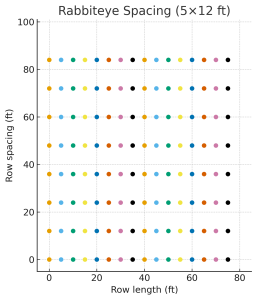
However, entering the specialty crop sector requires disciplined planning. Long-term success is contingent upon:
- Precise Site Assessment: Testing soil pH and organic matter prior to ordering rootstock.
- Strategic Variety Diversification: Planting a mix of early-season Southern Highbush and mid-to-late season Rabbiteyes to extend the harvest window and mitigate weather-related market risks.
- Proactive Crop Management: Committing to rigorous weed suppression, integrated pest management (IPM), and uninterrupted irrigation protocols.
With thoughtful planning, meticulous attention to agronomic spacing, and disciplined resource management, blueberries can serve as a cornerstone crop, delivering reliable yields and robust financial returns for Columbia County growers for decades to come.

0 Comments