

By Derrick Conover
Published: March 18, 2026
Category: Agriculture / Crops
Executive Overview
Agricultural producers across Columbia County and the broader North Florida region are grappling with a precarious intersection of extreme weather phenomena. As the area experiences what local agricultural authorities hope will be the final cold front of the season, the timing of these volatile temperature swings has placed immense stress on local farming operations. Occurring at one of the most sensitive junctures in the annual agricultural calendar—just as perennial fruit trees break dormancy and spring row crops are actively emerging or being planted—this narrow, high-stakes window leaves little margin for error. Even brief incursions of sub-optimal temperatures can severely compromise crop performance, impair physiological development, and drastically degrade ultimate yield potential.
Compounding the immediate frost threat is an ongoing, persistent drought gripping the state. When late-season cold fronts collide with abnormally dry soils, the resulting microclimatic and physiological stresses are mutually reinforcing, turning what might otherwise be a manageable weather blip into a compounding crisis. For local growers of peaches, blueberries, watermelons, sweet corn, and various warm-season vegetables, managing this dual-threat environment requires hyper-vigilance, strategic soil-moisture management, and an unyielding readiness to implement last-minute protective measures.
This comprehensive report examines the physiological mechanics of late-season cold injury, the compounding perils of concurrent drought conditions, the distinct challenges facing orchardists versus row-crop farmers, and the critical management strategies essential for safeguarding North Florida’s agricultural economy.
Detailed Chronology: The Anatomy of a Late-Season Weather Shock
The arrival of the mid-March cold front in Columbia County serves as a stark reminder of the vulnerabilities inherent in agricultural production cycles. To fully comprehend the gravity of these temperature fluctuations, one must examine how the vulnerability of plant tissue evolves over a seasonal timeline.
Phase 1: Winter Dormancy and Declining Cold Tolerance
During the depths of winter, deciduous fruit trees and perennial crops enter a state of deep physiological dormancy. In this resting phase, cellular water content is tightly regulated, and metabolic processes slow to a crawl, allowing crops such as peaches, plums, and blueberries to withstand severe freezing temperatures with little to no structural damage.
However, as daylight hours lengthen and ambient temperatures begin an upward trajectory in late winter, these perennial crops break dormancy. Buds swell, internal moisture shifts, and the plant mobilizes energy reserves to initiate spring growth. Unfortunately, this transition triggers a rapid, sharp decline in cold tolerance. Tissues that could effortlessly endure hard freezes in January become acutely sensitive to even modest frosts by mid-March.
Phase 2: The Vulnerable Bloom Window
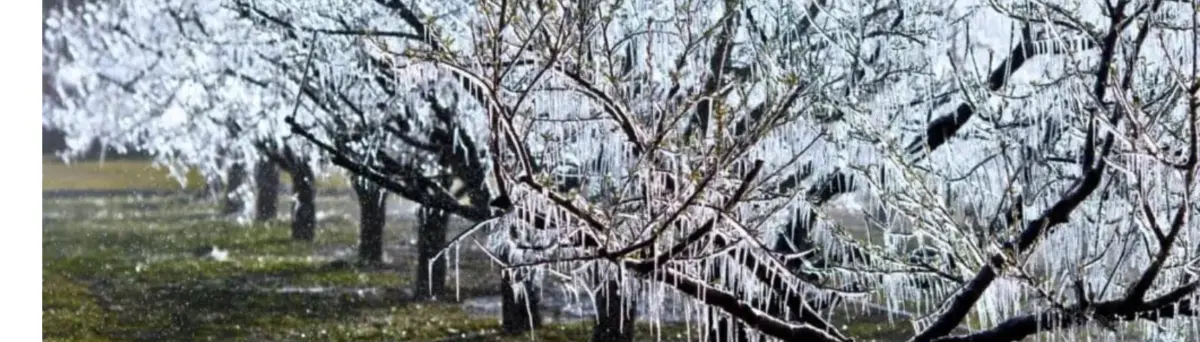
Once fruit trees enter the bloom stage, their reproductive organs are fully exposed to the elements. For stone fruit and berry producers in North Florida, the opening of blossoms marks a period of maximum vulnerability. A light, transient frost—temperatures dropping just below freezing for a matter of hours—can ice-crystalize fragile reproductive tissues, including the pistil, style, and ovary.
The damage is frequently insidious. In many cases, agricultural damage is not immediately visible to the naked eye. Flowers may retain a deceptively normal outward appearance for days following a freeze event, lulling growers into a false sense of security. Beneath the surface, however, internal cell death has occurred, rendering the flower incapable of fertilization. Days later, the blossoms drop, or the fruit fails to set entirely, resulting in devastating economic losses.
Furthermore, these low-temperature events introduce a secondary ecological hurdle: pollinator suppression. Honeybees and native pollinators are cold-blooded creatures that drastically reduce their foraging activity under cool, cloudy, or windy conditions—precisely the atmospheric profile that accompanies many late-season cold fronts. Even if a blossom survives a minor frost unscathed, the concurrent absence of active pollinators during a critically narrow flowering window severely restricts successful cross-pollination, compounding the yield penalty.
Phase 3: Physiological Stagnation and Cumulative Stress
Beyond direct cellular injury and bloom failure, cold weather induces a broader physiological slowdown in perennial trees. Leaf-out is delayed, bloom periods are artificially and erratically extended, and fruit development rates plummet.
An extended, stuttering bloom period actually increases systemic risk by stretching the window of vulnerability. Instead of a single, uniform cohort of flowers facing a single frost risk, trees may push blooms in waves, exposing successive rounds of tender tissue to lingering cold snaps. This repeated physiological stress drains the tree’s stored carbohydrate reserves. The long-term consequences extend well beyond the current harvest; depleted carbohydrate reserves can stunt tree vigor, compromise structural health, and diminish productivity and bud set for the following growing season.
Supporting Context & Metrics: Row Crops and the Soil-Moisture Matrix
While orchardists contend with arboreal freeze dynamics, North Florida row-crop producers face a distinctly different, yet equally formidable, set of logistical and physiological challenges. Spring-planted commodities—including watermelons, sweet corn, and assorted commercial vegetables—rely heavily on warm, stable soil environments to drive rapid germination and vigorous early root establishment.
+---------------------------------------------------------------------------------+
|                         THE FROST-DROUGHT AMPLIFICATION                         |
|                                                                                 |
|   [ DRY SOILS ]  ===>  Low Heat Capacity  ===>  Rapid Nocturnal Cooling         |
|                                                                                 |
|   [ RESULT ]     ===>  Lower Near-Ground Temperatures  ===> Severe Frost Injury |
+---------------------------------------------------------------------------------+
Germination Bottlenecks and Early Stand Establishment
When cold fronts sweep through while seeds are in the ground or early seedlings are pushing through the surface, germination rates stall. Cold, dense soils delay emergence, resulting in uneven stands across a field.
For high-value crops like watermelons, where field uniformity is paramount for efficient, synchronized harvesting and optimal sizing, crop variability translates directly into economic loss. Uneven maturity complicates weed and pest management, interferes with irrigation scheduling, and dilutes market value at harvest.

Pathological Pressures: Cold, Wet, and Vulnerable
Paradoxically, while drought dominates the broader regional climate, localized irrigation and spring weather variability often create damp microclimates at the soil surface. Cold, damp conditions are a primary breeding ground for soil-borne pathogens.
Seedlings under cold stress experience delayed cuticle development and sluggish cell division, making them sitting ducks for fungal pathogens. Diseases such as Pythium and Rhizoctonia thrive in cool, marginal soils, rapidly causing seed decay, seedling blight, and "damping-off"—a condition where young stems rot at the soil line, resulting in catastrophic plant population loss.
Transplant Shock and Pest Vulnerability
For crops established via vegetative transplants rather than direct seeding, cold weather exacerbates transplant shock. Low ambient and soil temperatures inhibit root growth, preventing the root system from anchoring and functioning efficiently.
This prolonged lag in early growth leaves young plants in a chronic state of physiological stress. Weakened plant tissues emit chemical signals that readily attract opportunistic pests and diseases, forcing growers into aggressive, costly defensive treatments simply to keep young stands alive.
The Drought Multiplier Effect
The severity of any cold event is intensely mediated by soil moisture conditions. Florida’s ongoing drought has created a high-risk baseline across many agricultural counties.
From a thermodynamic perspective, soil moisture acts as a crucial thermal buffer. Moist soils possess a high heat capacity; they absorb and store substantial thermal energy from solar radiation throughout the day and release that heat slowly into the near-ground atmosphere during the night. This natural buffering effect can elevate ambient microclimate temperatures by several critical degrees right at the canopy level, often preventing air temperatures from crossing the freezing threshold.
Conversely, dry soils exhibit a low heat capacity. They heat up quickly under the sun but radiate that heat away almost instantly after sunset. As a result, dry fields experience much sharper nocturnal temperature drops, generating severe, localized microclimates where frost forms intensely and lingers longer.
In practical terms, two adjacent farms experiencing identical regional air forecasts can suffer wildly divergent frost damage outcomes based solely on their soil moisture status. For North Florida growers, agricultural drought must be factored in not merely as a water-deficit crisis, but as an immediate risk multiplier for frost injury.
Official Statements and Expert Guidance
Agricultural extension specialists and industry leaders emphasize that while growers cannot control regional weather patterns, proactive management can meaningfully alter damage outcomes.
Derrick Conover, agricultural extension expert and author of the local advisories guiding Columbia County producers, underscores the critical need for situational awareness during these transitional weeks:
"These temperature swings come at a particularly sensitive time in the production cycle… The result is a narrow window where even brief periods of cold weather can have negative impacts on crop performance and yield potential."
Highlighting the mechanics of field-level microclimates, extension authorities point out that soil management is a potent defensive weapon. Where water availability permits, pre-irrigation prior to a forecasted cold event remains one of the most effective traditional mitigations. By ensuring soils are adequately hydrated before sunset, growers can maximize the soil’s thermal storage capacity, thereby dampening the severity of the nocturnal temperature plunge.
Furthermore, extension entomologists and horticulturists advise growers to closely monitor localized weather data networks—such as the Florida Automated Weather Network (FAWN)—rather than relying solely on regional broadcast forecasts. Microclimates vary dramatically across rolling terrain, low-lying frost pockets, and varying soil types within the same county.
Future Outlook: Risk Management in a Changing Agricultural Climate
As agricultural producers look toward the remainder of the spring season and plan for future production cycles, the overarching takeaway is the imperative of resilience and adaptability.
Key Strategic Recommendations for Growers:
- Intensive Monitoring: Maintain continuous tracking of hyper-local soil and air temperature sensors, utilizing real-time data platforms to anticipate frost thresholds hours before they occur.
- Proactive Soil Hydration Management: Leverage pre-event irrigation strategically in drought-affected blocks to capitalize on soil thermal mass, counteracting the rapid nocturnal cooling characteristic of dry earth.
- Staggered Planting and Cultivar Selection: Where feasible, stagger planting dates for sensitive row crops to hedge against sudden, late-season cold fronts. Consider incorporating cold-hardier rootstocks and cultivars bred for environmental plasticity.
- Post-Event Recovery Protocols: Following a frost event, avoid aggressive fertilization or immediate heavy pruning of damaged perennial crops. Allow plants time to naturally delineate between living and dead tissue to avoid inducing additional physiological shock.
- Integrated Pest Management (IPM) Readiness: Anticipate heightened vulnerability in cold-stressed crops by scouting early for opportunistic pests and secondary fungal infections, ensuring rapid intervention before infestations spread.
The intersection of late-season cold fronts and persistent drought represents a formidable test of agricultural endurance in Columbia County. However, by combining rigorous meteorological monitoring, tactical soil moisture management, and a deep understanding of crop physiology, North Florida growers can navigate these high-stakes weather shocks and protect their harvest potential for the season ahead.

0 Comments