

By Derrick Conover
Published: March 18, 2026
Executive Overview
Agricultural producers across Columbia County and the broader North Florida region are navigating a precarious start to the growing season, grappling with a volatile convergence of extreme weather phenomena. This week delivered what local growers hope will be the final late-season cold front of the spring. While temperature fluctuations are a standard feature of seasonal transitions, this year’s shifts have arrived at a uniquely vulnerable juncture in the agricultural production cycle.
Perennial fruit trees are rapidly breaking winter dormancy and entering the sensitive stages of bud break and bloom, while early-season row crops are simultaneously being established in fields or emerging from the soil. This creates an unforgiving biological window where even brief, marginal drops in temperature can trigger devastating physiological setbacks, compromising crop performance, lowering quality, and severely degrading total yield potential.
Compounding the immediate threat of frost is a persistent, underlying drought gripping the region. While agronomists often treat drought and frost as independent environmental stressors, their physiological and microclimatic impacts are deeply intertwined. Dry soils lack the thermal mass and moisture required to buffer against plummeting nighttime temperatures, creating a localized radiative environment that intensifies near-ground frost severity.
For commercial producers of peaches, blueberries, watermelons, sweet corn, and tender vegetables, this compounded stress regime threatens profit margins and food supply chains alike. As agricultural extension specialists urge heightened vigilance, local growers must reckon with a shifting climate pattern that demands advanced risk management, precise irrigation strategies, and proactive frost mitigation tactics.
Detailed Chronology: The Anatomy of a Late-Season Weather Event
The arrival of the mid-March cold front did not occur in a vacuum; rather, it represents the culmination of a broader seasonal transition marked by unseasonable warmth followed by abrupt thermal crashes. To understand the gravity of the recent temperature drop, one must examine the precise physiological timeline of Columbia County’s primary agricultural commodities.
The Fruit Tree Transition: From Dormancy to Vulnerability
During the depth of winter, deciduous fruit crops such as peaches, nectarines, and blueberries exist in a state of physiological rest known as dormancy. In this hardened state, these plants can withstand sub-freezing temperatures—often well below 32°F—with negligible internal injury. Cellular water is tightly regulated, and vital metabolic processes are slowed to a defensive crawl.
However, as ambient temperatures steadily climb during late winter, hormonal cues trigger the resumption of growth. Buds swell, scales drop, and the plant transitions into bloom. It is during this rapid physiological shift that cold tolerance plummets.
[Deep Winter Dormancy] ---> (Warming Trends) ---> [Bud Break & Bloom] ---> (Cold Front) ---> [Tissue Damage / Crop Loss]
  High Cold Tolerance                                Low Cold Tolerance       Severe Risk Zone
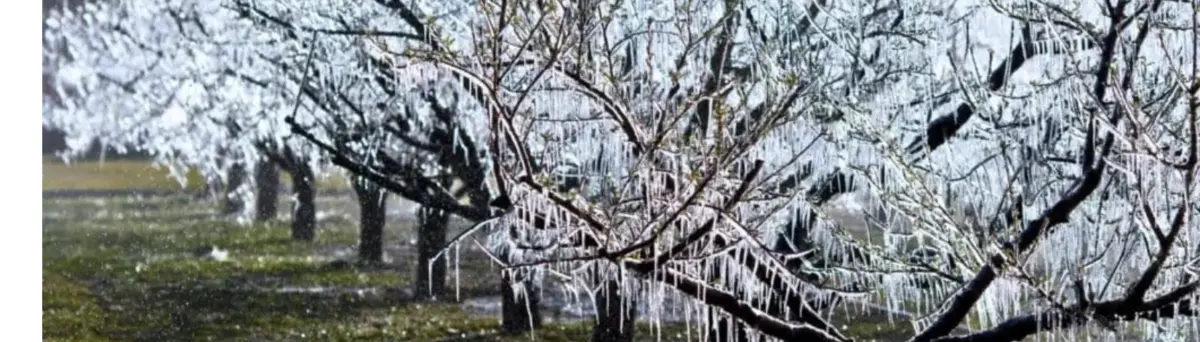
When the recent cold front swept through Columbia County, many stone fruit and berry orchards were caught right in the middle of this vulnerable transition. Once flowers open, the delicate reproductive organs—pistils, styles, and anthers—are exposed to the open air. Even a light, transient frost can form ice crystals within these extracellular spaces, rupturing cell membranes and causing tissue necrosis.
Crucially, the damage is frequently insidious. Growers inspecting their orchards the morning after a frost may observe outwardly normal-looking blossoms, only to watch them wither and drop days later as the internal reproductive structures fail to fertilize.
Furthermore, the timing of the cold snap severely disrupted pollination dynamics. Most vital pollinators, including honeybees and native bumblebees, drastically reduce their foraging activity under cool, cloudy, and windy conditions. The intersection of a narrow flowering window, frost-damaged petals, and grounded pollinators creates a compounding deficit in successful fruit set, setting the stage for significant harvest reductions.
Row Crop Establishment and the Danger of Cold, Wet Soils
While orchards faced the threat of aerial frost, North Florida’s row crop producers—cultivating acreage dedicated to watermelons, sweet corn, and assorted spring vegetables—faced an entirely different set of subterranean and surface challenges.
Spring-planted row crops rely heavily on optimal soil temperatures for uniform germination and rapid emergence. When a cold front drops ambient temperatures, soil temperatures invariably follow, stalling the biochemical reactions necessary for seed germination.
For crops like watermelons, where field uniformity dictates mechanical harvest efficiency and market timing, delayed and uneven germination is economically catastrophic. Staggered emergence results in uneven canopy development, complicating weed management and fertilizer applications.

Moreover, the combination of cold and occasionally wet conditions creates an ideal microenvironment for soil-borne pathogens. Pathogens such as Pythium, Rhizoctonia, and Fusarium thrive in cold, poorly drained soils, drastically increasing the incidence of damping-off and early-season seedling mortality.
For young transplants already established in the ground, the cold front presented a direct radiative frost threat. Tender leaves suffered marginal and total leaf burn, while stems experienced chilling injury that can stunt vascular development. Even if young plants manage to survive the cold event, the resulting physiological shock stalls root system expansion. This extended lag phase leaves plants vulnerable to secondary infections from opportunistic pests and pathogens that easily colonize weakened, cold-stressed plant tissues.
Supporting Context & Metrics: The Science of Drought-Amplified Frost
Perhaps the most critical factor elevating the severity of this season’s cold event is the ongoing drought condition persisting across Florida. The interaction between soil moisture deficits and radiative frost physics creates a compounding hazard that catches many producers off guard.
The Thermal Buffer: Soil Moisture Dynamics
To comprehend why dry soils make frost events worse, one must look at the principles of heat capacity and thermal conductivity.
- Moist Soils: Water possesses a remarkably high specific heat capacity. During daylight hours, moist soils absorb vast amounts of solar radiation, storing thermal energy deep within the soil profile. As ambient temperatures drop after sunset, the soil slowly and steadily radiates this stored heat upward into the microclimate immediately surrounding the plant canopy. This upward flux of thermal energy acts as a natural buffer, often keeping canopy temperatures a critical 2 to 4 degrees warmer than surrounding areas, frequently preventing the formation of damaging frost.
- Dry Soils: Conversely, dry soils are characterized by low heat capacity and poor thermal conductivity. They absorb less solar radiation during the day and, crucially, cool down with alarming rapidity once the sun sets. Lacking a reservoir of stored heat, dry soils fail to radiate adequate warmth upward during the night.
As a result, two adjacent fields experiencing the exact same macro-level weather forecast can suffer vastly different fates based entirely on their soil moisture status. A dry field will experience significantly colder near-ground temperatures, sharply increasing the duration and intensity of the frost event at the canopy level.
Physiological Strain and Cumulative Stress
Beyond the physical microclimate of the field, drought imposes chronic internal stress on plants well before a cold front arrives. Drought-stressed plants often exhibit reduced turgor pressure, restricted nutrient uptake, and depleted carbohydrate reserves.
When a sudden freeze hits a plant already weakened by water deficit, the cumulative damage is exponential.
- Delayed Recovery: Trees and vines suffering from moisture stress cannot mount an effective physiological recovery following a cold event. Leaf-out is severely delayed, bloom periods are artificially extended, and overall vegetative growth is stunted.
- Compounded Risk of Repeated Stress: An extended bloom period, paradoxically, increases the plant’s long-term vulnerability by spreading the window of susceptibility across multiple, potential late-season frost waves.
- Depleted Carbohydrate Reserves: Repeated cycles of cold stress force the plant to burn stored energy reserves simply to repair damaged tissues rather than investing those resources into fruit development and structural growth. Consequently, the negative yield impacts of a late-season cold event often spill over into the following agricultural season, depressing long-term orchard productivity.
Official Statements and Expert Guidance
Agricultural extension agents and regional specialists have emphasized that managing risk during this transitional window requires a fundamental shift in how growers view soil and weather data.
"When dry conditions and late-season cold fronts converge, growers cannot rely on regional weather forecasts alone," notes regional agricultural analysis. "Microclimates dictate survival. A dry field is effectively a colder field, and treating soil moisture as an active frost-protection tool is no longer optional—it is a necessity for crop survival."
Extension entomologists and agronomists have issued explicit guidelines for producers navigating the aftermath of the recent cold front:
- Pre-Event Irrigation Management: Where water availability and irrigation infrastructure permit, growers are advised to apply a thorough irrigation cycle prior to a forecasted freeze. Wetting the soil increases its thermal mass and maximizes radiant heat release during the night, effectively moderating near-ground temperatures.
- Post-Frost Scouting Protocols: Producers must avoid premature pruning of frost-damaged wood or foliage. Pruning stimulates new, tender growth that is even more susceptible to subsequent cold events. Growers should allow damaged tissues to fully declare themselves, ensuring that structural pruning occurs only after the definitive end of the frost season.
- Pest and Disease Vigilance: Because cold and drought stress weaken plant defense mechanisms, integrated pest management (IPM) scouting must be intensified. Early identification of opportunistic fungal pathogens and piercing-sucking insects in stressed row crops can prevent localized infestations from becoming field-wide epidemics.
Future Outlook: Adaptation in a Shifting Agricultural Landscape
As Columbia County agriculturalists look toward the remainder of the spring and the approaching summer growing seasons, the events of this week serve as a stark reminder of the mounting challenges facing North Florida farming operations.
The increasing volatility of late-season weather patterns—characterized by erratic winter warm spells followed by sharp, damaging freezes, all unfolding against a backdrop of chronic hydrological stress—underscores the urgent need for long-term agricultural resilience.
Moving forward, commercial producers are increasingly investing in advanced microclimate monitoring tools, including in-field temperature sensors and soil moisture probes, to make hyper-local, data-driven decisions. Furthermore, the integration of resilient rootstocks, frost-tolerant varietal selections, and efficient, automated micro-irrigation systems will play a pivotal role in safeguarding farm gate values.
For now, Columbia County growers remain vigilant, monitoring daily forecasts, protecting emerging crops wherever feasible, and managing the delicate balance between water conservation and thermal protection. In an era where agricultural margins are tighter than ever, navigating these early-season weather hurdles will ultimately dictate the boundary between a bountiful harvest and a challenging operational year.

0 Comments