

By Derrick Conover
Published: November 21, 2025 | Category: Agriculture, Crops, Horticulture
Executive Overview
For small- and medium-scale agricultural producers across North Florida, diversification is no longer just a strategy for risk mitigation—it is a cornerstone of long-term economic survival. Among the myriad specialty crops vying for acreage, blueberries have rapidly emerged as one of the region’s most promising and lucrative horticultural ventures.
Columbia County, anchored by favorable natural endowments such as mild winters, naturally acidic sandy soils, and an enthusiastic and expanding local consumer base, is uniquely positioned to support thriving commercial blueberry production. Whether an agricultural entrepreneur is looking to plant a modest one-acre "U-pick" operation or scale up an intensive commercial footprint, the region offers a remarkably hospitable environment.
This comprehensive guide breaks down the core agronomic factors that make blueberries thrive in North Florida. It provides actionable, research-backed insights into variety selection, plant spacing architectures, advanced irrigation methodologies, and overall orchard management designed to help growers establish a healthy, high-yielding patch from the ground up.
Detailed Chronology: The Evolution of Blueberry Production in North Florida
The ascent of blueberries as a premier specialty crop in Columbia County did not happen overnight. It is the result of decades of horticultural research, climate adaptation, and changing consumer preferences.
The Foundation Years (Late 20th Century)
Historically, North Florida agriculture was dominated by traditional row crops, timber, and livestock. However, agricultural extension agents and early innovators recognized that the region’s native pine flatwoods and sandy loam soils possessed inherent chemical properties—specifically, low pH levels—that mirrored the natural habitat of wild ericaceous plants.
During this period, agricultural researchers began evaluating low-chill blueberry cultivars capable of breaking dormancy without the extensive winter freeze requirements of traditional northern varieties. This laid the groundwork for the introduction of Southern Highbush and Rabbiteye cultivars tailored specifically to the climate of USDA Hardiness Zones 8 and 9.
The Shift Toward Specialty Markets (2010s)
As suburban growth transformed parts of North Florida and consumers increasingly sought out locally sourced, nutrient-dense foods, growers began looking for alternatives to traditional commodities. The Lake City Farmers Market and localized agritourism models began to flourish. Blueberries proved to be the ideal candidate: they are universally recognized, highly valued by health-conscious consumers, and capable of generating significantly higher gross revenues per acre than traditional field crops.
Modern Intensification and High-Density Systems (Present Day)
Today, Columbia County sits at the forefront of modern blueberry production methodologies. Modern growers are no longer restricted to traditional wide-row spacing. Instead, the adoption of high-density Southern Highbush production systems, advanced micro-irrigation, and precision fertigation has revolutionized yields. Producers can now harvest high-value, early-season fruit that hits the market when prices are at their seasonal peak, cementing blueberries as a vital economic engine for the region’s agricultural sector.
Supporting Context & Metrics: Agronomic Foundations in Columbia County
Establishing a successful commercial blueberry enterprise requires a deep understanding of the local environment’s biological and chemical parameters. Below is a detailed breakdown of the critical metrics governing blueberry production in Columbia County.
Soil Chemistry: The Acidic Advantage
Blueberries are calcifuges—plants that thrive exclusively in acidic environments and struggle significantly in alkaline soils. Fortunately, much of Columbia County naturally possesses sandy, acidic soils.
- Target Soil pH: Optimal blueberry production requires a soil pH ranging strictly between 4.5 and 5.5.
- Soil Modification: While native soils often provide a strong baseline, growers must conduct rigorous pre-planting soil tests. Minor adjustments using elemental sulfur or organic matter incorporation (such as peat moss or pine bark) may be necessary to fine-tune the rooting zone before planting both Southern Highbush and Rabbiteye varieties.
Chill Hours and Dormancy Dynamics
Berry plants require a specific accumulation of winter cold—measured in "chill hours" (temperatures between 32°F and 45°F)—to successfully break dormancy, flower, and set fruit.
- Regional Climate Metrics: Columbia County generally receives between 300 and 500 chill hours annually.
- Cultivar Alignment: This chill-hour accumulation is mathematically and biologically ideal for many low-chill Southern Highbush cultivars, while remaining comfortably within the acceptable range for Rabbiteye varieties. This precise alignment ensures consistent winter dormancy and predictable, uniform spring bloom timing year after year, minimizing the risk of catastrophic frost damage or erratic crop loads.
Land Economics and Yield Proportions
For beginning growers and diversifying operations, scale is a critical planning metric.
- Plant Density: Under standard management practices, a single acre of well-prepared land can support between 600 and 1,500 blueberry plants, heavily dependent on the chosen variety and spatial layout.
- Scaling Operations: Many beginning agriculturalists in Columbia County strategically launch their enterprises with a manageable one-acre plot. This allows them to master canopy management, pest dynamics, and local marketing channels before capital-intensive scaling.
Variety Selection and Spatial Architecture
Choosing the right blueberry cultivar is arguably the single most important decision a grower will make. Varieties must align with climate specifications, target harvest windows, labor availability, and irrigation infrastructure.
1. Southern Highbush Blueberries (Vaccinium corymbosum hybrids)
- Market Advantage: Best for early-season fruit production, capturing the highest market prices before mass volumes flood the national supply chain.
- Key Cultivars: ‘Emerald’, ‘Jewel’, ‘Meadowlark’, and ‘Suziblue’.
- Agronomic Profile:
- Pros: Early ripening window; exceptionally large, high-quality fruit prized by fresh-market consumers; rapid establishment.
- Cons: Shallow, delicate root systems; highly sensitive to drought and nutrient fluctuations; requires intensive management, vigilant pest control, and reliable irrigation.
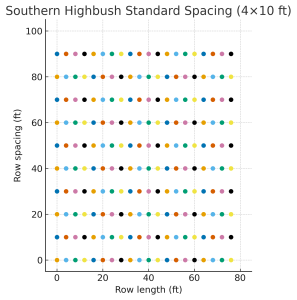
- Standard Recommended Spacing: Typically planted at 3 to 4 feet within rows, with 10 to 12 feet between rows, ensuring adequate machinery access and airflow.
2. High-Density Southern Highbush Systems
- Production Objective: Intensive, high-yield production tailored for strictly controlled, fully irrigated acreage.
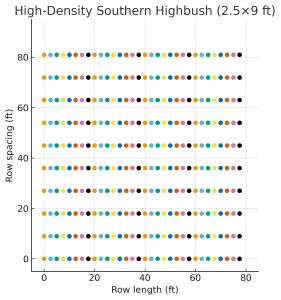
- Spatial Layout: 2.5 ft × 9 ft configuration.
- Management Realities: This ultra-dense system maximizes early, high-volume yields per square foot. However, it leaves zero room for error; success hinges on absolute mastery over localized drip irrigation, aggressive weed suppression, and precision fertigation programs.
3. Rabbiteye Blueberries (Vaccinium virgatum)
- Market Advantage: Best suited for low-input growers, organic operations, or agricultural sites lacking sophisticated, permanent irrigation infrastructure.
- Key Cultivars: ‘Climax’, ‘Brightwell’, and ‘Powderblue’.
- Agronomic Profile:
- Pros: Remarkably robust and vigorous plant architecture; highly resilient root systems; tolerant of marginal soils and minor management lapses; excellent for U-pick operations due to heavy, concentrated fruit clusters.
- Cons: Later harvest window (competing with larger market volumes); fruit can exhibit tougher skins or seedier textures compared to Southern Highbush.
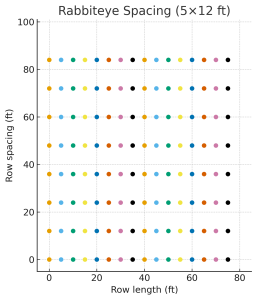
- Standard Recommended Spacing: Wider spacing is required due to the massive ultimate canopy size of mature bushes—typically 5 to 6 feet within rows and 12 to 14 feet between rows.
Official Guidelines: Irrigation and Moisture Management
Water management can make or break a commercial blueberry venture in North Florida. Because blueberries possess very fine, shallow root systems devoid of root hairs, they are notoriously incapable of efficiently scavenging for water during dry spells.
The Unpredictable Spring Challenge
Columbia County frequently experiences unpredictable dry spells during the critical spring transition—precisely when plants are sizing fruit and filling out canopies. Relying solely on natural rainfall is a high-stakes gamble that frequently leads to fruit drop, diminished berry size, and permanent root shock.
Irrigation Infrastructure Recommendations
- Microjet and Drip Systems: For Southern Highbush and high-density operations, permanent microjet or drip irrigation is strongly recommended. Drip lines ensure targeted water delivery directly to the root zone while minimizing weed germination in the middles.
- Fertigation Integration: Utilizing drip irrigation enables precise "fertigation"—the delivery of water-soluble fertilizers directly to the roots in micro-doses. This matches the exact nutrient uptake curves of the plant throughout its growing cycle, dramatically improving fertilizer use efficiency.
- Rabbiteye Resilience: While established Rabbiteye varieties possess deeper, more expansive root systems and can survive on ambient rainfall once fully rooted, installing supplemental irrigation rows remains best practice to insulate crops against multi-season precipitation anomalies.
Future Outlook: Building a Sustainable Horticultural Enterprise
The economic horizon for specialty crop producers in Columbia County remains exceptionally bright. Consumer demand for traceable, locally grown, and fresh-picked produce continues to outpace traditional retail supply chains.
Whether an operation is transitioning from legacy row crops or a newcomer is breaking ground on a single acre, blueberries offer a resilient financial framework:
- Strong Local Markets: Direct-to-consumer avenues—such as regional farmers markets, farm-gate sales, and agritourism U-pick operations—eliminate costly middleman logistics and maximize profit margins per pound.
- High Consumer Recognition: Unlike niche exotic fruits that require extensive consumer education, blueberries are a household staple. Demand is stable, resilient, and enduring.
- Scalability: The modular nature of berry farming allows growers to start small, refine their operational protocols, and expand acreage incrementally as capital and market demand dictate.
With meticulous pre-planning, rigorous soil management, deliberate variety selection, and disciplined irrigation protocols, blueberries can serve as a cornerstone of agricultural prosperity in Columbia County for generations to come.

0 Comments