

By Derrick Conover
Published: March 18, 2026
Category: Agriculture / Crops
Executive Overview
Agricultural producers across Columbia County and the broader North Florida region are grappling with a punishing meteorological double-whammy this spring. Following what agricultural extension agents hope will be the final cold front of the season, local farmers find themselves navigating a precarious landscape defined by sudden, sharp temperature swings intersecting with an ongoing regional drought.
This late-season freeze event has arrived at the most delicate juncture of the annual agricultural production cycle. Fruit trees are breaking dormancy, transitioning rapidly from cold-hardy slumber to active bud break and full bloom. Simultaneously, producers of warm-season row crops and early-spring vegetables are in the thick of planting and seedling emergence.
The convergence of sub-optimal, near-freezing temperatures and persistent soil moisture deficits has created a narrow, high-stress window where even brief cold snaps inflict disproportionate damage. While frost and drought are frequently evaluated as isolated environmental hazards, their physiological and microclimatic interactions amplify crop vulnerability. For North Florida growers, understanding the intricate mechanics of this dual stress—and implementing proactive management strategies—will determine the economic viability of the 2026 harvest.
Detailed Chronology: The Anatomy of a Late-Season Weather Shock
The recent drop in temperatures did not arrive in a vacuum; it capped a tense winter transition period characterized by erratic meteorological shifts. To understand the severity of the current crop stress, it is necessary to examine the sequence of physiological events triggered by the late-season cold front.
Phase One: The False Spring and Dormancy Breakdown
Throughout the earlier weeks of the season, unseasonably warm daytime highs across Columbia County tricked perennial crops into breaking winter dormancy prematurely. During true winter dormancy, temperate fruit crops—such as peaches, plums, and blueberries—possess robust defense mechanisms that allow them to endure sub-freezing temperatures with minimal tissue damage. Cellular water is tightly regulated, and metabolic activity drops to a baseline hum.
However, as ambient temperatures climbed, trees initiated sap flow, swelling buds and pushing open delicate blossoms. This transition represents an irreversible physiological commitment. As reproductive structures develop, the cold tolerance of the plant declines precipitously.
Phase Two: The Freeze Event and Invisible Injury
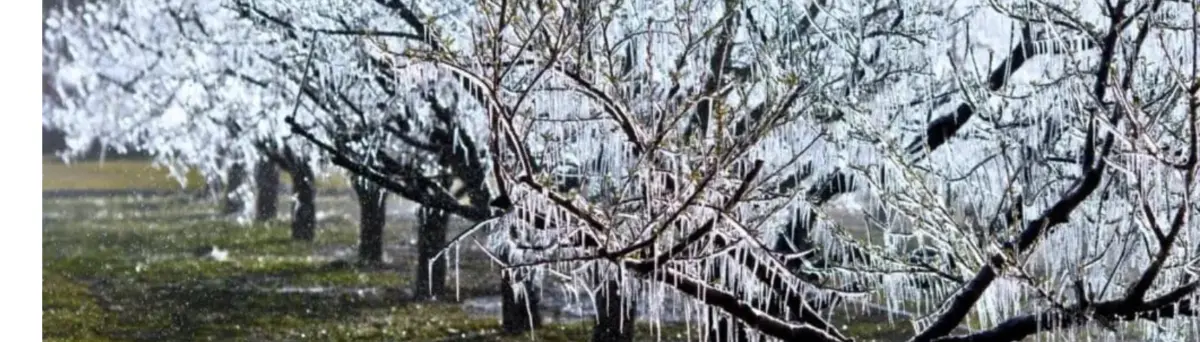
When the cold front swept through Columbia County this week, it plunged vulnerable orchards and open fields into overnight temperatures capable of forming surface frost. For crops like peaches and blueberries, open flowers are ground zero for cold-induced trauma. Even a light, transient frost can rupture the cellular walls of reproductive tissues, neutralizing pistils and stamens.
Crucially, the damage is frequently insidious. In many orchards, blossoms may appear superficially normal in the immediate aftermath of a cold event, creating a false sense of security for growers. Days later, however, these flowers fail to set fruit, revealing extensive internal necrosis.
Compounding the direct thermal injury is a secondary biological bottleneck: pollinator behavior. Honeybees and native pollinators are notoriously sensitive to environmental conditions. Under the cool, cloudy, and breezy parameters that typically accompany late-season cold fronts, pollinator flight activity plummets. This behavioral suppression severely narrows an already compressed flowering window, choking off successful cross-pollination even for blossoms that survived the frost.
Phase Three: Physiological Stagnation and Long-Term Vigor Loss
Beyond immediate tissue death, the cold front induced a systemic slowdown in tree physiology. Extension observations indicate that delayed leaf-out, prolonged and erratic bloom periods, and stunted fruit development are becoming widespread across the county.
An extended, stuttering bloom period paradoxically increases risk. It stretches the window of vulnerability, exposing successive waves of flowers to any subsequent, lingering frost events. Furthermore, the metabolic energy required for a tree to repeatedly attempt recovery, push secondary blooms, and repair damaged tissues depletes its vital carbohydrate reserves. This cumulative physiological stress not only depresses the current season’s yield potential but compromises tree architecture and productivity for the following year.
Supporting Context & Metrics: Row Crops and the Microclimate Crisis
While perennial orchards fight a war of attrition, row crop and vegetable producers face an entirely distinct set of physiological hurdles during germination and early stand establishment.
The Vulnerability of Spring Row Crops
North Florida’s early-season vegetable and row crop sectors—encompassing major acreage of watermelons, sweet corn, green beans, and various solanaceous crops—rely heavily on warm soil matrices to trigger uniform germination and vigorous early root development.
When cold air masses drag down soil temperatures, seed germination slows dramatically and becomes highly uneven. In uniform-market commodities like watermelons, field variability spells economic disaster. Uneven emergence leads to staggered crop maturity, complicating harvest schedules, increasing labor costs, and reducing pack-out percentages.

Furthermore, cold, damp soil conditions create an ideal incubator for soil-borne pathogens. Pathogens responsible for damping-off and root rot thrive in chilled, poorly aerated media. Seedlings struggling to emerge through cold soil lack the metabolic vigor to outpace fungal infections, leading to stand losses that often necessitate expensive replanting efforts.
For young seedlings and tender transplants already established in the field, the cold front introduces direct threats:
- Leaf Burn and Necrosis: Foliage exposed to frost suffers immediate cellular dehydration and membrane collapse, resulting in scorched, necrotic leaf margins.
- Stem Injury: Low temperatures can girdle young stems near the soil line, causing lodging or complete plant mortality.
- Transplant Shock Amplification: Transplants are particularly susceptible. Cold soil conditions paralyze root growth, halting the uptake of water and essential nutrients. This prolonged transplant shock leaves young plants uniquely vulnerable to secondary attacks from opportunistic insect pests and foliar diseases that easily penetrate weakened plant tissues.
The Drought Multiplier Effect
The severity of this season’s cold damage has been dramatically amplified by an underlying regional drought. While growers often conceptualize water deficits and freezing temperatures as independent phenomena, their intersection at the plant and microclimatic levels creates a synergistic disaster.
At the field level, soil moisture plays a profound, physics-driven role in frost mitigation:
- The Thermal Buffer of Moisture: Moist soils act as massive thermal batteries. During sunlit hours, wet soil absorbs solar radiation, storing significant thermal energy. As ambient temperatures drop after sunset, moist soil radiates this stored heat upward into the canopy, creating a microclimatic buffer that often prevents canopy temperatures from hitting critical freezing thresholds.
- The Dry Soil Liability: Conversely, dry soils possess a drastically lower heat capacity. They absorb less solar energy during the day and cool down with alarming rapidity once the sun sets. Consequently, two adjacent fields experiencing the exact same macro-level air temperature can suffer wildly disparate frost damage based solely on their soil moisture status. The dry field will record significantly colder near-ground temperatures, vastly accelerating ice crystal formation on plant surfaces.
For North Florida growers, this dynamic elevates dry soil conditions from an ordinary production headache to a primary risk multiplier during freeze warnings.
Official Statements and Industry Insights
Agricultural extension specialists and industry leaders emphasize that managing these compounding environmental pressures requires a paradigm shift in early-season risk assessment.
Derrick Conover, agricultural agent within the University of Florida’s Institute of Food and Agricultural Sciences (UF/IFAS) Columbia County Extension office, highlights the critical nature of proactive resource management during these compressed seasonal transitions:
"These temperature swings come at a particularly sensitive time in the production cycle, when fruit trees are breaking dormancy and many row crops are being planted or emerging. The result is a narrow window where even brief periods of cold weather can have negative impacts on crop performance and yield potential."
Conover notes that while growers cannot control sweeping meteorological fronts, understanding localized microclimates is essential for survival:
"From a field-level perspective, dry soils contribute to more severe frost conditions… In practical terms, two fields with identical air temperatures can experience very different levels of frost injury depending on soil moisture conditions. For North Florida growers, this means that dry conditions should be viewed as a risk factor when evaluating potential cold damage."
Extension leadership underscores that where irrigation infrastructure permits, pre-irrigation—applying water to fields prior to a forecasted cold event—remains one of the most effective mechanical defenses available. Pre-irrigation not only hydrates drought-stressed crops, boosting their internal cellular turgor and resilience against thermal shock, but directly enhances the heat capacity of the soil profile to moderate near-ground frost severities.
Future Outlook: Vigilance and Adaptation in Modern Agriculture
As weather patterns exhibit increasing volatility across the Southeastern United States, the traditional agricultural calendar is undergoing a stress test. Late-season cold fronts colliding with persistent spring droughts are no longer anomalies; they represent an evolving risk matrix that regional producers must systematically adapt to.
Looking toward the remainder of the 2026 production season, local growers are advised to maintain hyper-vigilance:
- Enhanced Monitoring: Producers must integrate real-time soil temperature probes and localized microclimate weather stations into their farm infrastructure, moving beyond regional broadcast forecasts that fail to capture micro-topographical variances.
- Strategic Planting Windows: Growers are increasingly evaluating whether to adjust traditional planting dates, utilizing risk-probability models to delay high-value direct seeding until soil temperatures definitively clear historical danger thresholds.
- Integrated Stress Management: Recognizing that drought and cold act as force multipliers, agronomic programs must prioritize root health and systemic plant vigor well in advance of predicted weather shocks. Utilizing biostimulants, mycorrhizal inoculants, and careful nutrient balancing can help fortify plant cell walls against environmental stress.
Ultimately, navigating the squeeze between erratic late-season freezes and punishing drought conditions demands a blend of agronautical science, proactive irrigation management, and calculated patience. As Columbia County producers assess the balance sheet of this latest cold snap, meticulous field management will remain the dividing line between economic resilience and agricultural loss.

0 Comments