

By Derrick Conover
Published: March 18, 2026
Category: Agriculture / Crops
Executive Overview
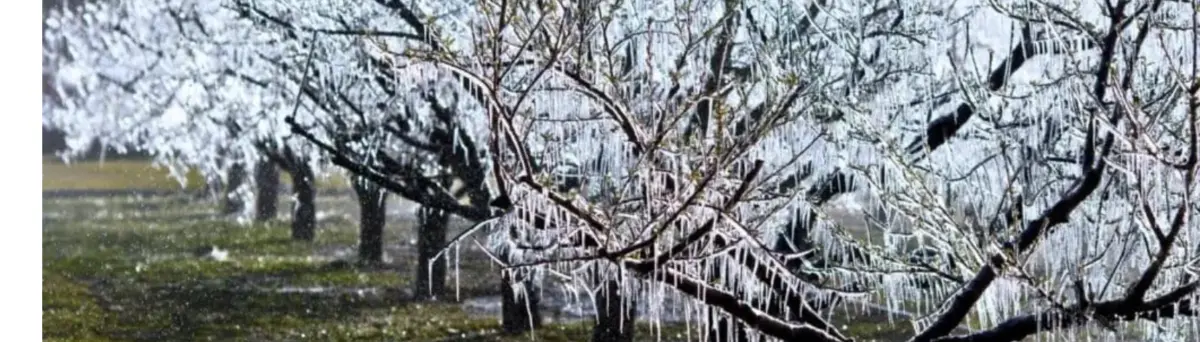
Agricultural producers across Columbia County and the broader North Florida region are grappling with a high-stakes convergence of environmental stress factors following what local agricultural extension experts hope will be the final cold front of the season. Arriving at a profoundly delicate juncture in the regional production cycle, this late-season temperature plunge has caught local farms at their most vulnerable. Fruit trees are actively breaking winter dormancy, while spring row crops are either emerging or undergoing critical establishment phases.
The juxtaposition of plummeting temperatures, active biological transition in perennial crops, and an entrenched regional drought has created a narrow, highly volatile operational window. In this pressurized environment, even brief, localized nocturnal frosts can trigger cascading failures in crop performance, severely eroding yield potential.
This comprehensive report examines the physiological mechanisms driving crop vulnerability, analyzes the compounding threat profile of concurrent drought conditions, details field-level vulnerabilities across both perennial orchards and spring-planted row crops, and provides strategic frameworks for regional growers navigating this climate-induced economic hazard.
Detailed Chronology & Meteorological Context
The recent weather event materialized as a swift-moving cold front sweeping down through the southeastern United States, plunging overnight temperatures across Columbia County into ranges historically associated with frost formation. While typical winter cold fronts find perennial crops safely insulated within deep physiological dormancy, this late-season descent struck just as regional microclimates were experiencing rapid springtime warming trends.
The Transition Window Trap
Agricultural climatologists note that the primary danger of late-season fronts lies not in absolute temperature lows—which are often less severe than mid-winter minimums—but in the timing relative to plant phenology. For months, local flora operated under low metabolic activity, characterized by hardened cellular structures capable of withstanding sub-freezing conditions. However, prolonged periods of unseasonal warmth in the weeks prior triggered the initiation of bud-break, cellular expansion, and the mobilization of sugars and water throughout vascular systems.
When the cold front slammed into the region, it abruptly halted this biological acceleration. The resulting temperature swings exposed hydrated, soft tissues to sudden freezing conditions, catching both commercial operations and smallholder farms off guard. Because the event occurred during a critical calendar window when fieldwork—such as land preparation, transplanting, and early irrigation management—was at its seasonal peak, the operational disruption was felt across nearly every sector of North Florida agriculture.
Physiological Impacts on Perennial and Row Crops
The physiological repercussions of the cold front vary dramatically between perennial fruit systems and annual spring row crops, yet both categories face severe threats to economic viability.
1. Fruit Tree Production: Orchards on the Edge
For perennial fruit crops such as peaches and blueberries—staples of the North Florida agricultural economy—the timing of the cold event was critical.
- Bud and Blossom Vulnerability: As temperatures rise and trees transition from dormancy to bloom, their inherent cold tolerance declines precipitously. Once flowers open, reproductive tissues lose their cellular defense mechanisms. Even a light frost can rupture cell walls within the pistil, stamen, and ovary, resulting in incomplete fertilization, abnormal fruit development, or total reproductive failure.
- The Illusion of Health: One of the most insidious aspects of frost injury in stone fruits and berries is the delayed visibility of damage. Blossoms may appear entirely normal immediately following a frost event, maintaining deceptive structural integrity for several days before dropping prematurely or failing to set fruit. Growers frequently experience a false sense of security in the immediate aftermath, only to discover widespread crop failure weeks down the road.
- Pollinator Disruption: Beyond direct thermal injury, the meteorological conditions accompanying the cold front severely depressed pollinator activity. Managed honeybees and native pollinators become largely inactive under cool, cloudy, and windy conditions. Because the blooming window for crops like blueberries is exceptionally narrow, days lost to poor pollinator flight activity cannot be recovered, leading to sparse fruit set even on undamaged blossoms.
- Long-Term Tree Stress and Vigor Loss: Cold events do not merely impact the current season; they induce systemic stress. Slowed tree physiology—manifested as delayed leaf-out, extended and irregular bloom periods, and sluggish fruit development—proposes compounding risks. An extended bloom period leaves flowers exposed to subsequent, albeit minor, frost events. Furthermore, the metabolic energy required to recover from cold stress depletes vital carbohydrate reserves, depressing tree vigor and diminishing productivity not only for the current harvest but potentially rolling over into the subsequent production year.
2. Row Crops: The Struggle for Uniformity and Establishment
While orchards battle reproductive failure, spring-planted row crops—including commercial watermelon, sweet corn, and a diverse array of fresh-market vegetables across North Florida—confront a completely different suite of systemic challenges.

- Germination and Stand Establishment: These warm-season crops demand specific soil temperature thresholds for optimal germination. When cold air is accompanied by chilling soil temperatures, germination rates plummet, and emergence becomes highly uneven. In crops like watermelon, where field uniformity is paramount for efficient, synchronized harvesting and packing, staggered emergence destroys scheduling models and increases labor costs.
- Pathogen Activation and Damping-Off: Cold, damp soil conditions create an ideal environment for soil-borne pathogens. Pathogens such as Pythium, Rhizoctonia, and Fusarium thrive in cool, wet media, aggressively attacking weakened seed coats and young radicles. This dramatically elevates the incidence of damping-off, seed rot, and early-season plant mortality, frequently forcing growers into costly replanting operations.
- Direct Foliar and Structural Injury: For seedlings that have already emerged or transplants recently set in the field, frost poses an immediate existential threat. Young, succulent plant tissues suffer severe leaf burn, vascular collapse, and stem girdling. Depending on the duration of the freezing temperatures, mortality rates can approach total loss.
- Transplant Shock and Secondary Vulnerabilities: Transplanted vegetable crops are particularly susceptible. Cold soil and ambient temperatures arrest root expansion, locking plants in prolonged transplant shock. This physiological stagnation leaves crops vulnerable to opportunistic secondary pests and diseases, which readily colonize compromised, slow-growing plant tissue.
Supporting Context & Metrics: How Drought Amplifies Cold Damage
Perhaps the most critical compounding factor in this season’s agricultural assessment is the persistence of drought conditions across Florida. While agricultural risk models frequently analyze frost and drought as independent environmental hazards, their physiological and microclimatic interactions are inextricably linked.
The Physics of Soil Heat Capacities
At a field scale, soil moisture content plays a decisive role in microclimate temperature regulation:
- Moist Soils as Thermal Buffers: Soils with adequate moisture possess a high specific heat capacity. Throughout daylight hours, they absorb substantial solar radiation, storing thermal energy. As ambient temperatures drop after sunset, moist soils slowly radiate this stored heat upward into the canopy, creating a vital microclimate buffer that can elevate near-ground temperatures by several crucial degrees—often the margin between frost formation and crop survival.
- Dry Soils as Thermal Sinks: In contrast, dry soils lack thermal mass. They heat up rapidly under direct sun but cool down precipitously after sunset. Without soil moisture to release latent heat, dry fields experience significantly colder near-ground temperatures.
Consequently, two adjacent agricultural fields experiencing identical regional air temperatures can endure drastically divergent outcomes based solely on soil moisture. In North Florida’s drought-stressed environment, dry soils have systematically exacerbated local frost intensities, transforming marginal cold events into destructive freeze episodes.
Official Statements and Strategic Guidance
Agricultural extension specialists and industry leaders emphasize that proactive, data-driven management is the primary defense against increasingly erratic seasonal weather patterns.
Derrick Conover, agricultural agent and author of the regional assessment, underscores the necessity of integrated risk management:
"These temperature swings occur at a particularly sensitive time in the production cycle… When soils remain cool and plants are breaking dormancy, we face a narrow window where even brief periods of cold weather can have negative impacts on crop performance and yield potential. Growers must view dry conditions not as a background inconvenience, but as a primary risk amplifier when evaluating potential cold damage."
Extension agronomy and horticulture teams recommend the following tactical measures for regional producers:
- Pre-Event Irrigation Management: Where water rights and infrastructure permit, pre-irrigation of fields prior to forecasted cold events can dramatically increase soil heat capacity and leverage the latent heat of fusion, moderating near-ground microclimates and buffering tender root zones.
- Enhanced Monitoring Protocols: Growers are urged to maintain localized, canopy-level weather monitoring networks rather than relying exclusively on regional airport or municipal weather stations, which frequently fail to capture microclimatic inversions and low-lying frost pockets.
- Staged Planting Strategies: To mitigate the catastrophic loss of entire acreage, producers should consider spreading planting dates across multiple windows rather than committing all resources to a single early-season establishment phase.
- Vigilant Scouting for Secondary Pests: Following cold events, scouting programs must be intensified to detect early signs of pathogen colonization in stressed tissues before minor infections escalate into systemic field epidemics.
Future Outlook
As shifting climatic baselines introduce greater volatility into seasonal transition periods, agricultural producers in Columbia County and across North Florida face an increasingly complex operating environment. The overlap of unseasonal temperature swings, shifting frost dates, and prolonged hydrological deficits underscores the urgent need for resilient farming systems.
Looking ahead, regional agricultural research institutions are prioritizing the development and dissemination of cold-hardy rootstocks, optimized micro-irrigation freeze-protection strategies, and advanced decision-support tools that integrate real-time soil moisture telemetry with localized frost forecasting.
For the immediate season, however, success will hinge on disciplined execution, hyper-vigilant field management, and the strategic deployment of protective measures wherever feasible. In the words of local agricultural authorities, careful, proactive management during these critical transition windows remains the definitive dividing line between a resilient, profitable harvest and a challenging, financially burdensome season.

0 Comments