

By Derrick Conover
Published: March 18, 2026
Executive Overview
As Columbia County bids a cautious farewell to what agricultural extension agents hope will be the final cold front of the season, local growers are left counting the cost of an exceptionally precarious transition period. Recent sharp temperature swings have collided directly with the most sensitive phase of the region’s agricultural production cycle. Fruit trees are actively breaking dormancy, while delicate spring row crops are either being planted or are currently fighting to emerge from the earth.
This tight window of vulnerability means that even fleeting dips into freezing or near-freezing temperatures can yield disproportionately catastrophic impacts on crop performance, physiological health, and ultimate market yield potential. Compounding this thermal volatility is an ongoing, stubborn drought across North Florida. The convergence of late-season frost events and parched soils has created a compounded stress matrix, leaving orchards and fields significantly more susceptible to damage than they would be under normal moisture conditions.
For commercial producers and small-scale farmers alike, the situation demands intense vigilance. Understanding the complex physiological mechanisms at play—from bud break susceptibility to soil-heat capacitance dynamics—is no longer merely academic; it is an urgent operational necessity for survival in a volatile climatic landscape.
Detailed Chronology: The Anatomy of a Late-Season Frost Event
The arrival of the recent cold front did not occur in a vacuum; its severity was dictated by a precise sequencing of atmospheric conditions and biological vulnerabilities.
The Fruit Tree Vulnerability Window
During the heart of winter dormancy, perennial fruit crops like peaches and blueberries possess remarkable physiological defense mechanisms, allowing them to tolerate sub-freezing temperatures with negligible cellular damage. However, as winter transitions into spring, rising ambient temperatures act as an environmental trigger, signaling trees to break dormancy, push out new buds, and enter the bloom phase.
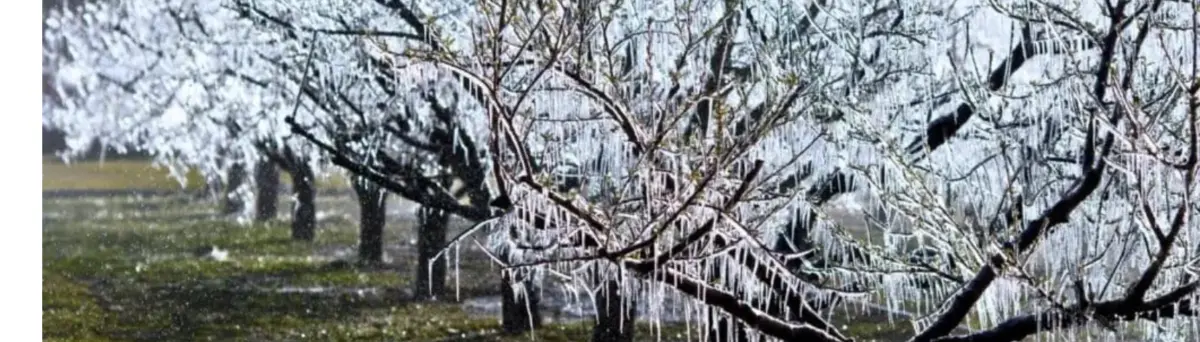
As this transition accelerates, the cold tolerance of the plant plummets. Once blossoms open fully, their reproductive tissues—specifically the pistils and stamens—become hypersensitive to frost. Even a light frost during this stage can rupture plant cells, resulting in localized tissue necrosis.
The damage is often insidious. Growers inspecting their orchards the morning after a freeze might observe blossoms that appear structurally intact, only to watch them fail to set fruit days later. Furthermore, the meteorological conditions accompanying cold fronts—typically cool, cloudy, and windy days—deal a secondary blow to production. Essential pollinators, such as honeybees and native insects, drastically reduce their foraging activity under these sub-optimal weather conditions. This drastically narrows an already tight pollination window, resulting in severely compromised fruit set across orchards.
Row Crop Germination and Emergence Hazards
While fruit trees battle the elements above ground, newly planted row crops face an equally perilous environment below the soil surface. Spring-planted staples across North Florida, including watermelons, sweet corn, and various tender vegetables, rely heavily on warm soils for rapid, uniform germination and early vegetative development.
When a sudden cold front drops both air and soil temperatures, the physiological processes governing seed germination stall. The result is uneven emergence, leading to fractured stand establishments. In crops like commercial watermelons, where field uniformity is paramount for efficient harvest logistics and market grading, this staggered growth can ruin overall field performance.
Compounding the thermal shock, cold and wet soil conditions create an ideal breeding ground for soil-borne pathogens. Pathogens responsible for "damping-off" and other early-season seedling diseases thrive in cool, sluggish soils, drastically increasing the risk of pre- and post-emergence plant mortality.
For crops that have already broken the surface or arrived as tender transplants, the threat is immediate and physical. Frost induces severe leaf burn, stem girdling, and, in severe cases, whole-plant death. Even when resilient plants manage to survive the ordeal, the lingering cold stress stunts their vigor, delays their vegetative development, and permanently lowers their ultimate yield ceiling. Transplants suffer acutely; cold soils restrict root system establishment, prolonging transplant shock and leaving the young, weakened plants defenseless against opportunistic pests and secondary diseases.
Supporting Context & Metrics: How Drought Conditions Intensify Cold Damage
To fully appreciate the severity of Columbia County’s recent agricultural strain, one must analyze the compounding effect of the region’s ongoing drought. In agricultural meteorology, drought and frost are frequently evaluated as isolated variables. Yet, at the plant physiological level and within the microclimate of a working field, their interactions are inextricably linked.

The Physics of Soil Moisture and Heat Retention
At the heart of this interaction lies the fundamental physics of soil heat capacity. Under normal, well-hydrated conditions, moist soils act as thermal batteries throughout the day. They absorb significant amounts of solar radiation and thermal energy, storing it within the soil matrix. As ambient temperatures plummet after sunset, moist soil slowly radiates this stored heat back upward into the microclimate immediately surrounding the plant canopy, providing a crucial thermal buffer against rapid, devastating temperature drops.
Dry soils, by contrast, possess a radically lower heat capacity. Lacking sufficient moisture to store thermal energy, parched soils cool down rapidly the moment the sun sets. This thermal deficit accelerates the drop in near-ground temperatures, turning an otherwise manageable ambient low into a severe, localized frost event.
Field observations consistently demonstrate this phenomenon: two adjacent fields experiencing identical regional air temperatures can suffer vastly divergent outcomes based entirely on their soil moisture profile. A dry field will experience a sharper, more destructive ground frost than an irrigated or naturally moist field.
Physiological Exhaustion in Perennials
Beyond microclimatic buffering, drought inflicts chronic internal stress on perennial fruit trees, leaving them biologically depleted when a freeze strikes. Trees struggling to access sufficient water under drought conditions often exhibit compromised carbohydrate reserves and diminished overall vigor.
When a late-season cold event forces a tree to endure physiological shock, the plant must expend precious energy reserves to repair damaged tissues, delay leaf-out, or push out a secondary bloom. This extended bloom period stretches the tree’s resources even further, exposing any late-developing flowers to subsequent frost risks. Consequently, the cumulative physiological toll does not merely write off the current season’s yield; it systematically compromises the tree’s structural health and productivity for the following harvest year.
Official Statements and Expert Guidance
Agricultural extension services and local industry leaders have mobilized to provide real-time guidance as growers assess their fields in the wake of the cold snap.
Extension Recommendations for Risk Mitigation
Derrick Conover, agricultural extension agent for Columbia County, emphasizes the importance of proactive management in the face of increasingly erratic weather patterns.
"These temperature swings are occurring at the absolute worst possible juncture in our production calendar," Conover stated during a recent grower briefing. "When fruit trees are transitioning out of dormancy and row crops are establishing their initial stands, plants have zero margin for error. We are urging producers to treat soil moisture not just as a drought-mitigation tool, but as an active frost-protection asset wherever irrigation infrastructure permits."
Extension specialists across the University of Florida’s Institute of Food and Agricultural Sciences (UF/IFAS) network recommend that, where water availability and wellhead capacity allow, growers should pre-irrigate fields prior to a forecasted freeze. Wetting the soil increases its thermal mass and maximizes radiant heat release during the night, effectively raising the temperature in the critical zone immediately above the soil line where tender seedlings and low-hanging fruit buds reside.
The Grower’s Checklist
Agricultural authorities have outlined several critical steps for producers navigating the remainder of the unpredictable spring season:
- Microclimate Monitoring: Install localized thermometers and hygrometers at crop-canopy level rather than relying solely on regional weather station data, which can misrepresent ground-level microclimates.
- Irrigation Management: Utilize proactive pre-freeze irrigation to leverage soil heat retention, taking care to balance water application with existing root-zone disease pressures.
- Pest and Disease Scouting: Increase scout frequency in fields recovering from cold stress, keeping a sharp eye out for opportunistic pathogens and insects exploiting weakened plant tissue.
- Input Adjustments: Postpone heavy nitrogen applications on frost-stressed row crops until plants have resumed active, healthy growth, avoiding the stimulation of tender new tissue that is vulnerable to subsequent stress.
Future Outlook: Adapting to Climatic Volatility
As Columbia County looks ahead, the challenges posed by this season’s late-season cold fronts and lingering drought serve as a stark reminder of the growing volatility facing modern agriculture. Producers can no longer rely on historical weather averages to dictate their planting schedules, cultivar selections, or frost-protection strategies.
Long-term adaptation strategies will likely require significant capital investments in agricultural infrastructure. Expanding automated micro-irrigation systems, upgrading wind-machine capabilities in high-value orchards, and adopting advanced soil-moisture telemetry will transition from optional upgrades to essential risk-management tools. Furthermore, agronomists are accelerating research into frost-tolerant rootstocks and drought-hardy row crop varieties specifically tailored to North Florida’s unique micro-environments.
For now, however, the immediate future hinges on day-to-day vigilance. Growers must remain hyper-aware of short-term meteorological forecasts, maintain readiness for emergency protective measures, and practice meticulous crop management. In an agricultural season defined by narrow margins and compounding stressors, the difference between a catastrophic loss and a resilient harvest will be decided by timely, informed, and proactive execution.

0 Comments