

By Derrick Conover
Published: November 21, 2025 | Last Updated: November 21, 2025
Categories: Agriculture, Crops, Horticulture
Executive Overview
In recent years, blueberries have rapidly ascended to become one of the most promising and lucrative specialty crops in North Florida. For small- and medium-scale agricultural producers looking to diversify their operations, mitigate market risks, and maximize land efficiency, blueberry cultivation offers a compelling pathway to economic resilience.
Thanks to a unique combination of regional environmental advantages—including mild winters, naturally acidic sandy soils, and a booming local consumer base—Columbia County is exceptionally well-positioned to support profitable commercial blueberry production. Whether an aspiring grower is planting a single experimental acre or an established farm is seeking to expand its existing footprint, the region provides a fertile foundation for success.
However, achieving maximum yields and long-term financial viability requires far more than simply putting plants in the ground. Establishing a thriving blueberry patch demands rigorous attention to detail: from selecting the right cultivar and mastering irrigation dynamics to optimizing planting layouts and implementing integrated pest management strategies. This comprehensive guide breaks down the essential agronomic principles, varietal comparisons, and management practices necessary for Columbia County growers to build a healthy, highly productive berry operation.
Detailed Chronology & Production Lifecycle
Transitioning raw land into a commercial blueberry-producing enterprise is a multi-phase endeavor that requires careful planning, timely execution, and ongoing agronomic management. Understanding the chronological milestones of a blueberry operation is critical for new and expanding growers alike.
Phase 1: Pre-Planting Preparation (Months 1–12 Before Planting)
Long before the first shrub is placed in the soil, foundational preparation must take place.
- Site Selection and Soil Testing: Growers must test soil pH and composition well in advance. While Columbia County features naturally sandy and acidic soils—often ranging from the ideal 4.5 to 5.5 pH window—adjustments may still be necessary.
- Land Clearing and Weed Eradication: Perennial weeds and root systems must be thoroughly eradicated. Failure to clear weeds early can result in intense competition during the vulnerable establishment years.
- Infrastructure Design: Designing and laying out irrigation infrastructure (drip or microjet systems) must occur before planting to ensure that water delivery is functional on day one.
Phase 2: Establishment and Planting (Year 1)
- Planting Window: Planting typically occurs during the dormant winter months, allowing root systems to establish before spring bud break.
- Density and Layout: Depending on the chosen variety and production system, growers determine plant spacing. Standard layouts allow for comfortable tractor access, while high-density systems maximize immediate canopy coverage.
- Initial Pruning: Growers remove weak wood and flower buds in the first year to force the plant to direct its energy toward root and vegetative shoot development rather than fruit production.
Phase 3: Early Growth and First Harvest (Years 2–3)
- Light Cropping: In year two, a light crop may be allowed, depending on plant vigor. By year three, commercial production begins to ramp up significantly.
- Nutritional Management: Implementation of fertigation (delivering fertilizers through the irrigation system) becomes routine to support rapid vegetative expansion.
- Pest and Disease Monitoring: Continuous scouting for mummy berry, Phytophthora root rot, and insect pests ensures that minor issues do not escalate into crop-threatening infestations.
Phase 4: Full Commercial Maturity (Year 4 and Beyond)
By year four, a well-managed blueberry patch reaches full production capacity. At this stage, standard maintenance transitions into a repeating annual cycle of post-harvest pruning, rigorous nutrient management, weed control, and seasonal harvesting to capture optimal market pricing.
Supporting Context & Metrics: Why Blueberries Thrive in Columbia County
The agricultural viability of any crop is fundamentally tied to local edaphic (soil) and climatic conditions. Columbia County possesses several distinct advantages that make it an ideal sanctuary for commercial blueberry production.
Soil Composition and Chemistry
Blueberries are calcifuges—plants that thrive in acidic soils and are highly intolerant of high pH levels. Much of Columbia County is characterized by naturally sandy, well-drained soils with a pH level hovering between 4.5 and 5.5. This natural acidity provides an optimal chemical foundation for both Southern Highbush and Rabbiteye varieties. Growers can achieve ideal growing conditions with minimal soil modification, drastically reducing upfront input costs compared to regions with alkaline soils.
Chill Hours and Dormancy
Unlike traditional fruit trees that require extensive winter freezes, low-chill berry cultivars are uniquely adapted to Florida’s climate. Columbia County generally receives between 300 and 500 chill hours annually. This specific range is:
- Perfect for Low-Chill Southern Highbush Cultivars: Ensures proper break of dormancy and uniform spring bloom timing.
- Within the Ideal Range for Rabbiteyes: Guarantees consistent year-to-year productivity without the risk of insufficient cold exposure.
Economic Scalability and Local Markets
Beyond agronomics, the economic landscape for blueberries in North Florida is exceptionally strong. Consumers increasingly prioritize locally sourced, fresh produce. Proactive local marketing channels—ranging from the bustling Lake City Farmers Market to popular seasonal U-pick agritourism operations—allow growers to bypass middle-man distribution costs and capture higher retail margins.
Furthermore, blueberries are a universally recognized and valued consumer staple, providing much more reliable market demand than niche or lesser-known specialty fruits. From a scaling perspective, a single well-managed acre can comfortably support between 600 and 1,500 blueberry plants, depending entirely on the chosen variety and planting density. For this reason, many beginning agricultural entrepreneurs in Columbia County choose to launch their operations on a manageable one-acre plot, scaling upward as capital, labor, and market demand allow.
Varietal Selection: Choosing the Right Cultivar
Selecting the correct blueberry variety is perhaps the single most critical management decision a grower will make. Cultivars must be matched to the site’s irrigation capabilities, labor availability, and target harvest window.
1. Southern Highbush Blueberries
- Best For: Early-season fruit production and capturing premium early-market prices.
- Popular Cultivars: ‘Emerald’, ‘Jewel’, ‘Meadowlark’, and ‘Suziblue’.
- Pros: Ripens significantly earlier than Rabbiteye varieties, hitting the market when fresh blueberry prices are at their annual peak. They offer exceptional fruit size, flavor, and texture.
- Cons: They possess a shallower, more sensitive root system, making them much more demanding regarding water management, weed suppression, and soil chemistry. They cannot tolerate drought stress.
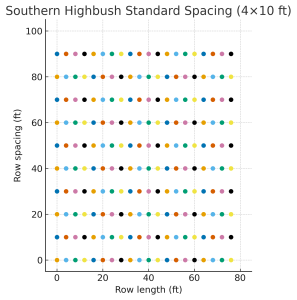
- Recommended Standard Spacing: Typically planted at 3 to 4 feet between plants within rows, with 10 to 12 feet between rows.
2. High-Density Southern Highbush Systems
- Best For: Intensive, high-yield production on meticulously managed, fully irrigated acreage.
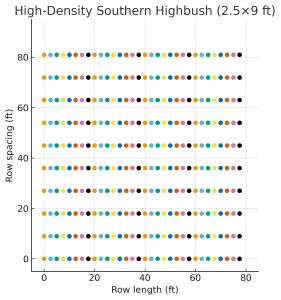
- Spacing: 2.5 feet × 9 feet.
- Overview: This ultra-intensive system accelerates early canopy closure and maximizes per-acre yields in the earliest years of production. However, it leaves zero margin for error; it demands absolute precision in automated irrigation, continuous weed control, and targeted fertigation to prevent nutrient competition and root disease.
3. Rabbiteye Blueberries
- Best For: Low-input growers, organic operations, or sites with limited irrigation infrastructure.
- Popular Cultivars: ‘Climax’, ‘Brightwell’, and ‘Powderblue’.
- Pros: Exceptionally vigorous, highly resilient, and tolerant of heavier soils. Once established, they possess deeper root systems that allow them to survive primarily on natural rainfall during moderate dry spells. They also exhibit strong natural resistance to many common root-rotting pathogens.
- Cons: Fruit ripens later in the season when market prices tend to drop due to nationwide supply volume. They generally require cross-pollination with multiple compatible varieties to ensure heavy fruit set.
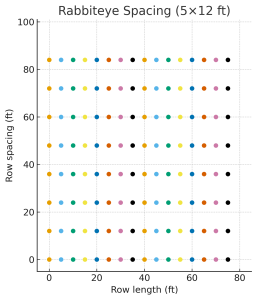
- Recommended Standard Spacing: Planted at 5 to 6 feet between plants, with 12 to 14 feet between rows to accommodate their larger mature shrub size.
Irrigation Considerations & Water Management
Water management is the linchpin of successful blueberry farming in North Florida. Because blueberries possess fine, fibrous, shallow root systems without root hairs, they are notoriously sensitive to both drought stress and waterlogged soils.
Overcoming Dry Springs
Columbia County frequently experiences unpredictable dry spring weather patterns right during the critical fruit-swelling and harvest windows. For Southern Highbush varieties, reliable irrigation is non-negotiable.
Microjet vs. Drip Irrigation
- Drip Irrigation: Highly efficient for delivering precise water volumes directly to the root zone. It minimizes weed growth between rows and supports highly efficient fertigation (injecting soluble fertilizers directly into the water stream to optimize plant nutrition).
- Microjet Systems: Provide a wider wetting pattern, which can be advantageous during establishment years in sandy soils to ensure root balls do not dry out at the edges.
Even though established Rabbiteye blueberries can theoretically survive on natural rainfall alone, installing dedicated irrigation rows remains the industry gold standard. Given the shifting and erratic precipitation trends recorded over recent growing seasons, supplemental irrigation guarantees consistent fruit sizing, prevents premature berry drop, and protects overall plant vitality.
Future Outlook: Building a Resilient Agribusiness
As agricultural markets evolve, diversification into high-value specialty crops like blueberries represents a proven strategy for long-term farm profitability in North Florida.
The future for Columbia County growers is exceptionally bright, driven by steady consumer demand for local foods, favorable climatic alignment, and ongoing advancements in high-density management and efficient irrigation technology. However, future success will belong to those who approach production with disciplined planning, rigorous pest scouting, and strict adherence to agronomic best practices.
With thoughtful variety selection, precise spacing geometries, and proactive water management, blueberries can transform from a simple experimental plot into a reliable, highly profitable agricultural enterprise that endures for decades to come.
For further technical assistance, soil testing protocols, or localized workshops, Columbia County growers are encouraged to reach out to the University of Florida/IFAS Extension office.

0 Comments