In an era dominated by instantaneous global positioning systems, digital mapping applications, and the relentless hum of the modern Anthropocene, the act of navigating via folded paper and printed ink has become an exercise in deliberate subversion. For writer and attorney Rob Rogers, stepping onto the trails of the Little Big Econ State Forest in Central Florida is not merely a recreational afternoon hike; it is an immersive, temporal expedition.
As Rogers locks his driver’s side door, stows his digital devices, and anchors his coordinates to a physical map, he engages in a conscious decoupling from the twenty-first century. This essay-turned-expedition explores how Florida’s remaining public lands serve as natural archives, preserving layers of human history that have been systematically paved over by strip malls, asphalt, and cookie-cutter suburban developments.
From the ranchlands that narrowly escaped developer bulldozers to the haunting, phantom echoes of nineteenth-century turpentine camps, the Second Seminole War, and the ancient Timucua fishing villages, this journey up the Econlockhatchee River reveals that true historical literacy in Florida requires abandoning the highway and returning to the brush.
Detailed Chronology: A Step-by-Step Historical Traverse
The Threshold of Modernity and the Rancher’s Legacy
The journey begins at the forest perimeter, where a stark reminder of contemporary land use confronts the traveler. A watchful range bull, eyeing hikers through the perimeter fencing, acts as a living emblem of the region’s recent past.
For generations, the fringes of the Little Big Econ were defined by cattle ranching and agricultural enterprise. However, as market forces evolved and real-time development pressures escalated, many legacy ranchers faced an existential choice: sell their ancestral plots to mass-market developers or donate them to state land preservation initiatives.
These conservation donations saved critical tracts from the steamroller of suburban expansion. Yet, as Rogers observes, the presence of livestock at the threshold serves as a jarring juxtaposition, highlighting how profoundly the geography of Central Florida has transformed within the span of a single human lifetime.
The Tunnel of Oaks and the Echoes of Forced Labor
Leaving the pastoral boundaries behind, the route pivots northward onto the River Trail. Here, the hiker enters a claustrophobic, verdant tunnel formed by slender live oaks. These trees are the second- and third-generation descendants of primeval giants that fell victim more than a century ago to the serrated iron teeth of industrial logging.
As the wind rustles through the canopy, the auditory landscape shifts. In the imagination of the mindful traveler, the quiet of the woods gives way to the sorrowful songs of Depression-era laborers and victims of Jim Crow-era penal systems. Long after the formal abolition of chattel slavery, marginalized populations were funneled into back-country turpentine and lumber operations under brutal convict-lease systems, performing grueling manual labor for corporate enrichment.
This acoustic phantom-zone is further haunted by the imaginary whistle of a Florida East Coast Railway locomotive. Though the steel rails have long been torn up and reclaimed by nature, the phantom depot still calls out in memory, recalling an era when ancient cypress and oaks were systematically carted away to build the burgeoning infrastructure of the American frontier.
The Econlockhatchee River and the Steamboat Era
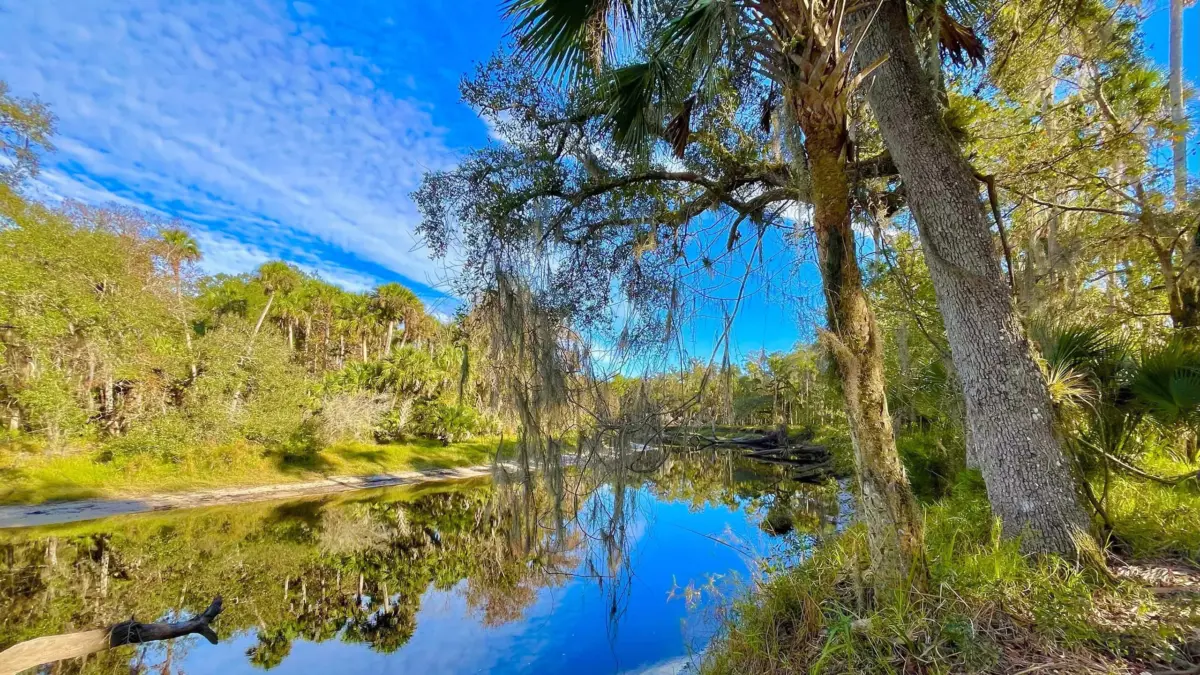
Pushing deeper into the wilderness, the trail intersects with the Econlockhatchee River. Today, it winds through a pristine, undisturbed basin, but centuries ago, this winding waterway functioned as a bustling water highway. Before locomotives and iron tracks civilized the interior, the Econlockhatchee carried early tourists, winter residents, and frontier traders deep into the heart of the Floridian peninsula.
During the dry season, the riverbanks and bluffs stand unsubmerged, allowing hikers to navigate the southern shore beneath a dense lattice of cypress trees and towering sable palms. In the atmospheric morning fog, one can almost conjure the surreal vision of a nineteenth-century paddle-wheeler chugging up the amber-tinted waters, its wood-fired boiler belching ash into the humid air as alligators slip quietly off sun-warmed sandbars.
The Shadows of the Second Seminole War
The expedition grows tense as the trail winds further downriver into the atmospheric haze. A sudden, deliberate rustling behind the traveler’s shoulder breaks the ambient quiet—too heavy and purposeful to belong to a native white-tailed deer or feral hog.
For a fleeting second, the imagination leaps back to the turbulent era of the Second Seminole War. This contested terrain, situated between historical outposts like Fort Mellon and Fort Christmas, witnessed fierce guerrilla skirmishes. The phantom flash of a native warrior sprinting into the dense palmettos, dissolving into war cries and distant musket fire, evokes the high-stakes asymmetric warfare that defined Florida’s territorial period. When the commotion fades, replaced once more by the screech of hunting hawks, the fragile peace of the forest returns.
The Timucua Presence at Culpepper Bend
Further along the banks, near the picturesque horseshoe curves of Culpepper Bend, the modern world vanishes entirely, replaced by the deep antiquity of the Timucua people. Piles of discarded freshwater mollusk shells—middens left behind by generations of indigenous inhabitants—mark the site of an ancient fishing village.
Though the physical structures are long gone, the sensory memory of the landscape remains potent. The omnipresent hum of fuel-injected engines and distant electrical towers dissolves, displaced by the phantom sounds of an eradicated language. The Timucua civilization, which once thrived along these riverways, was ultimately decimated not by steel or stone, but by invisible European pathogens introduced by early explorers—a tragic foundational chapter of Floridian history that remains inextricably tied to the soil.
Supporting Context & Metrics: Land Preservation and Heritage Tourism
The preservation of tracts like the Little Big Econ State Forest is part of a broader, statewide effort to safeguard Florida’s rapidly dwindling natural ecosystems against high-density urbanization.
Statewide Land Conservation Metrics: According to environmental planning data, Florida’s Rural and Family Lands Protection Program and the Florida Forever initiative have successfully conserved over 2.5 million acres of environmentally sensitive land since their inception. Despite these achievements, the state continues to lose an estimated 100,000 acres of rural and natural lands annually to development.
Historical Significance: The Econlockhatchee River basin represents one of the few remaining blackwater river systems in Central Florida that retains a largely intact riparian buffer. Ecologically, it serves as an essential wildlife corridor for black bears, panthers, wading birds, and migratory species.
Cultural Preservation: Historians note that Central Florida’s interior holds dozens of undocumented or semi-protected archaeological sites dating from the Archaic period through the Seminole Wars and the turpentine era. Academic resources, specialized regional memoirs, and local historical societies remain crucial for unearthing these narratives, which are frequently omitted from mainstream primary education curricula.
Official Statements and Expert Perspectives
Cultural historians, conservationists, and outdoor educators emphasize the critical psychological and educational value of untamed public lands.
"When we pave over a landscape to build master-planned communities and strip malls, we do not just displace wildlife—we sever the generational memory of the land," notes environmental historian Dr. Elena Vance. "Spaces like the Little Big Econ State Forest act as ecological libraries. Without them, future generations lose the ability to contextualize how modern Florida was forged through displacement, industrial exploitation, and ecological transformation."
Rob Rogers, reflecting on his backpacking journeys and his award-winning memoir Finding My Way Home: Fighting Depression Backpacking in Central Florida, underscores the personal and restorative dimensions of wilderness immersion:
"In a universe dominated by theme parks, digital distractions, and cookie-cutter asphalt, there are vanishingly few places left where you can truly connect with the people who walked these paths before us," Rogers explains. "It is only when we are untethered from the present, roaming free in our remaining natural spaces far from roads and bridges, that we can begin to discover what it actually means to be a Floridian."
Local park rangers and state forestry officials echo these sentiments, noting a steady rise in visitation to primitive trails as urban residents seek psychological refuge from high-stress digital environments. However, officials also stress the ongoing challenge of balancing public access with the rigorous preservation of sensitive archaeological and ecological sites.
Future Outlook: The Battle for Florida’s Remaining Wilds
As Central Florida’s population continues to skyrocket—fueled by thousands of new residents arriving weekly—the pressure on the state’s remaining greenbelts and state forests will only intensify. The future of spaces like the Little Big Econ hinges on aggressive state-level funding, vigilant conservation advocacy, and a cultural shift that values historical preservation alongside economic growth.
The humble paper map, crumpled in the pocket of a hiker returning from the bluffs of the Econlockhatchee, symbolizes a resilient resistance against total digitization and hyper-development. It serves as a physical key to unlocking hidden layers of heritage that have miraculously survived beneath the canopy.
For those willing to step off the paved walkways, silence their devices, and listen closely to the whispering oaks and rushing blackwater, Florida’s natural spaces will continue to tell their complex, unvarnished stories—ensuring that the ghosts of the past are never fully buried beneath concrete and asphalt.



0 Comments