

Executive Overview
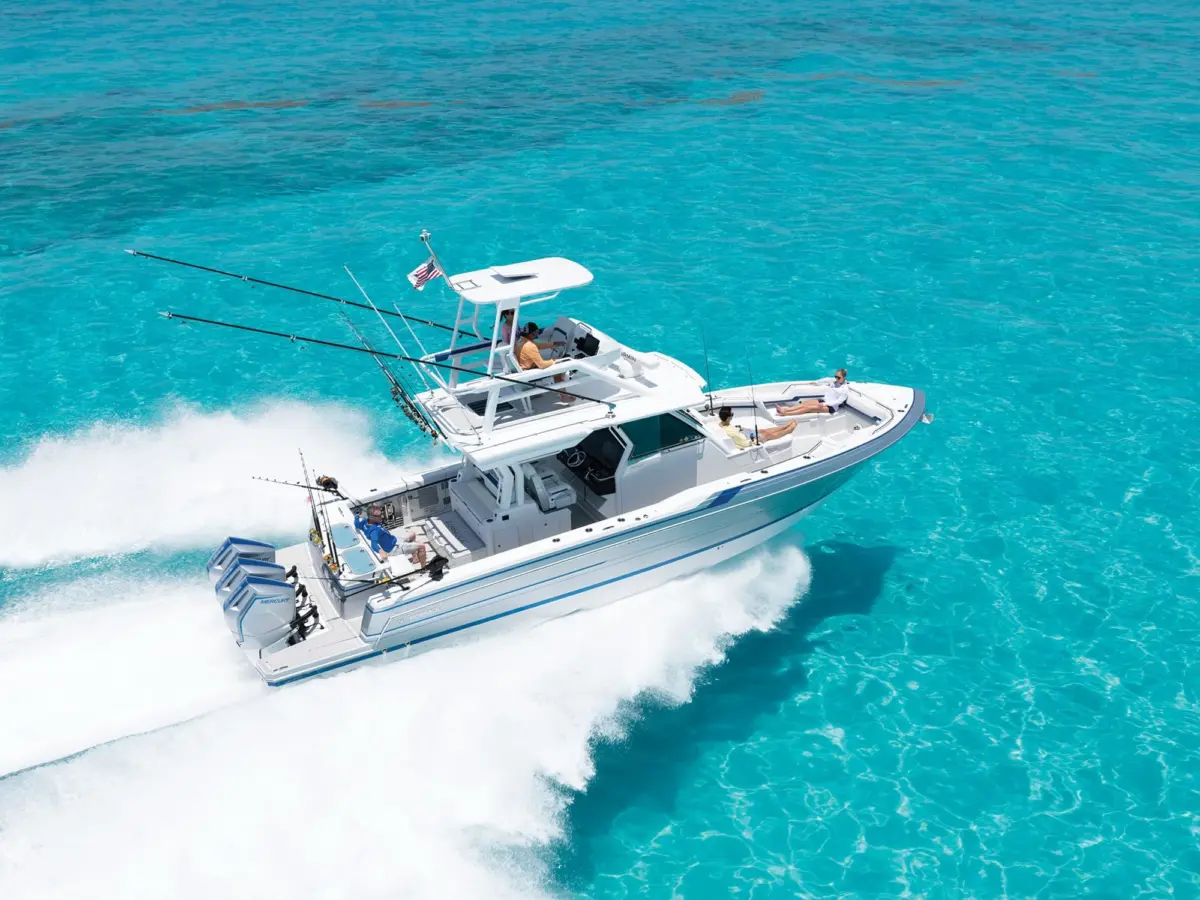
The evolution of the modern center console has long focused on compromises: balancing high-speed maneuverability with offshore comfort, and maximizing multi-angle fishability without sacrificing luxury accommodations. With the introduction of the new elevated second station on the Formula 387 CCF (Center Console Fish) Upper Station, Formula Boats has effectively neutralized these historical trade-offs. Debuting as a major option for the 2027 model year, this meticulously integrated tower transforms an already formidable tournament platform into an uncompromised command bridge machine.
Punched out past the notorious swells of Haulover Inlet in North Miami, Florida, testing conditions were far from calm. Yet, these less-than-ideal coastal waters provided the ultimate proving ground to test the true limits of the 11-ton, 41-foot-2-inch fishing platform. Equipped with triple Mercury 425 V-10 outboards, a Seakeeper 4 stabilization system, and the newly engineered tower, the 387 CCF Upper Station stands out not merely as an aesthetic upgrade, but as a masterclass in marine ergonomics, tournament-grade engineering, and high-performance hull design.
Detailed Chronology: A Test Drive Beyond the Inlet
Breaking Out of Haulover Inlet
The morning sun over North Miami revealed a choppy, restless Atlantic—ideal for highlighting the capabilities of Formula’s engineering investments. The primary objective of the sea trial was twofold: evaluate the real-world utility of the new upper helm station and test the vessel’s trolling readiness against a notoriously stubborn South Florida sargassum weed line.
As the boat idled through the inlet, the author made the ascent to the newly engineered upper command bridge. Unlike traditional, precarious tuna towers that require death-defying climbs, the 387 CCF features an intuitively designed internal transit route. The aft-facing mezzanine bench slides smoothly backward, revealing an electric slide-out cooler that functions as a heavy-duty, stable step up to the ladder hatch. Overhead, strategic grab handles ensure safe, three-point contact during transit.
Executing Plan A: Trolling and Rigging Innovation
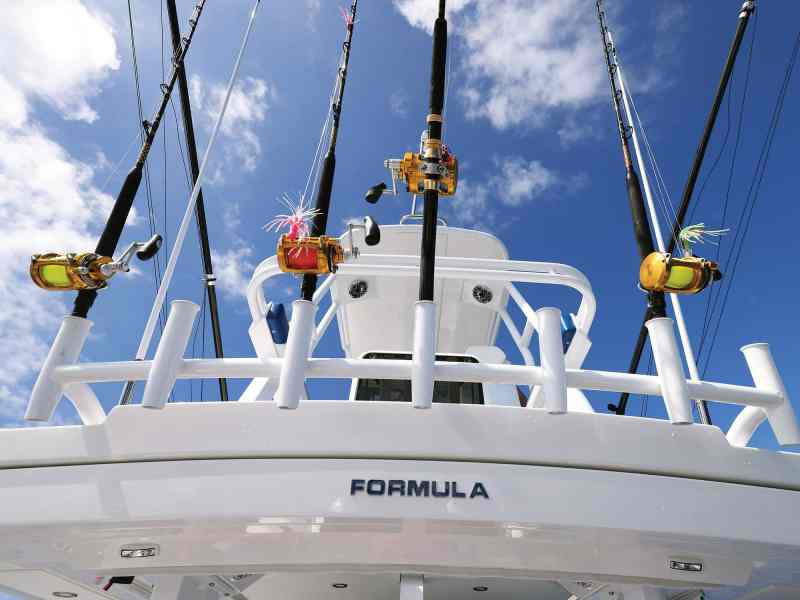
Once aloft, the panoramic view of the offshore swells was immediate. Aft at the cockpit, Formula veteran Vic Spellburg managed the throttles while product designer Abe Haines deployed the trolling spread. Haines demonstrated a clever, proprietary design touch: utilizing heavy-duty quick-release fender clips to rapidly deploy and secure the Gemlux outriggers—a practical modification born from thousands of hours spent both in CAD design studios and rocking on open waters.
Unfortunately, the Atlantic had other plans. South Florida’s recent heavy sargassum weed infestation immediately choked the trolling lines, turning the search for mahi-mahi into an endless cycle of clearing floating vegetation.
Shifting Gears to Plan B: Spotting and Performance
Abandoning the weed-choked trolling tracks, the crew transitioned to Plan B: hunting for floating debris and diving frigate birds from the elevated perch of the upper station. This pivot allowed the vessel to stretch its legs and demonstrate its raw performance characteristics.
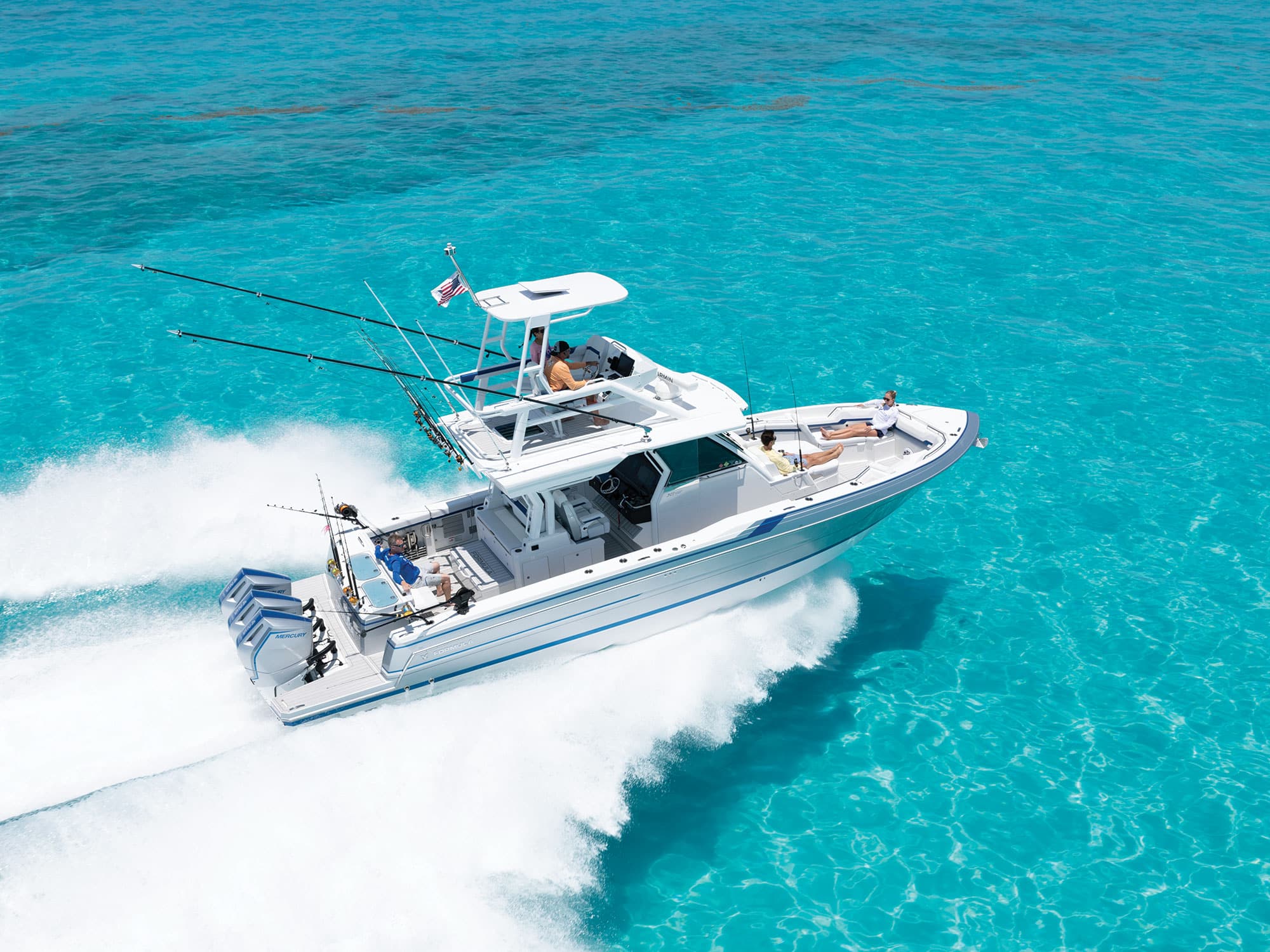
Powered by triple Mercury 425 V-10 outboards, the 387 CCF climbed effortlessly onto plane. The Fas³Tech multi-stepped hull forced high-volume air beneath the running surface, visibly reducing hydrodynamic drag while lifting the heavy transom. Up top, the starboard-side cushioned helm chair and port-side companion lounger offered a front-row seat to the boat’s high-speed stability. Even at a blistering top speed of 57.8 mph, the upper station remained remarkably free of violent buffeting, aided by the aerodynamic sweep of the hardtop structure.
Settling into Plan C: Deep-Water Bottom Fishing
With surface action proving sparse, the captain pivoted to Plan C: drifting over a local reef system. Spellburg engaged the Seakeeper 4 gyro stabilizer, instantly damping the rolling frequency and establishing a remarkably flat platform. In the expansive cockpit, ringed with plush coaming bolsters and deep toe kicks, the crew quickly brought up yellowtail snapper and grouper, proving the vessel’s seamless transition from high-speed cruiser to stationary fishing platform.
Supporting Context & Metrics: Architecture and Specifications
To fully understand the engineering triumph of the Formula 387 CCF Upper Station, one must examine the baseline architecture that supports its towering profile.
Hull Design and Propulsion Dynamics
The foundation of the 387 CCF is Formula’s proprietary Fas³Tech multi-stepped hull, paired with a deep-V configuration that tapers sharply to a 23-degree deadrise at the transom. This geometry cleaves through head-seas with minimal impact while providing dynamic lift at cruising speeds.
During the sea trial, fuel burn and performance metrics verified the efficiency of this hull form:
- Idle/Low Speed: Smooth maneuverability around docks via joystick controls.
- Mid-Range Cruise: A comfortable, highly efficient mid-20 mph range at 4,000 RPM.
- Fast Cruise: A fleet 36.8 mph cruising speed achieved at 4,500 RPM.
- Top End: An astonishing 57.8 mph maximum velocity driven by the 1,275 combined horsepower of the triple Mercury 425 V-10 outboards (with the hull rated up to 1,500 max horsepower).
Tournament-Ready Fishing Systems
Formula did not sacrifice fishing pedigree for luxury. The transom houses dual 40-gallon pressurized livewells equipped with multi-level LED-lit inlets to keep delicate live bait swimming naturally. These are backed by a redundant, auto-switching twin-pump system with helm alarms to eliminate offshore bait loss anxiety.
For the catch, twin 90-gallon insulated fishboxes isolate ice-melt and preserve table-fare quality. Directly behind the triple-wide helm seating, a comprehensive rigging station features a durable Corian countertop, a molded sink, and a removable cutting board. Rod storage is virtually limitless: rocket launchers line the hardtop, while specialized gunwale rodholder/cupholder combinations accommodate up to 30 rods onboard.
Belowdeck Accommodations and Comfort
When the rods are stowed, the 387 CCF transforms into an exceptional weekend cruiser. The cabin boasts an impressive 6 feet, 4 inches of headroom, housing a U-shaped lounge surrounding a dual-height table that converts effortlessly into a double berth. The fully appointed galley includes Corian countertops, a concealed sink, a microwave, a stainless-steel pull-out refrigerator, and a 32-inch HD Smart TV. A private head compartment features a Vacuflush toilet, vessel sink, and a hot/cold shower, all temperature-controlled via an 8,000 BTU marine air conditioning system.
Comprehensive Specifications Table
| Specification | Measurement / Detail |
|---|---|
| Length Overall (LOA) | 41’ 2” |
| Beam | 12’ 0” |
| Draft | 3’ 10” |
| Deadrise | 23 degrees |
| Fuel Capacity | 500 gallons |
| Dry Weight | 22,500 lbs. |
| Maximum Horsepower | 1,500 HP |
| Price As Tested | $1,885,530 |
Official Statements and Design Philosophy
The philosophy behind the 387 CCF Upper Station centers on accessibility and safety—two elements historically compromised in traditional tower design.
Abe Haines, key product designer for the 387 CCF series, emphasizes that every structural addition must serve a dual purpose without degrading the aesthetic lines of the boat. “We didn’t want a second station that felt like an afterthought or a hazard to climb into,” notes Haines. By integrating the electric slide-out cooler and the mezzanine step-ladder system, the design team eliminated the dangerous acrobatics typically required to reach tuna towers.
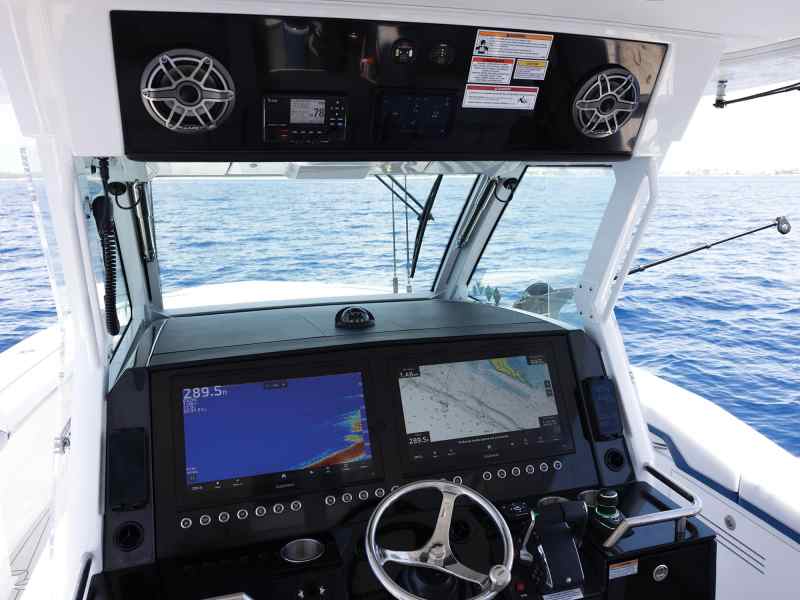
Furthermore, Formula’s engineering notes highlight the integration of the Wind-Armor system—clear acrylic weather doors that swing out from the console sides. This proprietary feature protects both the main helm and cockpit occupants from relentless wind blast and punishing salt spray during long offshore runs. Vic Spellburg reinforces this perspective, noting that the inclusion of the Seakeeper Ride system alongside the Seakeeper 4 gyro ensures that the vessel adapts dynamically to changing sea states, keeping operators fresh and focused whether standing at the main console or commanding from the aloft bridge.
Future Outlook: The Next Wave in Center Console Evolution
The introduction of the upper station option for the Formula 387 CCF marks a significant pivot point in the high-end center console market. As buyers increasingly demand the versatility of a multi-mission platform—capable of tournament sailfishing at dawn, family sandbar anchoring by afternoon, and comfortable overnight cruising by night—boatbuilders must innovate beyond basic cosmetic refreshes.
Formula’s execution of a fully integrated, easily accessible, and ergonomically sound second command bridge sets a new benchmark for the 40-foot class. By marrying high-performance stepped-hull dynamics with redundant tournament-grade fishing systems and luxury cabin amenities, the 387 CCF Upper Station proves that modern sportfishing yachts no longer require structural compromises. For serious anglers and luxury cruisers alike, this vessel establishes a formidable new standard on the water, ensuring that whatever the ocean conditions present—whether sargassum weeds or rolling swells—the captain and crew remain fully equipped for the mission ahead.

0 Comments