
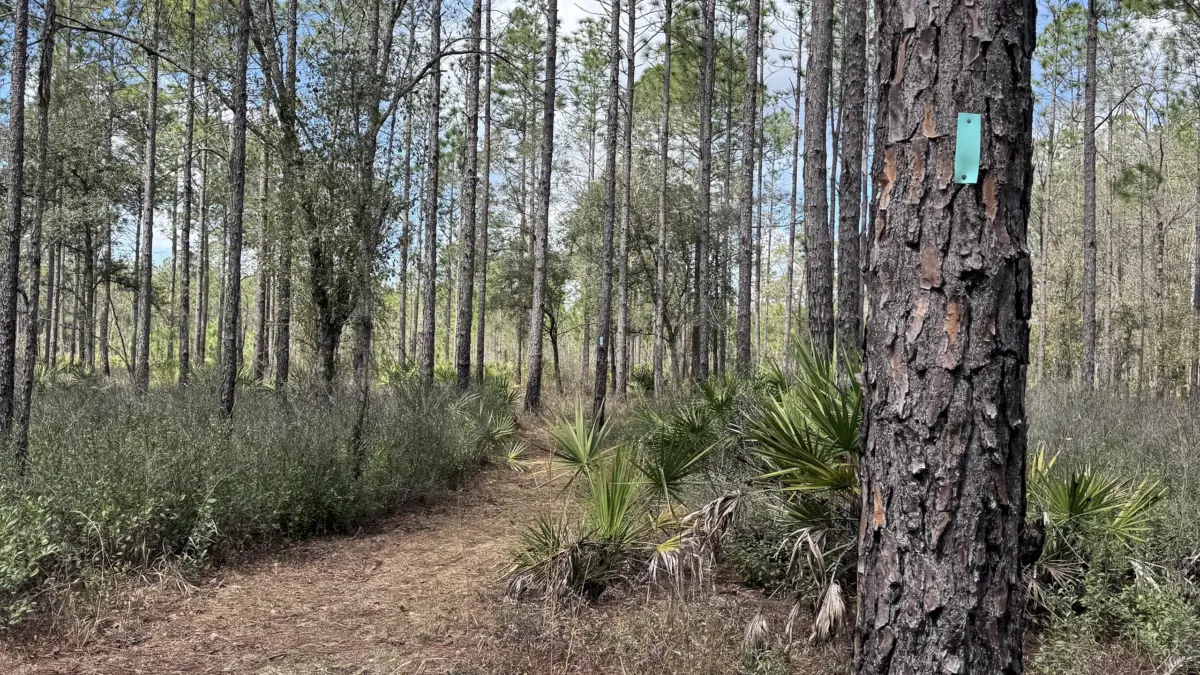

Tucked away in the sprawling expanses of Nassau County just northwest of Jacksonville, Florida, the Thomas Creek Tract of Cary State Forest offers an intimate encounter with the rugged, quietly enduring ecosystems of North Florida. While the forest’s southern sectors—featuring the popular Cary Nature Trail, established campgrounds, and bustling recreation hubs—frequently capture the attention of weekend campers and casual day-trippers, the lesser-traveled Thomas Creek Tract holds a distinct historical and ecological value. Centered around the Whittmore Mill Recreation Area, this northern sector is home to the Dahoma Historic Trail: a meticulously maintained, 1.1-mile hiking-only loop named in honor of the nearby, bygone unincorporated community of Dahoma.
Spanning more than 20 square miles, Cary State Forest as a whole serves as a vital ecological buffer and recreational asset managed by the Florida Forest Service (a division of the Florida Department of Agriculture and Consumer Services). However, the Dahoma Historic Trail functions on a more personal scale. It invites hikers to step back in time, tracing pathways that weave through timeless pine flatwoods, ancient cypress domes, and hardwood forests bordering the blackwater corridors of Thomas Creek. Despite centuries of intensive human alterations—including extensive historical logging and turpentine extraction operations that shaped much of the regional landscape during the 19th and 20th centuries—the tract retains a remarkable degree of biological integrity and natural resilience.

This report provides a comprehensive examination of the Dahoma Historic Trail, detailing its geographical setting, chronological trail progression, administrative guidelines, historical context, and its place within the broader network of North Florida conservation and outdoor recreation lands.
Detailed Chronology: Navigating the Dahoma Historic Trail
For the outdoor enthusiast or investigative traveler looking to experience the Dahoma Historic Trail firsthand, understanding the precise spatial and ecological progression of the route is essential. The journey begins at the Whittmore Mill Recreation Area, located off Jennifer Road in Callahan, Florida.

The Trailhead and Eastern Ascent
The adventure officially commences at the trailhead kiosk, where visitors turn left to follow the distinct blue blazes marking the route. Initial steps take hikers onto the eastern half of the loop, a slightly elevated and sun-drenched section of the path. Here, a well-defined footpath cuts directly through classic pine flatwoods. The canopy overhead consists of tall, slender pines, while the understory presents a rich, shrubby savanna dominated by native gallberry and dense saw palmetto.
Strategically placed interpretive signage flanks this initial stretch. Managed by land authorities to educate the public, these educational markers offer deep insights into the region’s complex flora, fauna, and environmental dynamics, emphasizing the concept of "Life in the Pines."

Wetland Transition and Cypress Domes
At approximately the quarter-mile mark, the trail dynamic shifts. The path curves deliberately toward the west, crossing a quiet forest road and passing a rustic wooden bench designed for quiet contemplation. Shortly thereafter, the trail skirts the edge of a striking cypress dome.
During drier seasonal cycles, adventurous hikers can explore the fringes of this depression, observing the broad, fluted bases of ancient cypress trees that thrive in these seasonally flooded lowlands. Breaks in the dense trailside foliage provide clear, unobstructed glimpses into the interior of the wetland basin, highlighting the stark ecological contrast between the dry flatwoods and the hydric soil communities.

Traversing Toward Thomas Creek
Continuing southward, the terrain undergoes a subtle shift in elevation. The forest floor becomes noticeably drier, and the vegetative makeup transitions to include scattered turkey oaks among the pines.
At the half-mile mark, following the authoritative blue blazes requires a sharp right turn onto a sandy forest road. Along this section, delicate clusters of deer moss carpet the left-hand side of the path. The topography here drops away noticeably, sloping downward into a rich, shadowed canopy of bay trees and thick hardwoods that demarcate the immediate watershed of Thomas Creek. The air cools slightly under the dense, multi-layered canopy as the trail hugs the edge of this thriving riverine ecosystem.

The Return Loop via Planted Pines
By the 0.7-mile mark, the trail begins its gradual climb away from the creek basin. A second well-placed wooden bench sits invitingly beneath the cooling, protective shade of a massive live oak tree, offering an ideal vantage point to rest and listen to the symphony of local wildlife.
Leaving the creek behind, hikers transition onto a wide, mowed pathway that points due north. This final quarter-mile leg guides visitors through a structured grove of planted pines, underscoring the managed nature of the working state forest. The loop ultimately closes as the path reconnects seamlessly with the Whittmore Mill Recreation Area trailhead, rounding out a satisfying, highly concentrated 1.1-mile trek.

Supporting Context & Metrics
To properly contextualize the Dahoma Historic Trail and plan a safe, regulation-compliant excursion, visitors must consult the official operational metrics and guidelines established by the Florida Forest Service.
Operational Metrics & Logistics
- Location: Callahan, Nassau County, Florida.
- Trail Length: 1.1 miles (closed-loop configuration).
- Trailhead Coordinates: 30.475056, -81.897306.
- Physical Address: Jennifer Road, Callahan, FL.
- Access Fees: A nominal fee of $2 per vehicle is required for entry, supporting site maintenance and conservation efforts.
- Restroom Facilities: None available on-site; visitors are advised to plan accordingly.
- Operating Hours: Open daily from sunrise to sunset.
- Land Manager: Florida State Forests (Florida Department of Agriculture and Consumer Services).
- Administrative Contact: 904-266-8398.
- Pet Policy: Leashed dogs are welcome to accompany hikers along the trail.
Safety Protocols & Seasonal Considerations
Cary State Forest is an active, multi-use public land. As such, seasonal hunting is permitted within designated areas and timeframes. Prospective visitors are strongly urged to check official hunting calendars in advance of their trip. Hikers choosing to visit during active hunting seasons must wear bright, high-visibility orange clothing for personal safety.

Additionally, because portions of the trail traverse low-lying flatwoods and wetland margins, footwear suited for damp or sandy conditions is recommended.
Driving Directions
Accessing the Dahoma Historic Trail requires attention to detail, as the turnoff can be easily missed. From Interstate 10 west of Jacksonville (near Baldwin), travelers should head north on US Highway 301 for approximately 14.4 miles. After passing the primary entrance to Cary State Forest, motorists will turn right onto Jennifer Road. This is a quiet, unpaved dirt road marked by a small, unassuming sign. Proceeding 0.4 miles down Jennifer Road leads directly to the dedicated trailhead parking area.

Official Statements and Forest Management Philosophy
The management of Cary State Forest—and by extension, the preservation of historical corridors like the Dahoma Historic Trail—reflects a delicate balance between active timber management, environmental conservation, and public recreation.
According to regional land management updates provided by the Florida Forest Service, state forests in Florida are managed under a multiple-use mandate. This philosophy dictates that public lands must simultaneously protect critical watersheds, maintain healthy wildlife habitats, support sustainable timber and forest product industries, and offer enriching recreational opportunities for citizens and tourists alike.

State forestry officials frequently emphasize that the presence of planted pine rows and the historical scars of past turpentine camps do not diminish a forest’s ecological worth. Instead, they serve as living testaments to the region’s socio-economic history. Interpretive signage installed along paths like the Dahoma Historic Trail represents a concerted administrative effort to bridge the gap between historical education and environmental stewardship. By understanding how the landscape was utilized during the 19th and early 20th centuries—when naval stores operations formed the backbone of the local economy—visitors gain a deeper appreciation for the forest’s remarkable capacity for natural regeneration and ecological recovery.
Furthermore, collaboration with outdoor advocacy groups, such as the Florida Trail Association, ensures that trails within Cary State Forest remain clearly blazed, safely cleared of natural debris, and accessible to the public. Trailmasters and forestry volunteers work in tandem to maintain infrastructure like footbridges, benches, and informational kiosks, ensuring that the human footprint within these sensitive habitats remains minimal and sustainable.

Future Outlook
Looking ahead, the long-term outlook for the Thomas Creek Tract and the Dahoma Historic Trail remains positive, anchored by ongoing state commitments to conservation land acquisition and passive recreation enhancement. As the greater Jacksonville metropolitan area continues to experience rapid suburban expansion and population growth, green spaces like Cary State Forest assume an increasingly critical role as ecological sanctuaries and urban escapes.
Future initiatives by the Florida Forest Service are expected to focus on climate resilience, invasive species management, and the careful application of prescribed fire regimens. Prescribed burning is an indispensable tool in maintaining the health of North Florida’s pine flatwoods and wiregrass ecosystems, preventing catastrophic wildfires while encouraging the growth of native understory plants that support local wildlife populations, including white-tailed deer, wild turkeys, and numerous avian species.

For hikers, naturalists, and history buffs, the Dahoma Historic Trail will continue to serve as an accessible, bite-sized window into the wild heart of Nassau County. Whether explored as a standalone 1.1-mile nature walk or paired with larger regional adventures—such as the Cary Nature Trail, Camp Milton Historic Preserve, the Jacksonville-Baldwin Rail Trail, or the Sal Taylor Creek Preserve—this hidden gem along Thomas Creek stands ready to educate, inspire, and ground visitors in the enduring natural heritage of the Sunshine State.

0 Comments