

Tucked discreetly away within the vibrant coastal city of Sarasota, Florida, lies Pinecraft—a community entirely unique within the Sunshine State. Long celebrated by the Amish and Mennonite diaspora as a quintessential winter sanctuary, this low-key enclave maintains a delicate balance between traditional plain lifestyles and the rapid, modern development of Southwest Florida. At the beating heart of this historic neighborhood rests Pinecraft Park, a modest municipal green space hugging the winding banks of Phillippi Creek.
Established initially in the 1920s as a seasonal tourist camp, the park and its surrounding enclave offer a captivating window into a culture defined by simplicity, community cohesion, and deep-rooted heritage. Visitors navigating the park’s grounds are routinely greeted by the distinct sight of residents dressed in plain clothing, navigating the neighborhood on three-wheel bicycles and conversing in Pennsylvania German dialects. Yet, beyond its cultural significance, Pinecraft Park serves as a vital ecological and recreational hub. Featuring a meandering 1.1-mile trail system—comprising both a paved waterside levee walk and a rugged, hurricane-impacted mesic hammock—the park presents a surprising mosaic of native flora, rare botanical specimens like the Pigmy fringetree, and crucial access for local paddlers.

This comprehensive report examines the complex layers of Pinecraft Park, detailing its rich history, the current state of its trail systems in the wake of severe storm events, its ecological value, and the broader socio-cultural landscape of Florida’s only permanent Amish and Mennonite settlement.

Detailed Chronology: Navigating the Trails of Pinecraft Park
A journey through Pinecraft Park is officially mapped out as a compact, 1.1-mile dual-experience walk that seamlessly bridges manicured community recreation with untamed, semi-tropical wilderness.

The Mesic Hammock Expedition
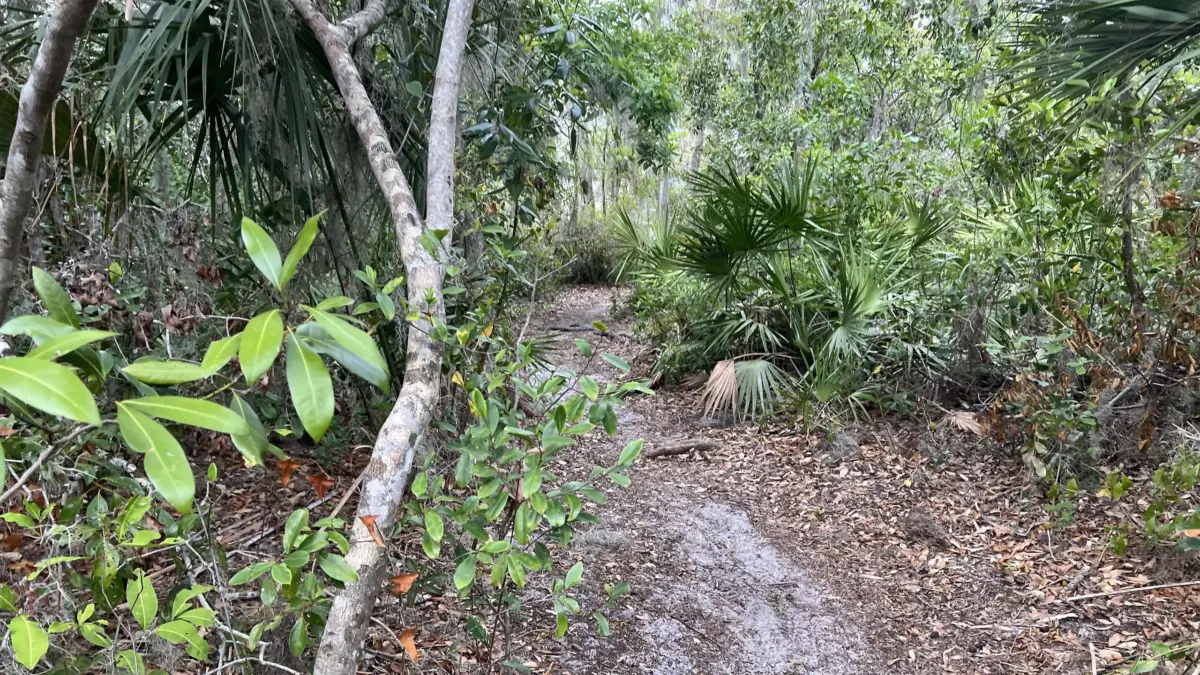
The adventure begins at the southern edge of the property, where a welcoming sign marks the threshold of the Mesic Hammock Trail. Stepping across a pedestrian bridge over Phillippi Creek transports hikers immediately from open park lawns into a dense, shaded canopy. Encountering a three-way junction, hikers typically bear left to embark on a clockwise circuit.

The overhead oak canopy, while historically robust, bears the visible scars of recent severe weather events like Hurricane Milton, leaving portions of the overhead shelter sparse, broken, and shredded. Beneath this recovering canopy, a narrow, unpaved footpath snakes tightly through a thicket of understory vegetation. Here, wild grapevines swarm neighboring trunks, while coral bean bushes display striking, spiky crimson blooms. Southern red cedar trees and patches of wild coffee further diversify the dense, green landscape.

As the footpath winds deeper south, hikers navigate a series of sharp turns and T-intersections, ducking beneath low-hanging branches of young trees and climbing past towering hickories and stands of marlberry. A strategic side excursion leads toward the park’s back gate, offering an unobstructed vantage point of a brisk stream flowing directly out of the adjacent residential neighborhood and emptying into the park’s main water bodies.

Returning to the main trail, hikers parallel the stream along a wooded bluff. Here, rare yellow trail blazes mark the path, cutting through a semi-tropical ravine heavily colonized by ornamental landscaping plants migrating from nearby properties. Further along the winding route, an unmistakable natural sculpture catches the eye: the curlicue trunk of a strangler fig whose roots and shape eerily mirror a musical clef from sheet music.

Traversing the Bluffs and Confluences
As the sandy path presses onward, it transitions through dense marlberry thickets and dips into a distinct hollow dominated by saw palmetto. A short sandy spur offers a rewarding detour to a bluff overlooking Phillippi Creek, revealing a rare, untouched natural shoreline along the otherwise heavily managed waterway.

Continuing the loop, the trail weaves gracefully among cabbage palms before descending to a secondary T-junction near the confluence of the neighborhood stream and the broader creek. A nearby warning sign cautions hikers of an active honey bee hive in the vicinity, underscoring the wild, untamed nature preserved within this urban pocket.

The trail culminates in a final, challenging uphill scramble along a narrowing, steep ridge. This final ascent reconnects hikers with the central path, guiding them past the musical-clef strangler fig once more and back across the entry bridge at the 0.6-mile mark.

The Paved Levee Walk
To complete the full 1.1-mile itinerary, visitors transition from the rugged dirt trails to a quarter-mile linear paved walkway. This paved path fronts a channelized portion of Phillippi Creek atop an elevated levee. Flanked by majestic live oaks and magnolias, the walk passes the park’s primary activity hubs: bustling children’s playgrounds, community picnic pavilions, and fiercely contested shuffleboard courts where Amish and Mennonite men gather daily for friendly athletic competition. A boat ramp situated just below the parking area provides an easy launch point for kayakers and paddleboarders looking to explore the wider reaches of Phillippi Creek.

Supporting Context & Metrics
Understanding Pinecraft Park requires examining the hard data, geographic parameters, and logistical frameworks that govern its daily operations and environmental upkeep.

Core Metrics & Facility Overview
- Location: Sarasota, Florida (Sarasota County)
- Total Trail Length: 1.1 miles (comprising 0.6 miles of unpaved mesic hammock trails and 0.5 miles of paved park pathways)
- Trailhead Coordinates: 27.319510, -82.503992
- Physical Address: 1420 Gilbert Ave, Sarasota, FL 34239
- Operating Hours: Open daily from 6:00 AM to 10:00 PM
- Admission Fees: Free to the public
- Amenities: Restrooms at the trailhead, picnic pavilions, children’s playground, shuffleboard courts, and a boat launch for non-motorized watercraft.
- Land Management: Maintained and overseen by Sarasota County Parks and Recreation (Contact: 941-861-5000).
- Regulations: Bicycles are strictly prohibited on the nature/mesic hammock trails (though unauthorized off-road tire tracks remain visible); pets are not permitted within the park grounds per posted county signage.
Botanical Significance: The Pigmy Fringetree
While the mesic hammock is heavily populated with aggressive invasive and ornamental plant species introduced from surrounding urban developments, it harbors a remarkable ecological treasure: the Pigmy fringetree (Chionanthus pygmaeus).

During the month of March, these rare shrubs burst into delicate, attention-grabbing ivory-green blooms that contrast sharply against the dark backdrop of surrounding saw palmetto. Nationally recognized as an endangered species native to Florida scrub ecosystems, Pigmy fringetrees are remarkably uncommon even within North Florida. Their presence in Pinecraft Park marks the absolute southernmost edge of their natural geographic range, transforming an ordinary county park into an unexpected hotspot for botanical conservation and study.

Geographic Accessibility & Directions
Reaching Pinecraft Park is straightforward for regional travelers and tourists alike.

- From Interstate 75: Take Exit 210 and head west on Fruitville Road to the very first traffic light.
- Turns: Turn left onto Cattlemen Road and proceed south for approximately 1.2 miles until reaching Bahia Vista Street.
- Enclave Entry: Turn right onto Bahia Vista Street and drive 3.2 miles straight through the beating heart of the Pinecraft community.
- Final Approach: Past Beneva Road, watch closely for Gilbert Ave on the left-hand side. Turn left onto Gilbert Ave and follow it for 0.2 miles through the quiet neighborhood streets directly to the park entrance on the right.
Official Statements & Community Impact
The coexistence of a vibrant, traditional religious enclave within a bustling, modern Florida metropolitan area has long been a subject of sociological fascination and municipal care.

Local authorities and community historians emphasize that Pinecraft Park acts as the indispensable social anchor for the enclave. According to Sarasota County park officials, the space was explicitly designed to accommodate the recreational and cultural needs of a population that intentionally abstains from many modern technological conveniences. The heavy utilization of the shuffleboard courts and picnic grounds underscores the park’s role as a generational gathering space where community ties are reinforced.

At the same time, environmental stewards from local conservation groups point to the delicate ecological balance maintained along Phillippi Creek. Representatives from Sarasota County’s environmental protection divisions note that managing urban parks like Pinecraft requires constant vigilance against invasive exotic plant species—which frequently spill over from residential landscaping into natural hammocks—while actively protecting sensitive indigenous species like the Pigmy fringetree.

Furthermore, community elders in Pinecraft have long maintained a cooperative, respectful relationship with municipal leaders, ensuring that the park remains a peaceful sanctuary where visitors can observe, but not disrupt, the quiet rhythms of traditional plain life.

Future Outlook
Looking ahead, Pinecraft Park and its surrounding enclave face a unique set of environmental and developmental challenges that will shape their trajectory in the coming decades.

Foremost among these challenges is ecological restoration following extreme weather events. The severe canopy damage inflicted by recent hurricanes, most notably Hurricane Milton, has permanently altered the structure of the Mesic Hammock Trail. The sudden opening of the forest canopy has accelerated the intrusion of aggressive vines and invasive flora, threatening to choke out native understory species such as wild coffee and the fragile Pigmy fringetree. Sarasota County land managers face an ongoing, labor-intensive battle to clear debris, suppress invasive species, and restore the natural integrity of the hammock without disrupting local wildlife or violating the quiet ambiance cherished by park visitors.

Simultaneously, the broader Pinecraft neighborhood experiences continuous pressure from the booming real estate market of Southwest Florida. As Sarasota expands rapidly, the boundaries of this historic enclave face increasing commercial and residential encroachment. Preserving the architectural modesty and cultural autonomy of Pinecraft while integrating modern stormwater management and infrastructure resilience along Phillippi Creek remains a top priority for local planners and community stakeholders.

Ultimately, Pinecraft Park stands as a resilient testament to cultural preservation and urban conservation. Whether visitors arrive to witness the rare spring blooms of the Pigmy fringetree, paddle the tannic waters of Phillippi Creek, or simply observe the peaceful, unhurried traditions of Florida’s only permanent Amish and Mennonite community, the park promises to remain an irreplaceable, low-key sanctuary within the heart of Sarasota for generations to come.

0 Comments