

Tucked discreetly into the urban fabric of Sarasota, Florida, lies Pinecraft—a unique community serving as the state’s only permanent Amish and Mennonite enclave. Established in the 1920s originally as a seasonal tourist camp, this low-key neighborhood has evolved into a vibrant cultural hub. At its geographical and social core sits Pinecraft Park, a modest county-managed green space edging the banks of Phillippi Creek. While widely recognized by community members as a tranquil winter getaway characterized by traditional three-wheel bicycles, distinct plain clothing, and spoken German dialects, the park also functions as an unexpected ecological sanctuary.
Recent field assessments, however, reveal a landscape in transition. Impacted severely by major meteorological events such as Hurricane Milton, the park’s mesic hammock exhibits a fragile balance between natural resilience and ecological stress. Despite broken tree canopies and an influx of ornamental invasive flora, the park harbors rare botanical treasures, including the southernmost range of the uncommon Pigmy fringetree. This investigative and descriptive report provides an authoritative overview of Pinecraft Park, blending cultural context, trail logistics, environmental analysis, and official municipal management insights to offer a comprehensive guide for visitors, naturalists, and local stakeholders.

Detailed Chronology & Trail Guide
A thorough exploration of Pinecraft Park requires navigating its distinct dual-personality layout: a manicured recreational area bordering Phillippi Creek and an untamed, rugged mesic hammock trail system. Designed for a total excursion of approximately 1.1 miles, the trail network transitions from social spaces to a semi-tropical wilderness.

The Recreational Core and Paved Walkways
The journey begins at the developed sector of the park, accessible via Gilbert Avenue. Here, visitors encounter a quarter-mile linear paved trail that fronts a channelized, ditched segment of Phillippi Creek. Below the parking area, a functional boat ramp serves as an active launch point for paddlers looking to navigate the tannin-stained waterways of the creek.

This developed zone is the social heart of Pinecraft Park. On any given day, visitors can observe Amish and Mennonite men congregating at the shuffleboard courts for competitive matches, while families utilize the adjacent picnic pavilions and playground facilities. The paved path is flanked by maturing live oaks and magnolias, serving as a levee barrier and offering an accessible route for casual walkers before they venture into the more rugged terrain of the park’s southern boundary.

Venturing into the Mesic Hammock Trail
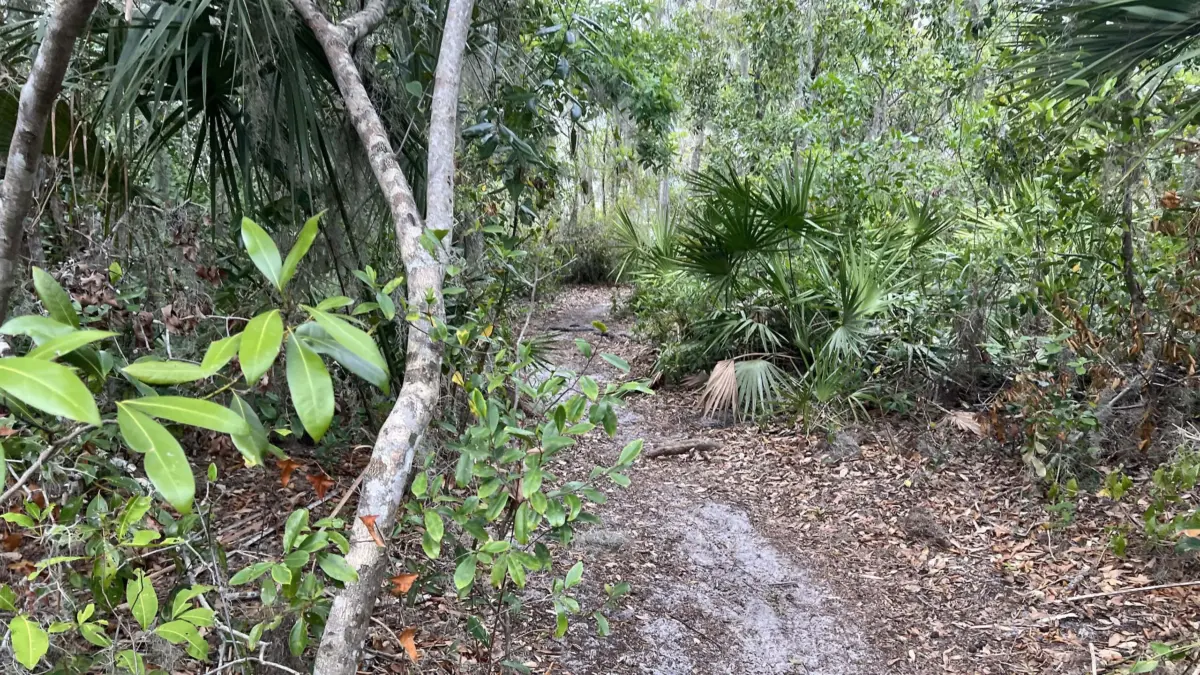
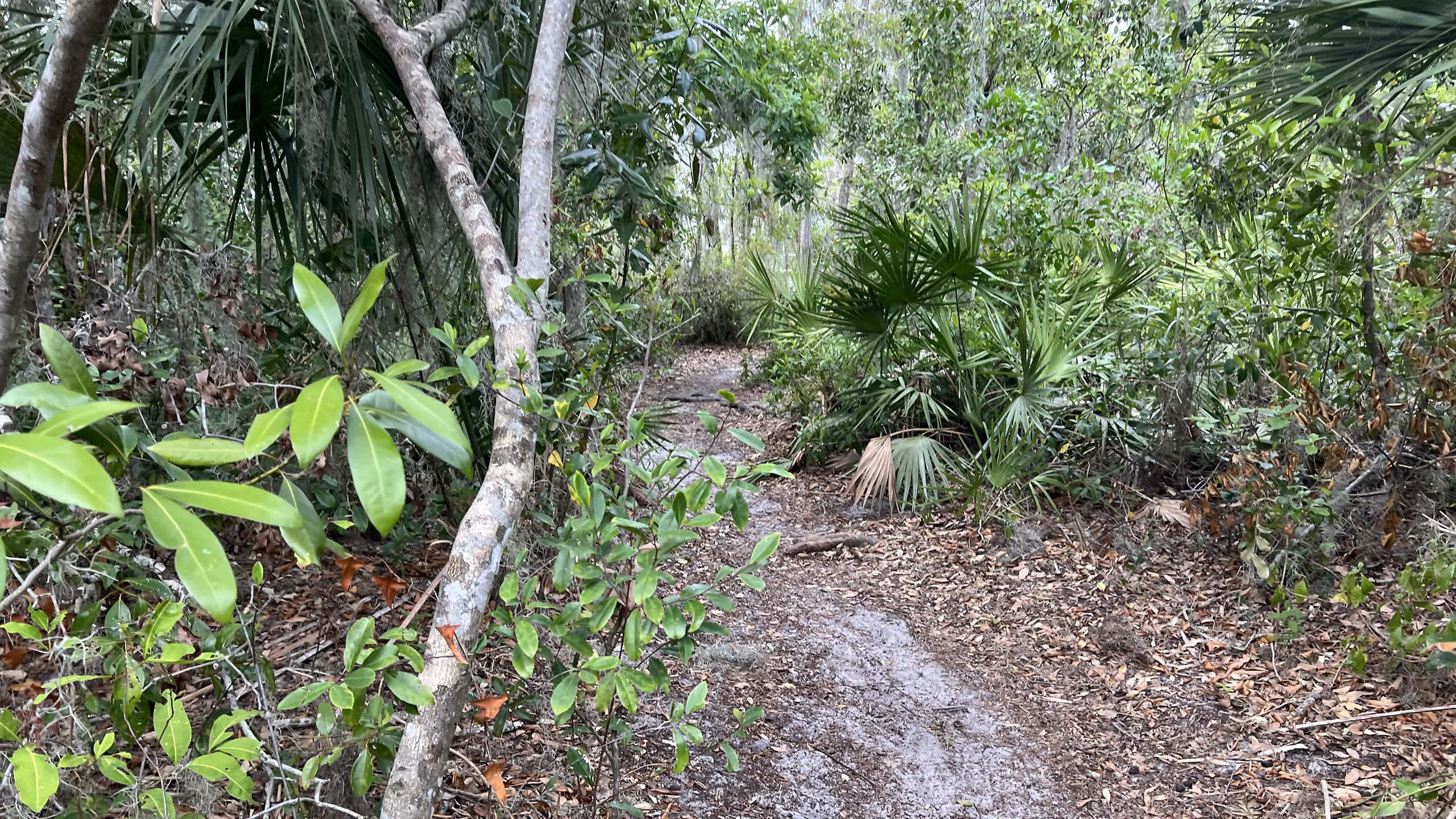
The true wilderness experience of Pinecraft Park begins at its southern edge, marked by a pedestrian bridge leading directly to the signposted Mesic Hammock Trail. Stepping across the bridge brings hikers to an immediate three-way junction. Choosing the left path initiates a clockwise circuit beneath an oak canopy that bears heavy scars from recent hurricane activity.

The footpath quickly narrows, winding through a thicket of dense understory vegetation. Here, native and invasive species entangle: wild grapevines swarm competing trees, and coral bean shrubs display vivid, spiky crimson blooms against a backdrop of saw palmetto. Southern red cedar and wild coffee further punctuate the leafy litter.

Navigating the trail requires careful attention, as unauthorized off-road bicycle use—despite official prohibitions—has contributed to a braided network of unofficial paths. Moving past a T-intersection where the left fork dead-ends, the route bears right, channeling hikers through a tight corridor of foliage past a towering hickory tree.

Stream Confluences and Botanical Discoveries
As the path loops deeper into the hammock, it crosses a series of rolling, undulating slopes. Approaching a stand of marlberry, a left turn leads toward a dramatic descent beneath massive live oaks, terminating briefly at a back gate overlooking a stream vigorously discharging neighborhood runoff into the park.

Returning to the main loop and tracking the stream along a wooded bluff, hikers encounter the first official trail marker: a solitary yellow blaze carved into a tree trunk. The path hugs the edge of a ravine, where a narrow, largely obscured waterway snakes through a cleft choked with aggressive residential landscaping plants.

Ascending past an arresting natural sculpture—a strangler fig whose twisted trunk uncannily resembles a musical treble clef—the sandy path weaves through a marlberry thicket. At approximately 0.3 miles, the trail approaches a junction near the entrance bridge. Taking the left fork sends hikers on a steep descent into a cool hollow dominated by saw palmetto. A short sandy spur leads to an elevated bluff overlooking a rare, natural, un-channeled shoreline of Phillippi Creek.

Continuing the loop, the path traverses a confluence where the neighborhood stream merges with the wider, tannic flow of Phillippi Creek. A final, rigorous climb up a steep ridge—marked by caution signage regarding local honey bee hives—forces a steady scramble through a narrowing vegetation corridor. Reconnecting with the central trail, hikers retrace their steps past the musical-clef strangler fig and cross back over the entry bridge at the 0.6-mile mark.

Completing the remaining distance requires returning to the paved park levee, where a round-trip past the playground, picnic areas, and bustling shuffleboard courts rounds out the total 1.1-mile journey.

Supporting Context & Metrics
Environmental Metrics and Geographic Data
- Location: Sarasota, Florida (Sarasota County)
- Total Trail Length: 1.1 miles (comprising a 0.6-mile natural hammock loop and a 0.5-mile paved park/levee walk)
- Trailhead Coordinates: 27.319510, -82.503992
- Physical Address: 1420 Gilbert Ave, Sarasota, FL 34232
- Operating Hours: Daily, 6:00 AM to 10:00 PM
- Admission Fees: Free
- Amenities: Restrooms at the trailhead, boat launch for paddlers, picnic pavilions, playground, and dedicated shuffleboard courts.
- Restrictions: Bicycles are strictly prohibited on the nature/mesic hammock trail; pets are not permitted within the park per local signage.
Botanical Significance: The Pigmy Fringetree
While the mesic hammock is heavily impacted by ornamental invasive plants introduced from surrounding residential lots, it plays host to a remarkable native species of high botanical value: the Pigmy fringetree (Chionanthus pygmaeus).

In March, these plants produce striking ivory-green blooms that contrast sharply against the surrounding saw palmetto. The presence of the Pigmy fringetree in Pinecraft Park is notable because the species is exceptionally rare even within its native North Florida habitats. Sarasota County represents the absolute southernmost boundary of its geographic range, making the park an unexpected micro-refuge for rare regional flora despite its heavy urban enclosure.

Official Statements & Land Management
Pinecraft Park is owned and managed by Sarasota County Parks, Recreation and Natural Resources. Municipal management focuses on balancing the recreational needs of a dense urban population and a culturally distinct tourist community with the ecological stewardship of a fragile riparian corridor.

In official communications, county land managers emphasize the challenges posed by severe weather events. The impact of Hurricane Milton left widespread structural damage throughout Phillippi Creek’s surrounding green spaces, including snapped hardwoods, fractured canopies, and accelerated erosion along the creek’s bluffs.

Furthermore, park authorities continually address human-induced pressures on the natural areas. Despite clear signage prohibiting bicycles on the unpaved nature trails, enforcement challenges persist. Unauthorized off-road cycling has widened fragile footpaths, accelerated soil compaction, and disturbed sensitive understory zones. Sarasota County Parks maintains an active dialogue with local community associations to encourage responsible stewardship, ensuring that visitors respect both the cultural heritage of Pinecraft and the fragile ecological integrity of the Phillippi Creek watershed.

Future Outlook
As Sarasota continues to experience rapid commercial and residential development, green spaces like Pinecraft Park face mounting pressures from urban sprawl, stormwater runoff, and recreational overuse. The long-term viability of the park’s natural systems depends heavily on active habitat restoration and adaptive management strategies.

Future municipal initiatives are expected to focus on invasive species eradication—targeting the dense thickets of ornamental plants choking the mesic hammock—alongside native replanting efforts to fortify the canopy against future tropical storm events. Additionally, trail hardening and clearer demarcation of pedestrian routes may be implemented to mitigate the unauthorized bicycle traffic that currently degrades the fragile soils of the hammock.

For the Amish and Mennonite communities who have cherished Pinecraft as a winter haven for nearly a century, and for the broader Sarasota public seeking a quiet connection with nature, Pinecraft Park remains an invaluable cultural and natural intersection. Preserving its dual identity as a vibrant social gathering space and an urban wildlife refuge will require continued cooperation between local government agencies, conservationists, and the community members who call this unique Florida enclave home.

0 Comments