Tucked discreetly behind sprawling central Florida ranchlands and moisture-laden swamps southeast of Sebring lies Lake Istokpoga, the state’s fifth-largest body of open water. Spanning nearly 42 square miles, this aquatic expanse serves as an essential nexus for regional recreation, drawing anglers, boaters, and airboat captains to its vibrant, wildlife-rich waters. While much of the shoreline remains privately held or inaccessible, Lake Istokpoga Park functions as the area’s premier public gateway. Managed by Highlands County, this unassuming trailhead provides the public with a rare, immersive window into a landscape defined by towering ancient cypresses, dense floodplain forests, and panoramic aquatic vistas.
Recent field evaluations of Lake Istokpoga Park highlight a meticulously maintained, 0.6-mile loop trail system that combines elevated boardwalks with natural surface footpaths. Designed to accommodate both casual walkers and dedicated nature enthusiasts, the trail navigates a complex ecological transition zone where land meets water. Despite its modest length, the route offers a rich sensory experience, characterized by the gentle undulation of boat channels, the rustling of a fern-carpeted forest floor, and unobstructed horizons stretching across open water dotted with water lilies. As regional eco-tourism continues to evolve, understanding the infrastructural layout, ecological characteristics, and logistical framework of destinations like Lake Istokpoga Park becomes paramount for visitors seeking a genuine encounter with Old Florida.
Detailed Chronology & Route Breakdown
Navigating the 0.6-mile loop at Lake Istokpoga Park requires a keen eye for its diverse structural and ecological waypoints. The journey begins near the primary picnic grounds, where visitors must first navigate the park’s dual-purpose boater parking infrastructure. From this staging area, a well-defined boardwalk pulls walkers directly into a striking, cathedral-like stand of large cypress trees, immediately establishing an atmosphere of quiet isolation from the adjacent parking facilities.
Upon crossing the boater parking area, hikers step onto the initial boardwalk section, which threads through the aforementioned cypress strand. Emerging momentarily within sight of the active boat ramps, trail users are instructed to remain strictly behind the yellow safety posts defining the left edge of the ramp infrastructure. This brief transitional zone quickly gives way to a secondary boardwalk system that tops the concrete seawall, running parallel to the primary boater navigation channel.
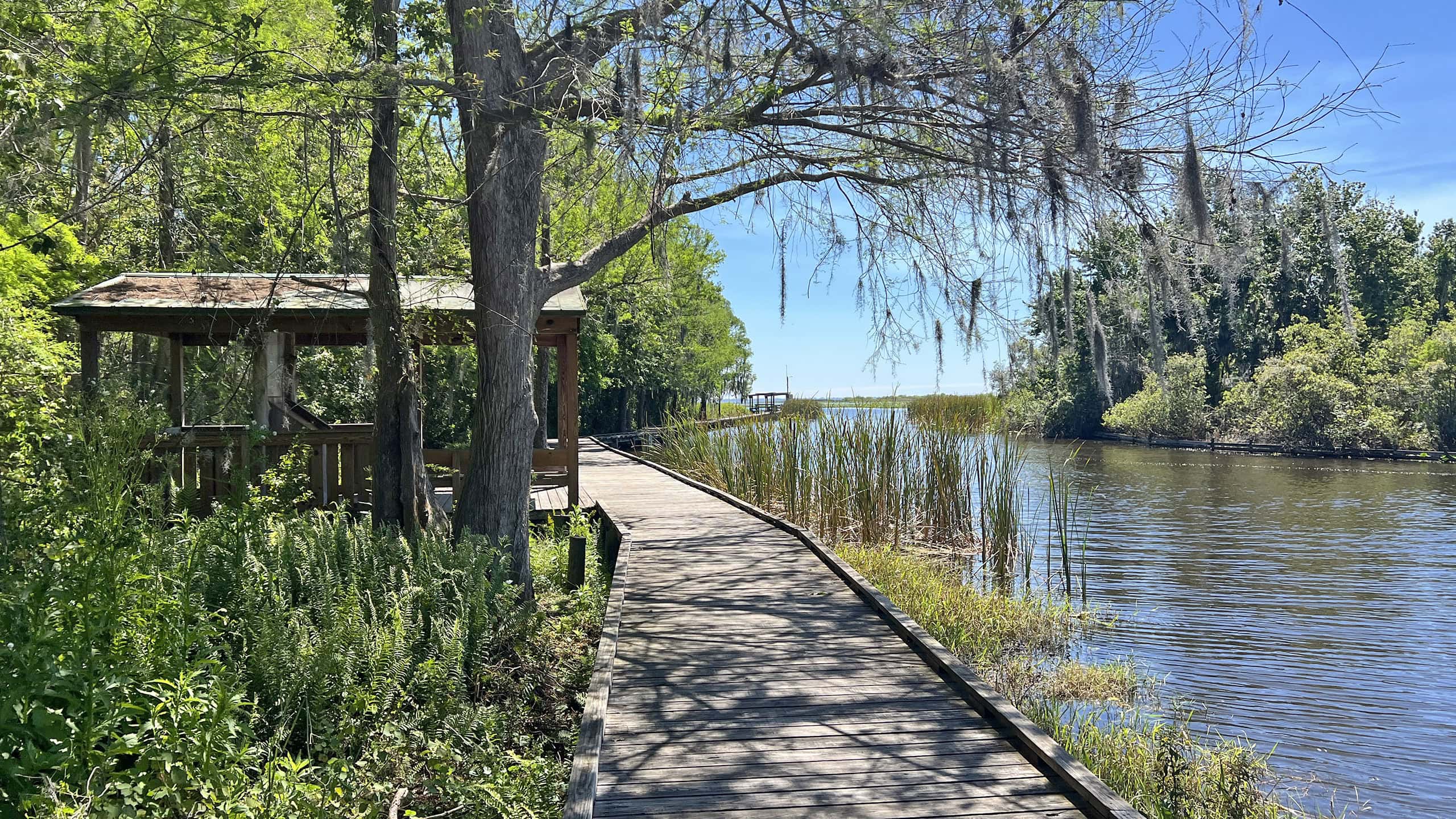
Here, ancient cypress trees overhang the water, casting deep shadows across the channel and providing a cool, sheltered microclimate. Positioned along this stretch is the first of several roofed wooden shelters. Outfitted with comfortable benches, this waystation features specialized interpretive information detailing prime regional fishing locations, nodding to the lake’s legendary status among freshwater anglers. Continuing past this shelter, the boardwalk hugs the edge of the scenic channel, offering sweeping visual access into the dense, untamed floodplain forest.
Traversing the Open-Water Boardwalks
At a distinct junction marked by a prominent lamppost, the trail splits. To maintain the intended round-trip loop, hikers bypass the left-hand spur and continue outward across the open waters of the marsh. As the trail emerges from the heavy canopy of the cypress strand, the boardwalk transitions to an elevated expanse hovering directly above a sprawling, swampy cove. In this sun-drenched sector, vibrant primrose willow grows in dense, aggressive clusters, competing for space with native aquatic vegetation.
A second roofed shelter along this section serves as an exceptional perch for avian observation, allowing birdwatchers to scan the marsh for wading species while enjoying a framed perspective back toward the mainland shore. Moving forward, the marsh environment gradually opens into a vast expanse of open water heavily decorated with blooming water lilies. A third and final shelter marks the formal 0.25-mile turn-around point of the board-walked route.
Engineering Note: During peak periods of recreational boating, water displaced by passing watercraft frequently travels beneath the elevated platforms. This hydrodynamic effect causes the boardwalk to gently undulate, an experience that can occasionally prove disorienting to pedestrians.
Aviation and Avian Activity: The convergence of open water and sheltered coves creates an ideal foraging habitat for local raptors, wading birds, and migratory waterfowl, making this open-water stretch a focal point for wildlife photography.
The Return via Forested Berms and Hammocks
Upon reaching the final overwater shelter and absorbing the panoramic horizon of Lake Istokpoga, hikers retrace their steps across the cove of primrose willow, re-entering the protective shade of the shoreline cypresses. At this juncture, visitors take a sharp right onto the spur boardwalk previously bypassed at the lamppost junction. This elevated wooden pathway spans a lush, fern-rich understory, eventually depositing walkers onto a grassy, fern-lined earthen berm.
This berm leads directly into the dappled interior of the lakefront forest, where the trail broadens into a distinct, natural-surface green swath. At approximately 0.4 miles, the path introduces notable natural landmarks, including a wooden bench backed by a dense scrim of native vegetation, followed shortly by a striking split oak tree that dramatically arches over a secondary resting spot.
As the ground transitions from grass to a rich, leafy forest floor, the footpath deepens into a subtle indentation woven gracefully between mature cypresses, live oaks, and southern magnolias. Departing the immediate lakefront, the route transitions back onto an enclosed boardwalk system traversing an exceptionally dense floodplain forest choked with vibrant ferns. This final boardwalk straightaway, flanked by rows of young cypress trees, discharges directly onto the grassy eastern perimeter of the park’s central lawn. A final left turn channels visitors through a meticulously planted, oak-lined corridor, safely returning them to the parking grounds and completing the 0.6-mile circuit.
Supporting Context & Metrics
Evaluating Lake Istokpoga Park requires analyzing its physical dimensions, geographic positioning, and the logistical parameters established by its managing authority.
Core Metrics and Data Points
Official Location: Lorida / Sebring region, Highlands County, Florida.
Total Trail Length: 0.6 miles (loop configuration).
Physical Address: 720 Istokpoga Park Access Rd, Sebring, FL.
Access Fees: Completely free of charge to the general public.
Operational Hours: Open daily from sunrise to sunset.
Pet Policy: Leashed dogs are welcome; strict waste removal enforcement applies.
On-Site Amenities: Public restrooms located adjacent to the main picnic area; covered picnic pavilions; multiple shaded rest shelters along the boardwalk network.
Access and Logistical Framework
Reaching the trailhead requires specific navigational awareness. Travelers approaching from the south of Sebring via US 27 must transition eastward onto US Route 98, proceeding for exactly 8.2 miles. From US 98, motorists turn right onto Istokpoga Park Access Road, traveling an additional 0.3 miles before executing a final left turn into the designated parking infrastructure.
Park planners have thoughtfully segregated vehicular traffic: motorists hauling boat trailers are directed to park closest to the boat ramp and the initiation point of the trail system, while standard passenger vehicles find optimal placement near the shaded picnic grounds and sanitary facilities.
Official Statements and Local Management
Management of Lake Istokpoga Park falls under the jurisdiction of the Highlands County Board of County Commissioners (specifically overseen through the county’s Parks and Facilities Department). County literature and official site documentation emphasize that the park is designed to balance active water-based recreation with passive ecological appreciation.
"Lake Istokpoga Park serves as our community’s primary portal to one of Florida’s most ecologically significant aquatic environments," notes the Highlands County Parks Department in administrative briefs. "Our goal is to maintain minimal-impact infrastructure—such as elevated boardwalks and natural-surface footpaths—that allows residents and tourists to experience the native floodplain and cypress ecosystems without disrupting the delicate balance of the surrounding wildlife habitats."
Furthermore, county facilities management routinely highlights the dual-use nature of the park. While local anglers utilize the single public boat ramp to access the lake’s famous bass and speckled perch populations, casual visitors and hikers are encouraged to utilize the interpretive trail system to foster a deeper appreciation for watershed conservation. Park rangers actively enforce leash laws and sanitation protocols to preserve the pristine nature of the oak hammock and ensure harmonious coexistence between human visitors and the abundant local wildlife—including the notoriously bold resident squirrel population, which park authorities explicitly warn visitors not to feed.
Future Outlook
As central Florida experiences sustained population growth and increasing residential development pressures along its rural fringes, the long-term preservation of semi-wild sanctuaries like Lake Istokpoga takes on heightened urgency. Regional planners anticipate that public parks offering low-impact recreational access will face increased visitation rates in the coming decade.
To address these projected increases without compromising ecological integrity, Highlands County land managers continue to monitor trail erosion, boardwalk structural integrity, and invasive vegetative species (such as the persistent primrose willow encroaching upon the park’s coves). Future initiatives will likely focus on reinforcing boardwalk pilings against fluctuating water tables, enhancing interpretive signage regarding the lake’s unique watershed dynamics, and maintaining the seamless integration between motorized boating infrastructure and pedestrian nature paths. Through proactive oversight, Lake Istokpoga Park is positioned to remain a vital ecological refuge and a cherished outdoor recreation site for generations to come.








0 Comments