

The landscape of North Central Florida conservation has undergone a subtle yet significant transformation with the public integration of the Longleaf Ecology and Forestry Society (LEAFS) Preserve. Managed by the Alachua Conservation Trust (ACT) following a pivotal 2022 land donation by property stewards John and Mary Lou Winn, the preserve stands as both a testament to grassroots environmental stewardship and a living laboratory for longleaf pine (Pinus palustris) ecosystem restoration. Originally established as a non-profit organization in 1993, LEAFS was founded with the explicit mission to showcase, study, and protect the intricate ecology of the longleaf pine—a keystone species that historically blanketed vast swaths of the American Southeast before industrial logging and fire suppression reduced its range to a fraction of its former glory.

Today, the North Tract of the LEAFS Preserve—accessed seamlessly via the county-managed Lake Alto Park near Waldo—offers outdoor enthusiasts, botanists, and casual hikers an intimate 1.2-mile interconnected loop system. Comprising the 0.9-mile Blueberry Trail and the 0.3-mile Lake Edge Trail, this protected sanctuary provides a masterclass in regional topography, shifting seamlessly from high, dry upland pine corridors down to the moody, cypress-draped shores of Lake Alto. As regional development pressures mount across Alachua County, the preservation of tracts like LEAFS represents a critical bulwark in maintaining ecological connectivity, safeguarding vital watersheds, and providing the public with low-impact recreational access to unspoiled Florida wilderness.

Detailed Chronology
The trajectory of the LEAFS Preserve spans over three decades, tracing a path from private ecological vision to institutional conservation asset.

1993: Foundation and Ecological Vision
The narrative of LEAFS began in 1993 with the formal incorporation of the Longleaf Ecology and Forestry Society. Conceived as a non-profit organization by founders dedicated to preserving native pine flatwoods and sandhills, the society sought to demonstrate that private landownership could successfully harmonize active forestry principles with rigorous ecological conservation. For decades, the property—owned and lovingly stewarded by John and Mary Lou Winn—served as a private sanctuary and educational touchstone for regional foresters and naturalists interested in the propagation and management of longleaf pine communities.

2022: The Transition to Public Trust
Recognizing the necessity of long-term institutional protection for their life’s work, John and Mary Lou Winn executed a landmark agreement in 2022, donating the entirety of the property to the Alachua Conservation Trust (ACT). This transfer ensured that the land would be permanently shielded from residential and commercial fragmentation. ACT, a nationally accredited land trust known for its aggressive pursuit of conservation easements and acquisitions across North Central Florida, immediately integrated the property into its growing portfolio of public preserves, dividing the sanctuary into distinct management tracts designed for controlled public engagement.

Modern Era: Trail Development and Public Access
Following the transfer of ownership, ACT, in collaboration with local trail advocates and land managers, established a codified infrastructure of trails, informational kiosks, and blazed routes across the preserve’s North Tract. By tying access directly into the existing footprint of Alachua County’s Lake Alto Park, land managers created a cohesive recreational node. The formal introduction of the Blueberry Trail (marked by blue diamonds) and the Lake Edge Trail (marked by orange diamonds) transformed the private family sanctuary into an accessible, educational hiking destination, officially welcoming the public from sunrise to sunset.

Supporting Context & Metrics
Understanding the ecological and logistical footprint of the LEAFS Preserve North Tract requires an examination of its physical metrics, geographical positioning, and the biological communities that call it home.

Geographical and Logistical Specifications
- Location: Waldo, Florida (Alachua County)
- Total Trail Length: 1.2 miles (comprising the 0.9-mile Blueberry Trail and 0.3-mile Lake Edge Trail)
- Land Manager: Alachua Conservation Trust (ACT)
- Physical Address: 17800 NE 134th Place, Waldo, FL 32669
- Coordinates: 29.778389, -82.135139
- Operating Hours: Open daily from sunrise to sunset
- Access Fees: Free to the public
- Amenities: Restrooms located at the Lake Alto Park trailhead; leashed dogs permitted
Botanical and Ecological Profile
The preserve’s vegetative communities offer a textbook illustration of North Florida’s transition zones. Along the upper elevations of the trail corridors, hikers traverse dry upland forests dominated by a mixture of mature and regenerating longleaf pines, punctuated by sparkleberry, various oak species, and loblolly bay.

A notable aspect of the forest floor is the duality of its management history: while certain sections clearly display the linear geometry of historic planted pine rows, other tracts have successfully rewilded, allowing dense, native understories of saw palmetto (Serenoa repens) to reclaim the landscape. This mosaic of structured forestry and natural succession provides critical habitat for native fauna, including small mammals, avian species adapted to open pine ecosystems, and various reptiles native to the Floridan aquifer’s recharge zones.

Route Breakdown and Navigation
The hiking experience on the North Tract is designed for accessibility while offering immersive wilderness views:

- The Trailhead Initiation: Beginning at the southwestern corner of the Lake Alto Park parking lot, hikers pass an informational kiosk and immediately join a short segment of the blue-blazed Blueberry Trail.
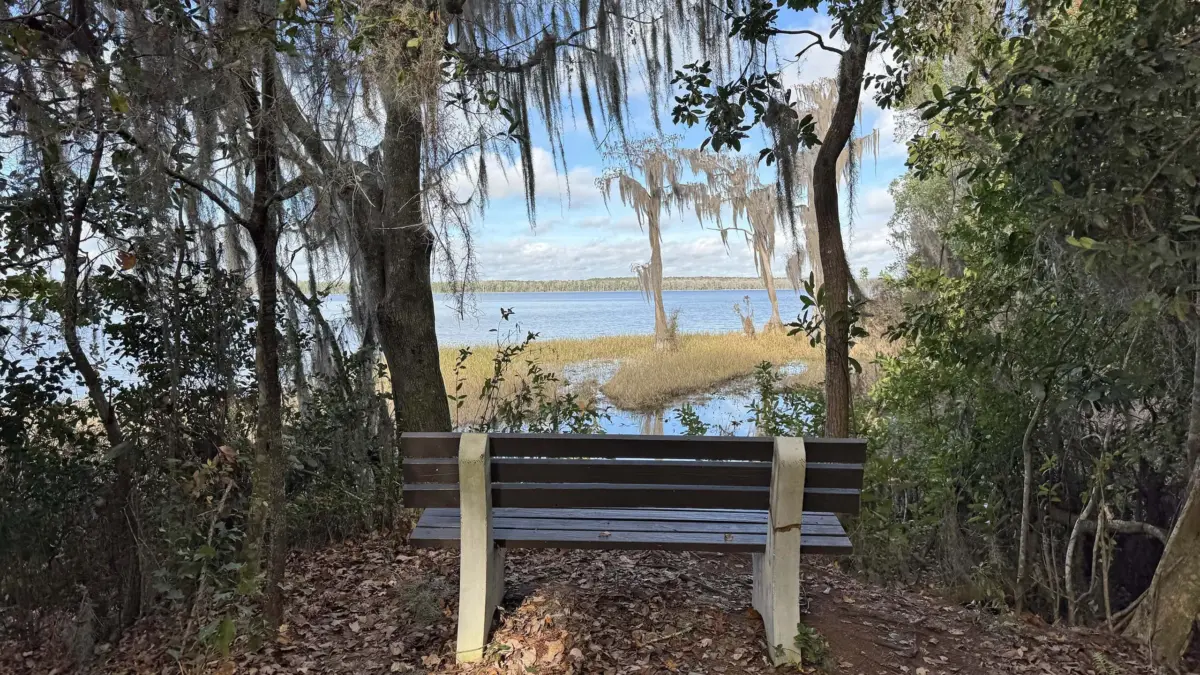
- The Lake Edge Diversion: At approximately 0.1 miles, the route intersects with the orange-blazed Lake Edge Trail. Following this path southward through a dense canopy of oaks and bay trees leads, at the 0.25-mile mark, to a dramatic bluff overlooking Lake Alto. Here, a strategically placed bench offers panoramic views of glassy waters framed by cypress trees draped in Spanish moss.
- The Blueberry Loop Completion: Returning to the main junction, hikers complete the circuit via the blue-blazed Blueberry Trail. The path meanders through rewilded pinelands and managed stands, utilizing posts with blue arrows and squared-off turns to guide visitors safely back to the trailhead for a total excursion length of 1.2 miles.
Official Statements
The preservation and ongoing management of the LEAFS Preserve highlight the collaborative synergy between private landowners, non-profit conservation groups, and local municipal partners.

While the initial vision was forged by the dedicated efforts of John and Mary Lou Winn through their stewardship of the Longleaf Ecology and Forestry Society, the contemporary narrative is defined by the Alachua Conservation Trust’s commitment to permanent land protection. Representatives from ACT have repeatedly emphasized that acquisitions and donations of this caliber are vital not only for recreational tourism but for maintaining the ecological integrity of the greater Ocala to Osceola (O2O) wildlife corridor initiative.

Local conservation advocates note that parcels like the LEAFS North Tract serve as living classrooms. By maintaining public access through passive recreation, organizations like ACT bridge the gap between academic conservation science and public awareness. Land managers point out that witnessing firsthand the resilience of rewilding saw palmetto understories and the majestic architecture of aging longleaf pines fosters a deeper, community-wide appreciation for Florida’s imperiled native habitats. Furthermore, coordination with Alachua County regarding shared infrastructure at Lake Alto Park exemplifies inter-agency cooperation, maximizing public utility while minimizing the ecological footprint of human visitors.

Future Outlook
As North Central Florida faces unprecedented population growth and suburban expansion, the long-term outlook for the LEAFS Preserve hinges on proactive land stewardship, invasive species monitoring, and ecological restoration techniques such as prescribed burning.

Longleaf pine ecosystems are pyrogenic communities; they depend on periodic, low-intensity fire to clear competing hardwood underbrush, stimulate the germination of native wiregrass and wildflowers, and recycle essential nutrients back into the sandy soil. Future management plans by the Alachua Conservation Trust are expected to incorporate careful fire management regimes to maintain the open, park-like understory characteristic of healthy longleaf flatwoods—a structure that was central to the founding philosophy of the original LEAFS organization back in 1993.

Moreover, the integration of the LEAFS Preserve into the broader network of regional natural areas—such as the nearby Lake Alto Preserve North, Little Orange Creek Preserve, and Mike Roess Gold Head Branch State Park—creates a robust ecological matrix. This interconnected network ensures that wildlife migration routes remain open and that regional watersheds, including the Lake Alto basin, retain their natural filtration capacities. For the hiker, conservationist, and future generations of Floridians, the LEAFS Preserve stands as a permanent sanctuary where the resilience of the longleaf pine ecosystem is not only studied, but preserved in perpetuity.

0 Comments