

Executive Overview
Nestled within the densely populated residential sprawl of The Acreage community in Palm Beach County, Florida, lies a remarkably preserved natural refuge: the Acreage Pines Natural Area. Encompassing a carefully managed mosaic of vital South Florida ecosystems, this 2-mile trail network offers visitors an immediate and immersive escape into the wild, belying its suburban proximity to active sports complexes and paved thoroughfares.
Managed by Palm Beach County, the property serves as a vital ecological buffer and an accessible outdoor recreation site. Situated on the northeastern periphery of the historic Everglades, Acreage Pines Natural Area presents a masterclass in localized conservation. Here, native pine flatwoods, vibrant wetland prairies, and shaded tropical hammocks converge.
This comprehensive guide details the geographical layout, trail infrastructure, native flora and fauna, and essential visitor logistics for anyone looking to experience this unique Palm Beach County natural area.
Detailed Chronology and Trail Guide: Navigating Acreage Pines
Exploring Acreage Pines Natural Area requires an understanding of its distinct trail segments, which seamlessly alternate between elevated wooden boardwalks, pine-needle-strewn paths, and mowed maintenance tracks.

1. The Trailhead and Prairie Pond Boardwalk
The journey begins at the southwestern corner of the paved parking lot, where an informative trailhead kiosk sets the stage for the trek. A brief concrete sidewalk guides visitors inward before abruptly transitioning, after roughly 200 feet, into a sturdy wooden boardwalk.
This initial elevated structure spans a sprawling, grassy prairie pond. It guides hikers away from the suburban edge directly toward a dense island of native greenery.

2. The Tropical Hammock and Wetland Overlook
As the boardwalk pierces the tree line, it enters a compact, shade-drenched tropical hammock. Heavy oak branches overhead support a rich assortment of native airplants (epiphytes), while vibrant palmettos carpet the understory.
Emerging from the shaded canopy on the far side, hikers encounter a strategically positioned wooden viewing platform equipped with benches. This overlook provides expansive views of the surrounding wetlands, making it a prime location for birdwatching. Wetland species are frequently drawn to the open water, offering wildlife enthusiasts exceptional viewing opportunities just minutes from the trailhead.

3. The Alligator Flag Boardwalk and Pine Forest Transition
Returning to the main parking area via the boardwalk stairs, hikers can pivot northward onto an unmarked grassy path. Skirting a wooden split-rail fenceline for roughly one-tenth of a mile leads to a secondary boardwalk positioned on the opposite side of the parking footprint.
This second elevated span crosses a deeper section of the wetland marsh. During the peak of summer, these waters come alive with clusters of alligator flag (Thalia geniculata), which push up towering stalks crowned with brilliant purple inflorescences.

Upon reaching the far terminus of this boardwalk, a paved sidewalk cuts directly through a resilient stand of pine forest. The route snakes past an array of native understory plants, including:
- Cocoplums (Chrysobalanus icaco)
- Gallberry (Ilex glabra)
- Dahoon holly (Ilex cassine)
Within a mere hundred feet, the trail brushes against the outer boundary of a local neighborhood sports field.

4. The Northern Flatwoods and Perimeter Loop
To continue along the property’s northern trail network, visitors must walk eastward alongside the athletic fields until they reach a well-marked opening in the security fence.
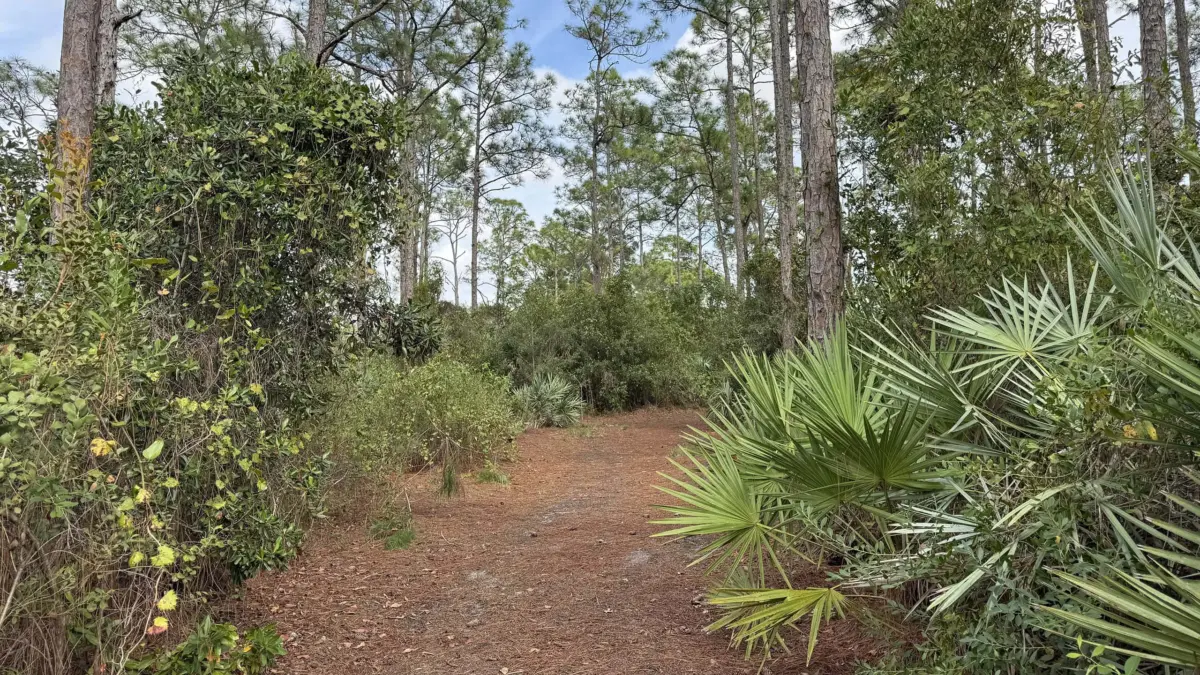
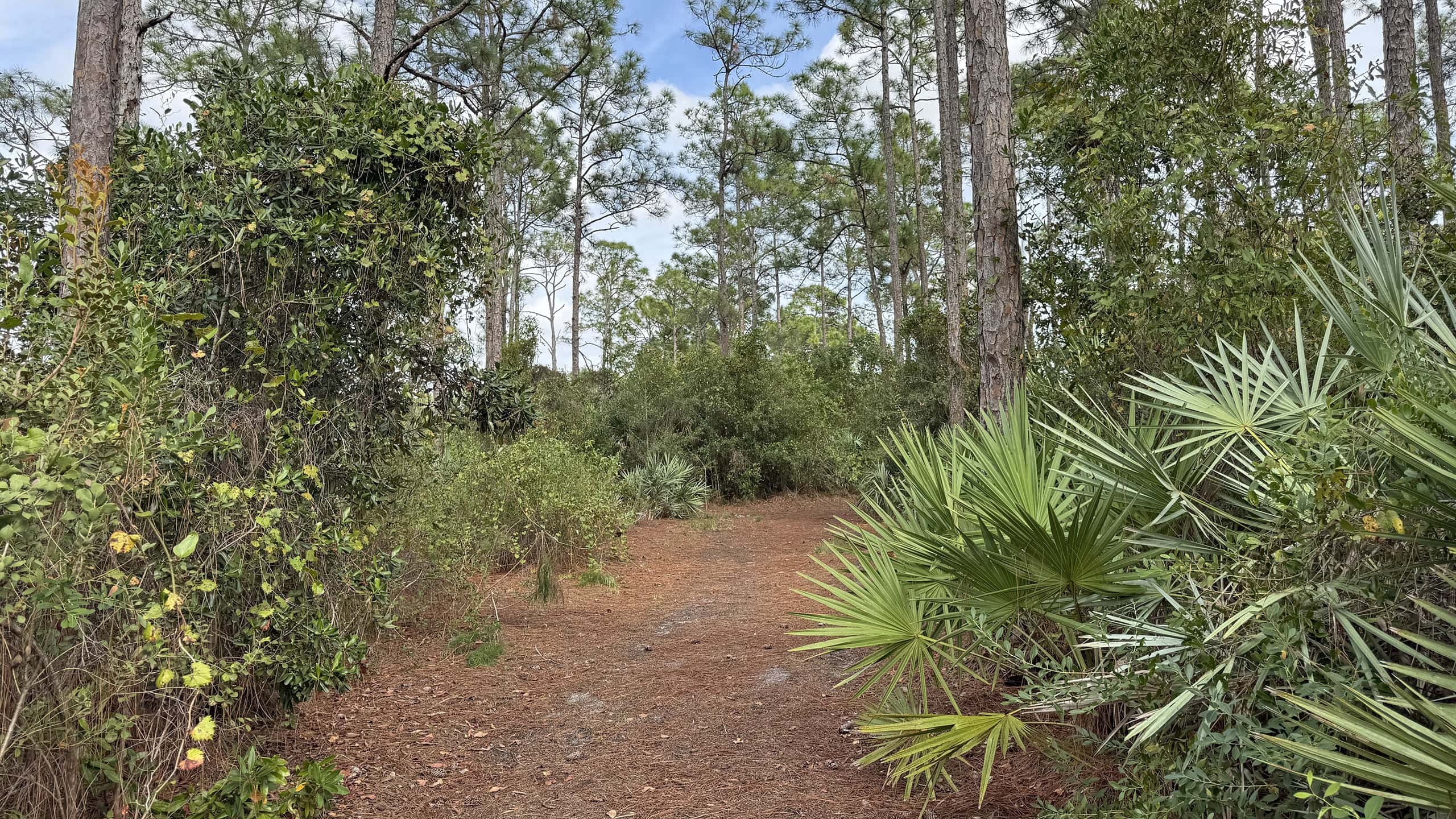
- The Flatwoods Corridor: Beyond the fence, a wide path cuts through the woods before tracing the perimeter of an open grassy lawn. From here, a pine-needle-laden corridor curves gracefully across a vibrant expanse of pine flatwoods for roughly a quarter of a mile, eventually terminating at a western access point along 143rd Drive.
- The Southern Spur and Dead End: Explorers attempting to loop back southward via a mowed fenceline will encounter a false lead; the path abruptly dead-ends at a locked security gate after 0.2 miles, requiring hikers to retrace their steps toward the central parking hub.
5. The Equestrian and Mesic Flatwoods Trail
For those seeking additional mileage, a separate linear trail extends southward from the initial boardwalk stairs. Shared harmoniously with local equestrians, this route follows a wide, meticulously mowed pathway flanked by traditional split-rail wooden fencing.

Meandering through a healthy mesic flatwoods community for 0.4 miles, this trail likewise culminates at a secure, locked gate along 143rd Drive, offering a quiet, shaded out-and-back walk.
Supporting Context & Metrics
Understanding the operational framework, ecological classifications, and logistical parameters of Acreage Pines Natural Area ensures a safe and compliant visit.

Key Site Metrics & Logistics
- Location: Loxahatchee, Palm Beach County, Florida
- Total Trail Length: Approximately 2.0 miles (inclusive of all loops and spurs)
- Trailhead Coordinates: 26.771722, -80.263667
- Physical Address: 6405 140th Ave N, Loxahatchee, FL 33470
- Admission Fee: Free and open to the general public
- Operating Hours: Daily, from sunrise to sunset
- Accessibility: Approximately 0.5 miles of the trail network (including the primary boardwalks) is fully accessible to wheelchairs and strollers.
- Amenities: Restroom facilities are conveniently located directly at the trailhead parking area.
- Pet Policy: Strictly no pets allowed to protect native wildlife populations and sensitive ground-nesting species.
- Land Management Agency: Palm Beach County Environmental Resources Management (ERM)
- Contact Phone: 561-233-2400
Ecological Significance
Acreage Pines Natural Area acts as an ecological bridge. While modern suburban development has fragmented much of South Florida’s historic landscape, parcels like this preserve crucial hydrology and native biodiversity.
The juxtaposition of mesic flatwoods and wet prairies demonstrates how native Florida ecosystems adapt to seasonal flooding and dry cycles. Pine flatwoods—characterized by an open canopy of South Florida slash pine (Pinus elliottii var. densa), a sparse understory of saw palmetto, and a rich layer of herbaceous groundcover—rely on periodic fires and natural sheet flow to maintain their health. By safeguarding these zones, Palm Beach County protects regional water quality and provides a secure sanctuary for resident and migratory fauna.

Official Statements and Management Objectives
Local land managers emphasize that natural areas embedded within urban and suburban matrixes serve a dual purpose: environmental protection and community wellness.
According to Palm Beach County Environmental Resources Management (ERM) representatives, the primary directive for properties like Acreage Pines is the restoration and perpetual maintenance of native habitats. By utilizing controlled burns, invasive exotic plant removal (targeting species like Brazilian pepper and melaleuca), and hydrological management, the county ensures that these pockets remain ecologically viable.

Furthermore, county officials highlight the importance of low-impact public access. Constructing elevated boardwalks over sensitive wetlands allows thousands of hikers, birdwatchers, and nature photographers to experience wild Florida firsthand without degrading the underlying soil or disrupting delicate aquatic life cycles.
Future Outlook
As Palm Beach County continues to experience rapid residential and commercial growth, the value of protected green spaces like Acreage Pines Natural Area will only appreciate. Future outlooks for the property focus heavily on adaptive management strategies in the face of shifting regional climate patterns and urban encroachment.

- Habitat Enhancement: Ongoing initiatives aim to further eradicate aggressive non-native vegetation, encouraging the natural recruitment of native wildflowers, ferns, and canopy trees.
- Community Engagement: Through educational programming, trail maintenance volunteer days, and partnerships with local outdoor advocates, public awareness of urban wilderness preservation is expanding.
- Connectivity: Planners continue to evaluate regional greenway connectivity, examining ways to link fragmented natural areas via protected wildlife corridors and multi-use trails, ensuring that wildlife populations maintain genetic diversity despite surrounding concrete development.
Ultimately, Acreage Pines Natural Area stands as a testament to successful community-integrated conservation—proving that wild Florida can endure, thrive, and inspire right in the backyard of a bustling modern neighborhood.

0 Comments