Tucked away in the densely populated coastal stretch of Volusia County, Florida, the Rose Bay Trail represents a rare intersection of delicate estuarine ecology, regional conservation history, and accessible outdoor recreation. Managed by Volusia County and situated directly within the sprawling Doris Leeper Spruce Creek Preserve, the 1.9-mile out-and-back trail provides a living laboratory for hikers, naturalists, and educators alike.
Accessed primarily through Spruce Creek Park at 6250 Ridgewood Avenue in Port Orange, the trail functions as an integral gateway to a much larger matrix of protected lands spanning the Spruce Creek basin. Bridged by the heavily trafficked U.S. Route 1, the park and its surrounding preserves protect vital mangrove flats, brackish marshes, pine-cedar islands, and coastal oak hammocks. Despite its proximity to modern infrastructure, the trail offers a genuine immersion into Central Florida’s untamed coastal ecosystems, complete with panoramic observation decks, outdoor learning areas, and dynamic tidal waterways.
However, navigating this landscape requires preparation. Ecological realities—ranging from seasonal flooding and high-tide inundation to relentless mosquito populations—shape every excursion along the path. This comprehensive overview examines the trail’s layout, historical context, geographical characteristics, logistical parameters, and long-term ecological trajectory within the Spruce Creek basin.
Detailed Chronology of the Trail Experience
The Trailhead and Initial Boardwalk Crossing
The journey begins at Spruce Creek Park, located on the west side of U.S. 1 just north of the airport when traveling from New Smyrna Beach. Visitors turn into the park entrance, bear right toward the environmental center and picnic pavilion, and locate the trailhead adjoining the children’s playground.
An inviting boardwalk structure marks the initial transition from traditional park amenities into the wild heart of the estuary. This elevated pathway crosses a short tidal span before descending onto a graded path. Visitors are immediately greeted by the sights and sounds of the tidal waterway below. A strategically placed bench halfway across the boardwalk offers a prime, sunlit perch for birdwatching, allowing hikers to spot herons, egrets, and other wading species foraging in the shallows.
Transitioning to the Island Interior
Upon crossing the sturdy span that connects the park island to the next landmass—situated entirely within the Doris Leeper Spruce Creek Preserve—the path leads under a dense canopy of slash pines, red cedars, and cabbage palms. Here, informational signage introduces hikers to the Rose Bay Legacy Project, detailing local conservation efforts aimed at restoring and protecting the basin’s fragile shorelines.
While Volusia County has installed low bog boardwalks to mitigate muddy conditions, hikers must remain vigilant. Portions of the trail lacking boardwalk protection can quickly become squishy or waterlogged following heavy rainfall or during peak high tides.
Continuing along the path, hikers cross a small wooden bridge spanning a quiet tidal outflow, where spiky yaupon holly dominates the thick understory. A sharp left turn leads beneath towering slash pines that edge a brackish marsh. This zone demands caution: the combination of exposed tree roots, sticky muck, and proximity to brackish water makes for slippery footing. Moreover, this stretch serves as a prime habitat for wildlife, requiring hikers to watch closely for sunning alligators and native snakes.
The Observation Tower and Panoramic Vistas
At approximately the 0.25-mile mark, the trail rounds a bend to reveal its centerpiece: a sturdy, covered observation tower. Rising above the surrounding canopy, the multi-story structure is an indispensable asset for visitors.
Elevation & Breeze: The height of the tower catches coastal breezes that naturally sweep away mosquitoes, offering a comfortable reprieve from insects.
Shelter: The solid roof provides reliable protection against sudden Central Florida rain showers or intense afternoon sun.
Scenery: From the upper deck, visitors enjoy an uninterrupted 360-degree panorama. Spruce Creek can be seen snaking its way through an expansive, emerald-green sea of needlerush marsh, demonstrating the vast scale of the local estuarine system.
Hammocks, Classrooms, and the Push to Rose Bay
Descending from the observation tower, hikers face a fork where two parallel tracks diverge. Park management recommends taking the right-hand path, as the route hugging the marsh is significantly more prone to flooding.
The two paths eventually reconvene inside a deeply shaded tropical glade. Here, giant leather ferns tower over rustic picnic benches. These benches double as informal stations for the area’s designated outdoor classrooms, where students and guided tour groups study coastal ecology firsthand.
As the path pushes deeper into a coastal hammock dominated by sand live oaks, the dense saw palmetto understory crowds the edges, and the unmistakable scent of salt air drifts in from the east. At the 0.7-mile mark, the trail intersects with an access road originating from U.S. 1. Turning left, hikers enter a lush palm hammock that borders the southern expanse of Rose Bay.
Trail’s End at the Mangrove Flats
The final stretch of the trail offers a striking geological and ecological surprise. The well-defined path gradually gives way to an open expanse of mud flats surrounded by dense mangrove thickets.
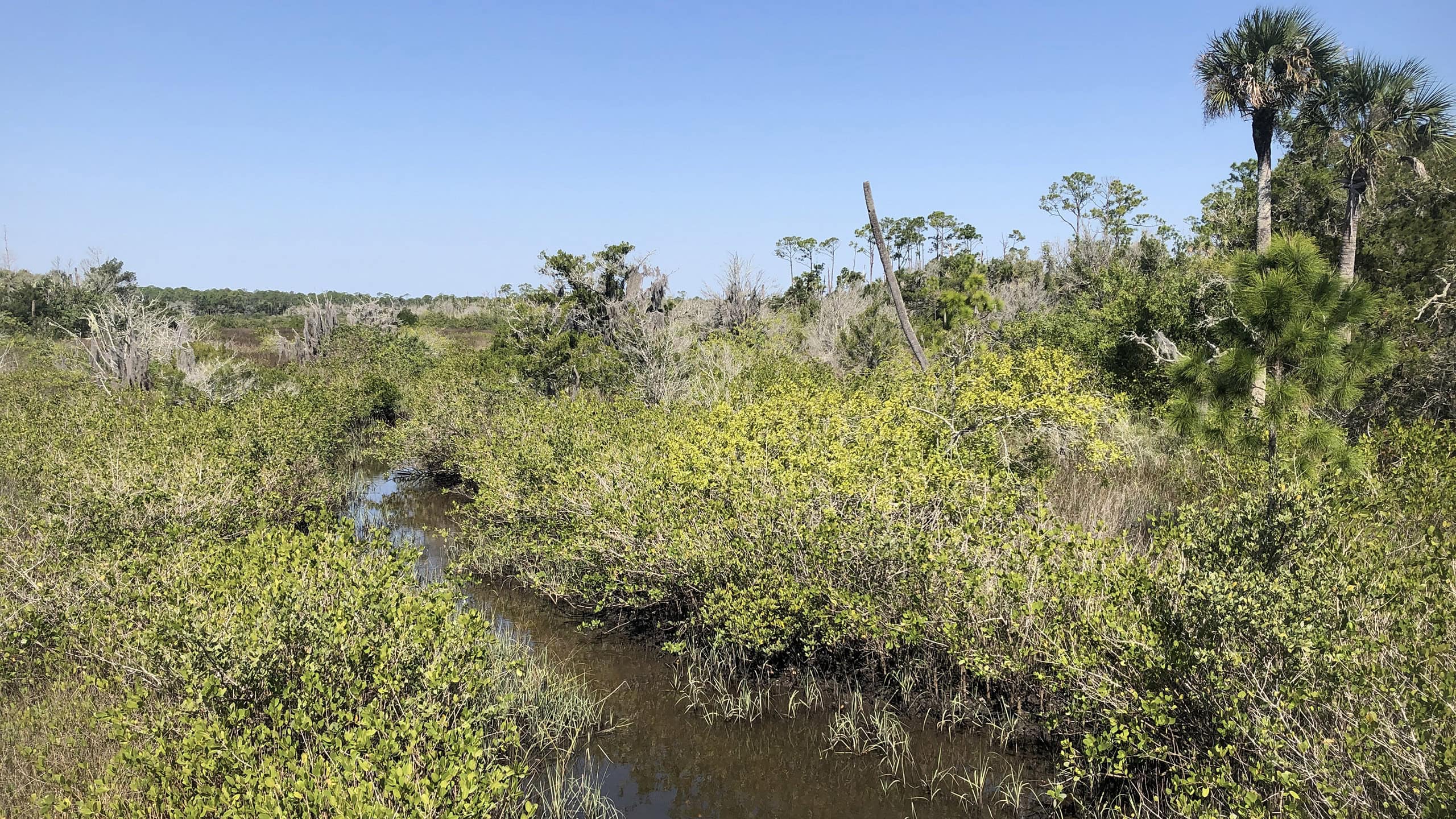
Rather than terminating at a formal overlook or man-made structure, the trail simply peters out into the tidal mud. Visitors are encouraged to wander cautiously along the remaining traces of the old road to experience an active habitat restoration site. Thousands of mangrove propagules (shoots) can be observed taking root in the mud—living proof of the ecosystem’s resilience and a harbinger of future mangrove forests. Gaps in the canopy provide dramatic final glimpses of Spruce Creek to the north before hikers must turn back to retrace their steps.
Supporting Context and Metrics
To ensure a safe and efficient visit, outdoor enthusiasts and researchers must review the precise logistical metrics and environmental advisory parameters established by Volusia County Resource Stewardship:
Parameter
Detail
Location
Port Orange, Volusia County, Florida
Trailhead Coordinates
29.09489, -80.97202
Physical Address
6250 Ridgewood Ave, Port Orange, FL
Land Manager
Volusia County (Resource Stewardship / Land Management Division)
Contact Phone
386-322-5133
Operating Hours
Open daily from sunrise to sunset
Admission Fees
Free to the public
Restroom Facilities
Available at the Spruce Creek Park trailhead picnic pavilion
Pet Policy
Leashed dogs are welcome
Total Distance (Tower Only)
0.5 miles round-trip
Total Distance (Mangrove Flats)
1.9 miles round-trip
Total Distance (Including Spruce Creek Park Loop)
2.7 miles round-trip
Essential Visitor Advisory
Insect Mitigation: Mosquito repellent is mandatory year-round due to the prevalence of standing brackish water and tidal wetlands.
Hydration and Sun Protection: Open sections along the marsh expose hikers to direct sunlight; carry adequate water.
Tidal Awareness: High tides and heavy precipitation events frequently flood low-lying sections of the dirt paths and bog boardwalks. Waterproof footwear or old shoes are strongly advised.
Official Statements & Land Management Insights
Volusia County’s land management strategy regarding the Doris Leeper Spruce Creek Preserve centers on balancing public access with aggressive ecological preservation. According to county resource stewards, the integration of boardwalks and elevated infrastructure was explicitly designed to protect sensitive wetland soils from chronic erosion while maintaining educational opportunities.
"Our objective across the Spruce Creek basin is to provide meaningful, low-impact public engagement with pristine estuarine environments while ensuring that the underlying natural hydrology remains uninterrupted," notes regional park administration literature. "Through facilities like the Rose Bay Trail’s outdoor classrooms and observation towers, we cultivate environmental stewardship by allowing the public to witness active coastal restoration and habitat succession firsthand."
Conservation partners, including regional hiking advocates and publishing groups such as Florida Hikes, have long championed the site as a model for urban-adjacent wilderness preservation. By linking neighborhood parks like Spruce Creek Park with thousands of acres of protected marshlands, county planners have successfully created an urban wildlife corridor that shields local waterways from overdevelopment.
Future Outlook: Ecological Succession and Preservation
The long-term trajectory of the Rose Bay Trail and the wider Spruce Creek basin is defined by ongoing natural and anthropogenic pressures. On the ecological front, the ongoing recruitment of red, black, and white mangroves along the trail’s terminal mud flats illustrates dynamic coastal succession. As sea levels shift and regional climate patterns evolve, these intertidal zones are expected to migrate inland, reshaping the boundaries between upland hammocks and brackish marshes.
Concurrently, county land managers face the ongoing challenge of managing visitor volume while maintaining infrastructure vulnerable to saltwater corrosion and storm surges. Routine maintenance of the bog boardwalks, observation towers, and drainage culverts will remain paramount to keeping the trail accessible.
For conservationists, researchers, and casual hikers alike, the Rose Bay Trail remains a vital educational window into Florida’s coastal future. It stands as a testament to the power of municipal preservation, proving that even alongside bustling highway corridors, untamed wilderness can endure, recover, and thrive.







0 Comments