

By Derrick Conover
Published: March 18, 2026
Executive Overview
As winter yields reluctantly to spring, agricultural producers across Columbia County and the broader North Florida region find themselves locked in a high-stakes battle against volatile weather patterns. This week brought what local farming communities hope will be the final cold front of the season—a dramatic temperature plunge arriving at one of the most biologically sensitive windows in the annual agricultural production cycle.
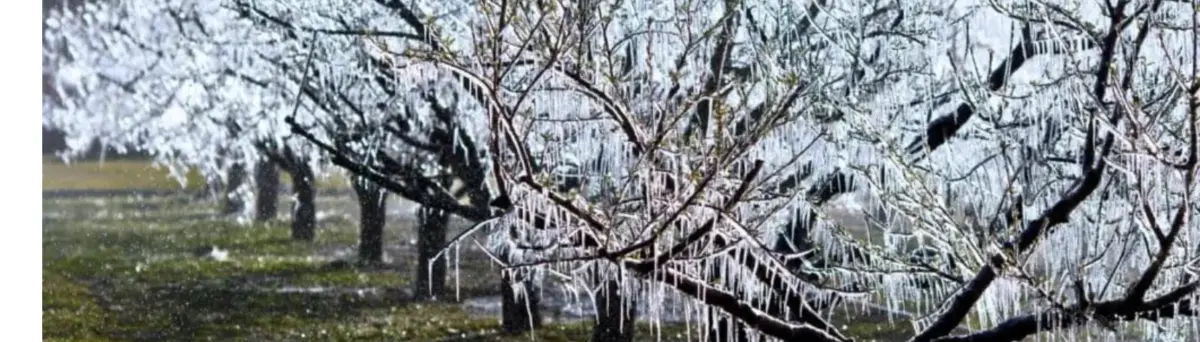
This late-season frost risk does not strike in a vacuum. It coincides with a critical transition period when perennial fruit trees are breaking winter dormancy and rushing into their bloom cycles, while spring row crops are actively being seeded, germinating, or pushing through the soil. Even a brief, overnight dip into freezing temperatures during this narrow window can inflict disproportionate physiological damage, threatening crop performance, reducing marketable yields, and jeopardizing farm-level economic viability.
Compounding this seasonal hazard is a persistent, underlying drought plaguing the region. While agriculturalists often analyze cold snaps and water deficits as distinct meteorological events, their combined physiological and microclimatic impacts are deeply intertwined. Dry soils drastically reduce the earth’s thermal retention capacity, accelerating near-ground radiative cooling during clear, cold nights and magnifying the severity of frost events. For North Florida growers, this hazardous intersection of drought and freeze requires heightened vigilance, adaptive management strategies, and proactive mitigation to safeguard the 2026 harvest.
Detailed Chronology and Physiological Impact: Fruit Trees Under Siege
The timing of this week’s cold front could hardly have been worse for perennial fruit production. During the depths of winter dormancy, deciduous fruit crops—including regional staples like peaches and blueberries—exhibit remarkable cold hardiness, easily withstanding freezing temperatures with little to no internal cellular damage. However, as ambient temperatures gradually rise through late winter and early spring, chemical signals trigger trees to break dormancy, push out new buds, and advance rapidly toward full bloom.
As this vegetative and reproductive transition accelerates, the cold tolerance of the crop drops precipitously. Once flowers open, reproductive tissues are left exposed and profoundly vulnerable. A light, transient frost that would have bypassed a dormant orchard without notice can now decimate open blossoms, leading to catastrophic pollination failures, severe fruit-set reduction, or, in worst-case scenarios, a total wipeout of the seasonal crop.
[Winter Dormancy] ---> [Bud Break & Bloom] ---> [Extreme Cold Vulnerability] ---> [Reduced Pollinator Activity] ---> [Yield Loss]Compounding the immediate threat of tissue necrosis is a subtle psychological and biological deception: injury from late-season cold events is rarely immediately visible. Following a borderline frost, blossoms may appear superficially intact and normal for days, masking the internal damage done to styles, stigmas, and ovules until the flowers ultimately fail to develop into fruit.
Furthermore, cold-induced disruptions extend well beyond the immediate window of the freeze event:
- Suppressed Pollinator Activity: Cool, cloudy, and windy conditions accompanying cold fronts significantly depress the foraging behavior of native and managed pollinators. Because the flowering window is already strictly limited, a reduction in insect flight days further compromises fertilization success.
- Delayed Tree Physiology: Post-freeze recovery is characterized by slowed physiological processes. Growers frequently observe delayed leaf-out, abnormally prolonged and staggered bloom periods, and stunted fruit development.
- Secondary Exposure Risks: An extended, erratic bloom period exposes subsequent rounds of flowers to secondary frost events, compounding structural damage over weeks.
- Resource Depletion: Repeated cold stress forces the tree to draw heavily upon stored carbohydrate reserves to initiate emergency recovery and re-bloom. This depletion of vigor compromises not only the current season’s yield but also structural resilience and productivity for the following year.
Row Crops and the Early-Season Vulnerability Matrix
While perennial orchards contend with the fragility of floral tissues, spring-planted row crops face an entirely different—yet equally formidable—set of physiological hurdles across North Florida’s sandy soils. Staple commodities such as watermelon, sweet corn, and various warm-season commercial vegetables rely heavily on warm ambient and soil temperatures for successful germination and vigorous early-season growth.
When cold fronts sweep through during planting season, cold soils drastically impair emergence rates. Germination becomes uneven and protracted, resulting in poor stand establishment. In uniform-harvest crops like commercial watermelons, where field consistency directly dictates harvesting efficiency and pack-out percentages, this variability degrades overall field performance and market value.
+-----------------------------------------------------------------+
|               EARLY-SEASON ROW CROP STRESS FACTORS              |
+--------------------------+--------------------------------------+
| Cold, Wet Soils          | Favors seedling pathogens; causes    |
|                          | damping-off and early stand loss.    |
+--------------------------+--------------------------------------+
| Frost & Low Temperatures | Causes direct leaf burn, stem injury,|
|                          | and plant mortality.                 |
+--------------------------+--------------------------------------+
| Transplant Shock         | Slows root establishment, extending  |
|                          | vulnerability windows.               |
+--------------------------+--------------------------------------+
| Secondary Pests          | Opportunistic pathogens attack       |
|                          | cold-weakened plant tissues.         |
+--------------------------+--------------------------------------+
Moreover, cold and wet soil conditions create an ideal microenvironment for soil-borne pathogens. Pathogens responsible for "damping-off" and root rots thrive in cool, saturated media, dramatically increasing early-season plant mortality. For seedlings that have already emerged or transplants freshly set in the field, direct frost poses an immediate threat of leaf burn, stem collapse, or complete plant death depending on the duration and intensity of the freeze.

Even when young plants manage to survive a cold event, the resulting chronic cold stress manifests as stunted growth, suppressed vigor, and depressed ultimate yield potentials. Transplanted vegetable crops are particularly susceptible; cold soils inhibit root system expansion and prolong transplant shock. This prolonged developmental lag leaves young plants defenseless against opportunistic insect pests and secondary diseases that rapidly colonize weakened, stressed cellular tissue.
Supporting Context and Metrics: The Drought-Frost Amplification Effect
Perhaps the most critical complicating factor in navigating this season’s weather volatility is the lingering regional drought. Growers frequently analyze water deficits and temperature extremes as independent variables, but at the plant physiological and field microclimatic levels, their interactions are inextricably linked. When drought and frost converge, the synergistic stress is exponentially more destructive than either phenomenon acting in isolation.
The Physics of Field-Level Radiative Cooling
To understand why drought intensifies frost damage, one must examine the thermal properties of agricultural soils:
- Moisture as a Thermal Battery: Moist soils possess a high volumetric heat capacity. Throughout daylight hours, they absorb massive amounts of solar radiation and store thermal energy. As ambient temperatures plummet after sunset, damp soils slowly radiate this stored heat back upward into the plant canopy, creating a natural thermal buffer that often keeps near-ground temperatures above freezing.
- The Dry Soil Liability: Conversely, dry soils exhibit a vastly lower heat capacity and poor thermal conductivity. They fail to absorb and store sufficient daytime solar energy and cool down rapidly immediately following sunset.
- The Microclimate Divergence: This thermodynamic deficit leads to significantly colder near-ground microclimates. In practical agricultural terms, two adjacent fields experiencing identical ambient air temperatures reported by regional weather stations can encounter vastly different biological outcomes based entirely on soil moisture content. A bone-dry field will experience much more severe, localized frost conditions than an adequately irrigated field.
[Daytime Solar Radiation]
   ---> Moist Soil: Absorbs & Stores Heat ---> Nighttime Release: Buffers Canopy against Frost
   ---> Dry Soil:   Fails to Store Heat     ---> Nighttime Release: Rapid Cooling & Severe Frost
For North Florida agriculturalists, this reality redefines drought not merely as a water-supply issue, but as a direct predisposing risk factor for catastrophic freeze injury. Where irrigation infrastructure permits, strategic pre-irrigation prior to a forecasted cold event can serve a dual purpose: enhancing overall plant cellular turgor and resilience while artificially elevating near-ground thermal buffering capacity.
Official Statements and Industry Insights
Agricultural extension agents and regional crop specialists emphasize that management during this transitional window demands absolute precision.
"We are operating in an environment where margins for error are razor-thin," notes regional agronomic advisory communications. "When you couple the natural biological vulnerability of bud-break and early germination with a baseline drought condition, growers cannot afford to rely on historical averages. Every management decision—from the timing of transplanting to pre-frost irrigation scheduling—carries immediate economic consequences."
Extension specialists stress that farm managers must shift away from reactive troubleshooting and instead embrace continuous, high-frequency monitoring of hyper-local microclimate data. Because soil moisture levels dictate radiative cooling rates, uniform water management is now recognized as an essential component of frost-mitigation engineering.
Future Outlook: Building Resilience for an Unpredictable Climate
As agricultural producers look toward the remainder of the 2026 production season, the lessons of this week’s cold snap highlight a broader, systemic trend: increasing climatic volatility during critical crop transitions. The juxtaposition of prolonged droughts with sharp, late-season temperature swings underscores the urgent need for adaptive agricultural infrastructure.
Looking forward, regional farm management strategies must increasingly incorporate:
- Enhanced Irrigation Efficiency: Upgrading systems to ensure rapid, uniform pre-wetting capabilities for frost mitigation without exacerbating water conservation pressures.
- Climate-Resilient Varietals: Investing in crop varieties exhibiting broader chilling-requirement tolerances and extended bloom windows that minimize total susceptibility periods.
- Precision Micro-Climate Monitoring: Deployment of IoT-based soil and canopy temperature sensors across variable field topographies to track micro-climatic divergences in real-time.
Ultimately, while growers cannot control the vagaries of atmospheric cold fronts or regional precipitation deficits, disciplined risk management, proactive soil-moisture engineering, and vigilant adherence to localized meteorological forecasts will remain the definitive dividing line between a resilient harvest and a challenging season.
Posted by Derrick Conover on March 18, 2026. Category: Agriculture, Crops. Tags: Agriculture, Crop Management, Freeze Mitigation.

0 Comments