

Executive Overview
In the heart of Clearwater, Florida, a profound transformation has quietly unfolded along the shores of Alligator Creek. Once dismissed as a utilitarian drainage ditch flanked by modern condominiums and the remnants of a historic trailer park, the waterway has undergone an ambitious ecological rehabilitation. Today, Kapok Park stands as a prime example of successful urban ecological restoration, serving as both a recreational asset for local outdoor enthusiasts and a protected sanctuary for native Florida wildlife.
Managed by the City of Clearwater, this 1.1-mile trail system integrates seamlessly with the broader Ream Wilson Trail network, offering visitors an accessible yet immersive journey through thriving cypress swamps, hardwood hammocks, and restored wetlands. The concerted efforts to revegetate the Alligator Creek basin have yielded immediate dividends: wading birds now forage undisturbed along marshy edges, cypress domes have filled out with vibrant new growth, and the water quality and aesthetic integrity of the corridor have vastly improved.
This report provides a comprehensive examination of the Kapok Park trail system, detailing its geography, logistical considerations, structural trail layout, ecological significance, and its vital role within Pinellas County’s interconnected greenways.
Detailed Chronology: Navigating the Kapok Park Trail System
Exploring Kapok Park requires an understanding of its interconnected entry points, which tie the destination directly into the regional trail system. Because parking options vary in capacity and proximity, visitors have several strategic choices depending on their preferred route length and mode of transportation—whether arriving on foot, bicycle, or vehicle.

Trailhead Access Points and Logistics
The primary approaches to Kapok Park stem from its strategic connectivity with the Ream Wilson Trail and adjacent municipal green spaces:
- Cliff Stephens Park Approach: Situated at 919 Fairwood Ave, Clearwater, this is a popular starting point for hikers and cyclists alike. Visitors can utilize the disc golf parking area off Fairwood Avenue. From State Road 60 (Courtney Campbell Causeway), motorists travel north on McMullen-Booth Road for half a mile, turn left onto Drew Street, proceed for one mile to Fairwood Avenue, and find the parking lot on the right just before the railroad tracks.
- Official Glen Oak Avenue Trailhead: For those seeking a dedicated neighborhood-access point, the official trailhead is located at 2950 Glen Oak Ave N, Clearwater. Situated within a residential subdivision west of the bustling McMullen-Booth Road corridor, this site provides straightforward access to the park’s eastern terminus. It can be reached via Terrace View Lane, approximately 0.4 miles north of the Drew Street traffic light.
- Eddie C. Moore Park Complex Approach: Long-distance trail users frequently opt to park at the Eddie C. Moore Park Complex (specifically near Complexes 5-7 along Drew Street). From there, a southward or westward connection via the Ream Wilson Trail seamlessly bridges the gap into the Kapok Park trail network.
[Cliff Stephens Park / Fairwood Ave]
       │
       ▼ (Paved Bike Path & Live Oak Canopy)
[Alligator Creek Crossing]
       │
       ▼ (Boardwalk & Observation Deck)
[Restored Cypress Swamp & Marshland]
       │
       ▼ (Historic Trailer Park Clearing)
[Wetland Boardwalk & Restored Dome]
       │
       ▼
[Eastern Trailhead / Glen Oak Ave N] (1.1-Mile Total Loop)
The 1.1-Mile Route: Step-by-Step
Setting out from the Cliff Stephens Park entrance, visitors are greeted by an orientation map alongside a directional sign pointing toward Kapok Park. The journey begins on a broad asphalt multi-use path that cuts through a manicured green space utilized by local disc golfers, shadowed overhead by a towering canopy of mature live oaks.

As the path progresses, Alligator Creek begins to peek through the peripheral vegetation. Initially, this section of the channel exhibits the stark characteristics of historical channelization: steep, engineered banks with residential condominiums rising sharply on the opposite bluff. However, the urban landscape quickly gives way to natural beauty as hikers make a right-hand turn at the junction, crossing a pedestrian bridge that spans the creek. From this lower elevation perspective, the basin takes on a much more organic character.
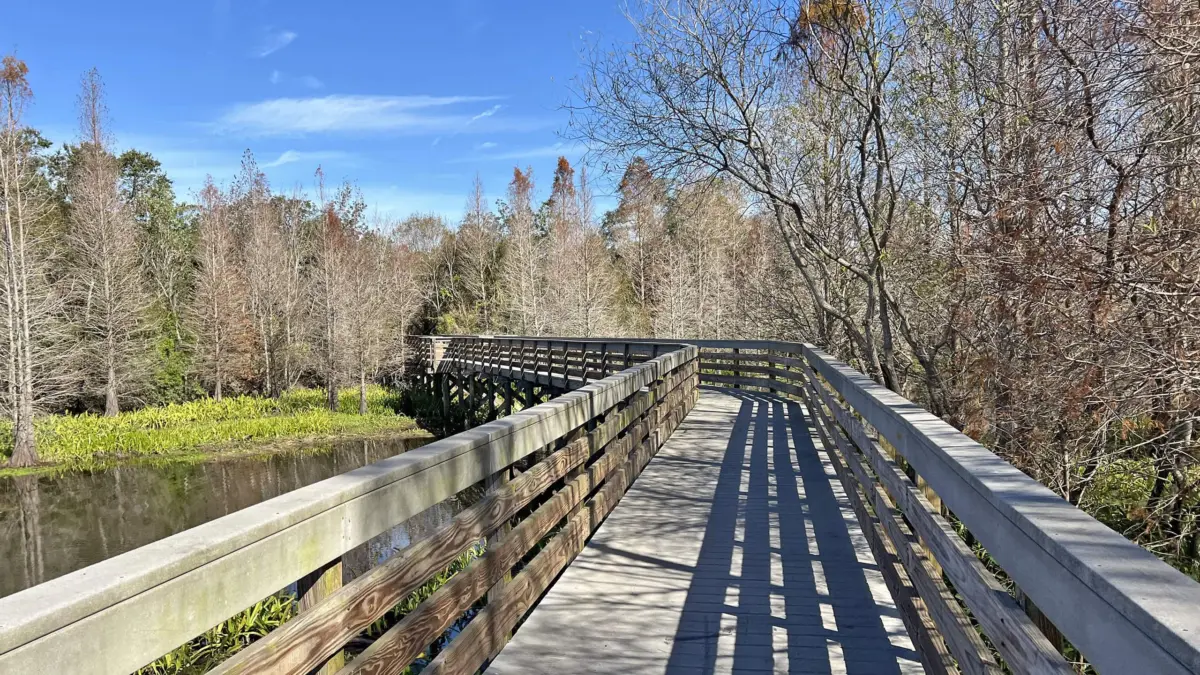
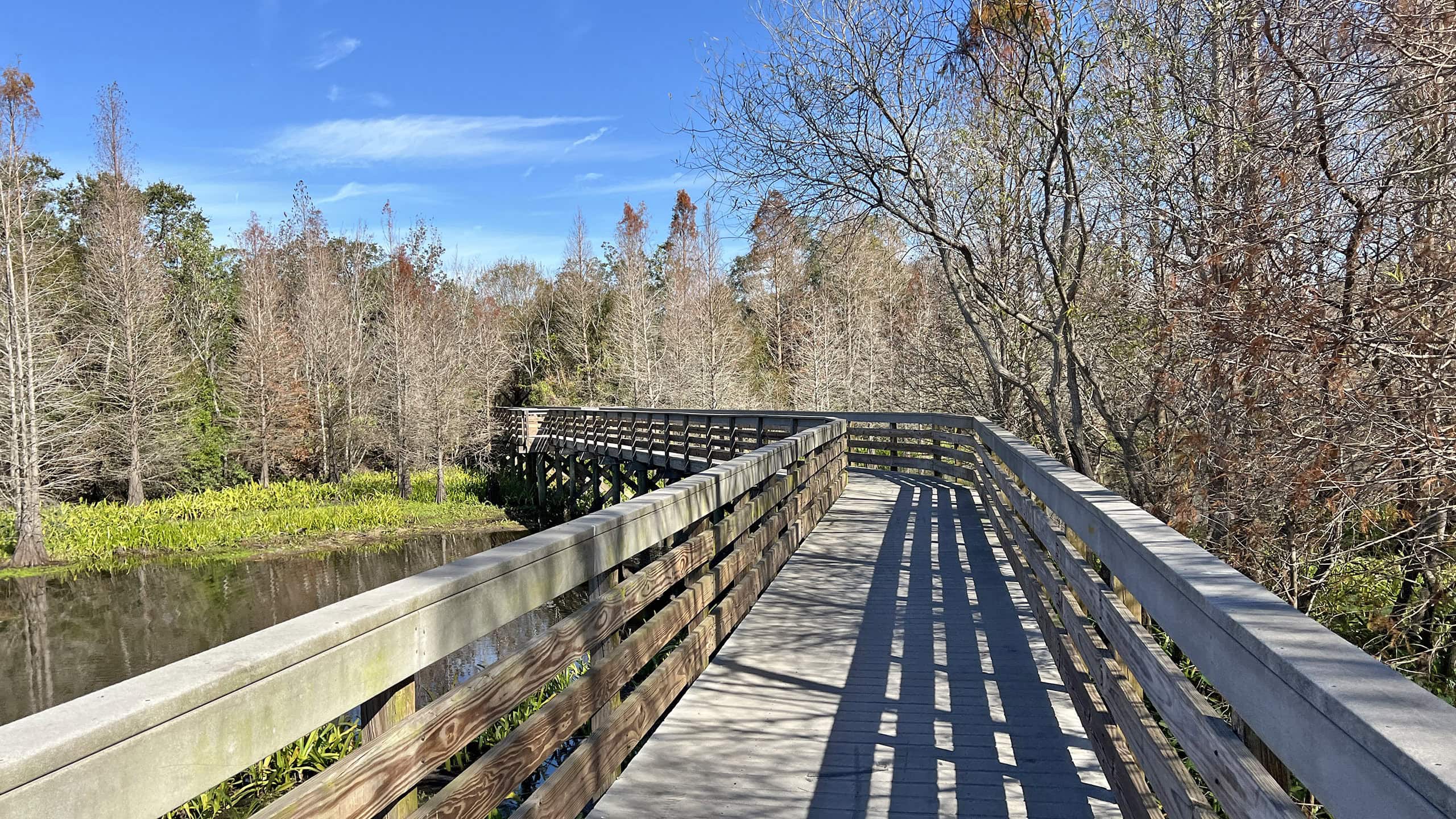
Continuing parallel to the creek on the paved path, hikers reach a critical junction at approximately the 0.4-mile mark. Veering left away from the main artery of the Ream Wilson Trail brings visitors onto an elevated wooden boardwalk network. A long spur boardwalk extends directly over the waterway, culminating in an observation platform. From this vantage point, the ecological dichotomy of Alligator Creek is striking. While upstream near the condominiums the channel resembles a drainage ditch, this protected section showcases thriving, cypress-lined shores that act as a magnet for wading birds, particularly great blue herons, snowy egrets, and glossy ibis.

Returning to the main boardwalk, the trail loops alongside a rich freshwater marsh. The surrounding flora shifts to feature a diverse mix of red maples, sweet gums, and wax myrtles framing the dark, tannin-stained waters. Wooden bridges carry pedestrians directly over minor tributaries and channels, where dense rafts of floating aquatic lilies mirror the towering silhouettes of the surrounding cypress trees.
The boardwalk terminates abruptly at a wide, grassy clearing shaded by sprawling live oaks. Historically, this parcel was occupied by a residential trailer park; today, through municipal acquisition and environmental remediation, it has been successfully returned to nature. A paved path resumes here, guiding visitors across a canal shaded by heavy, overhanging oak branches.

Navigating deeper into the park’s interior, the path intersects a second major boardwalk that cuts through a restored cypress dome. Here, open water shimmers beyond marshy edges, providing vital foraging habitat for resident and migratory waterfowl. At the 0.7-mile mark, the path divides at a Y-junction:
- Right Fork: Leads eastward within 0.2 miles to terminate at the official Glen Oak Avenue trailhead.
- Left Fork: Completes the loop through Kapok Park, passing a secluded bench overlooking a peaceful bend in the creek.
Reconnecting with the initial bridge junction near the condominiums, hikers retrace their steps straight ahead, completing the 1.1-mile loop as they re-enter the park boundaries of Cliff Stephens Park.

Supporting Context & Metrics
Urban restoration projects require rigorous planning, long-term financial investment, and multi-agency cooperation. Kapok Park is a prime case study in remediating altered hydrological systems within a heavily developed coastal county.
Park Metrics and Specifications
- Location: Clearwater, Florida (Pinellas County)
- Total Trail Length: 1.1 miles (loop configuration with multiple spurs)
- Primary Trailhead Coordinates: 27.974529, -82.720150
- Physical Address: 919 Fairwood Ave, Clearwater, FL 33759
- Operating Hours: Open daily from sunrise to sunset
- Admission Fees: Free to the public
- Amenities: Restroom facilities available at the trailhead; paved and elevated boardwalk surfaces suitable for walking and cycling; pet-friendly (leashed dogs permitted with mandatory waste disposal).
- Land Manager: City of Clearwater Parks and Recreation Department
- Contact Information: 727-562-4800
Ecological Restoration Dynamics
Pinellas County is recognized as the most densely populated county in Florida. Consequently, preserving contiguous wildlife corridors presents an extraordinary challenge. Alligator Creek functions as a crucial hydrological artery draining into Tampa Bay. Historically, rapid post-WWII development led to the channelization, dredging, and hardening of the creek banks to mitigate flood risks for surrounding urban infrastructure—including residential subdivisions, mobile home communities, and commercial corridors along McMullen-Booth Road.

The transformation of Kapok Park involved strategic ecological interventions:
- Bank Softening and Reshaping: By removing invasive exotic vegetation and reshaping engineered vertical banks where feasible, restoration engineers re-established shallow littoral zones. These sloping edges allow for the natural recruitment of native aquatic plants, which trap urban runoff sediments and filter pollutants before they reach Tampa Bay.
- Reforestation with Native Taxa: Thousands of bald cypress (Taxodium distichum), red maple (Acer rubrum), and sweetgum (Liquidambar styraciflua) were planted within the basin and historical trailer park footprint. These species re-establish the vertical forest structure essential for canopy-dwelling avians and create organic detritus that fuels the aquatic food web.
- Hydrological Reconnection: Constructing elevated boardwalks rather than traditional fill roads allowed historic floodplains to re-engage naturally during heavy precipitation events, reducing downstream peak flows while maintaining wetland soil saturation.
Official Statements
Municipal and environmental authorities have long championed the integration of passive recreation with rigorous habitat restoration in urban environments.

The City of Clearwater Parks and Recreation Department emphasizes that projects like Kapok Park serve a dual purpose: enhancing community health through accessible outdoor recreation while executing vital stormwater management and environmental stewardship. City planners have consistently highlighted that transforming acquired properties—such as the former mobile home park within the Alligator Creek basin—into protected green space pays long-term dividends for water quality in the Old Tampa Bay watershed.
Local conservation advocates and authors Sandra Friend and John Keatley, who have extensively documented Florida’s natural landscapes through Florida Hikes, have noted the striking metamorphosis of the area:

"Since we first visited the boardwalks and paved paths of Kapok Park, restoration of the Alligator Creek basin has created a wildlife haven. Planted cypress now line the creek like a slough; others fill out cypress domes. Wading birds forage the marshy edges… Where the basin once looked like a concrete-rimmed drainage ditch by the condominiums, the cypress-lined shores are now a vibrant sanctuary for herons, egrets, and waterfowl."
Furthermore, regional transportation planners point to Kapok Park as an integral link in the Ream Wilson Trail network, demonstrating how non-motorized commuter and recreational corridors can double as ecological showcases.

Future Outlook
As Pinellas County continues to experience high residential density and limited vacant land, the preservation, expansion, and active management of urban parks like Kapok Park will remain a critical priority for local governance.
Looking forward, municipal asset managers face several ongoing challenges and opportunities:

- Climate Resilience and Sea-Level Rise: Being situated in a low-lying coastal plain connected to Tampa Bay, tidal influence and storm surge pose persistent management challenges. The restored wetlands and robust cypress root networks at Kapok Park act as natural buffers against storm surges and rising water levels, making climate-adaptive landscape architecture increasingly vital.
- Invasive Species Management: Urban parks are inherently vulnerable to the introduction of invasive flora (such as Brazilian pepper and air potato) and fauna. Ongoing maintenance requires diligent, cyclical removal programs by municipal crews and citizen science volunteers to protect newly established native plantings.
- Regional Trail Integration: Discussions continue among county and municipal stakeholders to further expand and upgrade the Ream Wilson Trail network, potentially improving cycling and pedestrian connections to nearby natural assets such as Moccasin Lake Nature Park and the expansive Fred Marquis Pinellas Trail.
Kapok Park proves that intensive human development and thriving natural ecosystems are not mutually exclusive. Through visionary land acquisition, dedicated ecological engineering, and thoughtful trail design, Clearwater has turned an overlooked drainage basin into a flourishing wildlife sanctuary that will educate and inspire outdoor enthusiasts for generations to come.

0 Comments