

Executive Overview
Nestled within the northern reaches of Tallahassee, Florida, the Okeeheepkee Prairie Preserve stands as a masterclass in urban ecological engineering. Far more than a simple recreation space, this protected expanse operates as a vital filtration marsh for municipal stormwater, intercepting runoff from surrounding neighborhoods before it can compromise downstream water bodies. By routing urban inflows through natural settling ponds and engineered marshes, the preserve functions as an environmental kidney, slowly discharging purified water into Meginnis Arm at the southern terminus of Lake Jackson.
Managed by Leon County, the site melds civic planning, ecological restoration, and community engagement. Visitors accessing the preserve via Parwez Alam Park are immediately greeted by innovative infrastructure—including the county’s inaugural nature playground—before stepping onto a well-maintained levee system that loops through a vibrant wetland mosaic. Spanning a concise yet immersive 0.5-mile trail loop (with optional extensions toward Lake Jackson), the preserve offers a microcosm of North Florida’s diverse aquatic flora, vibrant birdlife, and intricate hydrological dynamics. This report examines the preserve’s ecological architecture, its role in municipal water management, recreational offerings, and its significance within the broader landscape of Tallahassee’s public lands.
Detailed Chronology & Site Exploration
The Gateway: Parwez Alam Park and the Nature Playground
The journey into Okeeheepkee Prairie begins before hikers even reach the edge of the marshland. Access is routed through Parwez Alam Park, located at 1294 Fuller Road. Here, Leon County established its first-ever nature playground, a design philosophy that departs from traditional steel-and-plastic play equipment in favor of natural materials like carved logs, boulders, and native plantings.
Of particular note within the playground’s layout is a low earthen mound. This topographic feature is not merely a play element; it serves as an artistic and structural nod to the region’s deep historical roots, subtly evoking the hidden features of the nearby Lake Jackson Mounds that remain shielded from public display.

Passing a roofed picnic shelter that anchors the trailhead area, visitors move past the playground’s perimeter fence to reach the start of the primary trail system. From this eastern entry point, hikers join the graveled levee surrounding the Okeeheepkee Prairie basin, initiating a clockwise circuit designed to showcase the shifting gradients of the wetland ecosystem.
TRAILHEAD PROFILE & QUICK FACTS:
- Location: Tallahassee, FL (Fuller Road)
- Primary Loop Length: 0.5 miles (levee circuit)
- Extended Route: +0.2 miles to Lake Jackson / Meginnis Arm
- Operating Hours: Sunrise to Sunset
- Admission: Free
- Land Manager: Leon County (Parks & Recreation)
Navigating the Levee and Wetland Gradient
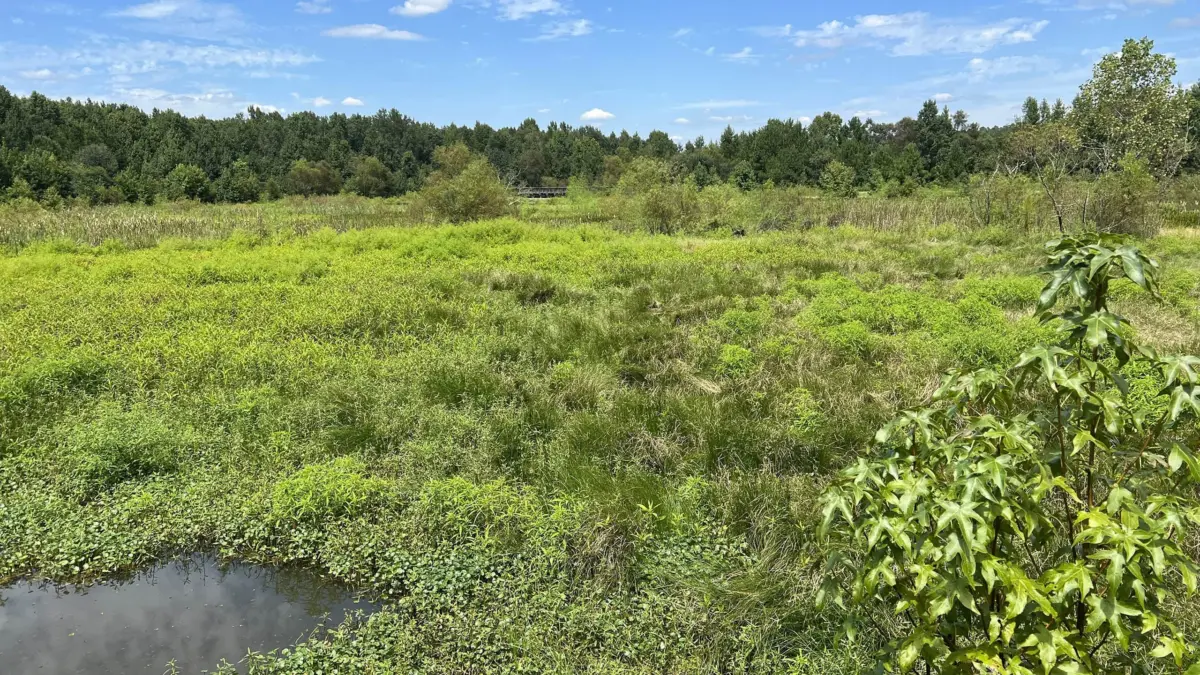
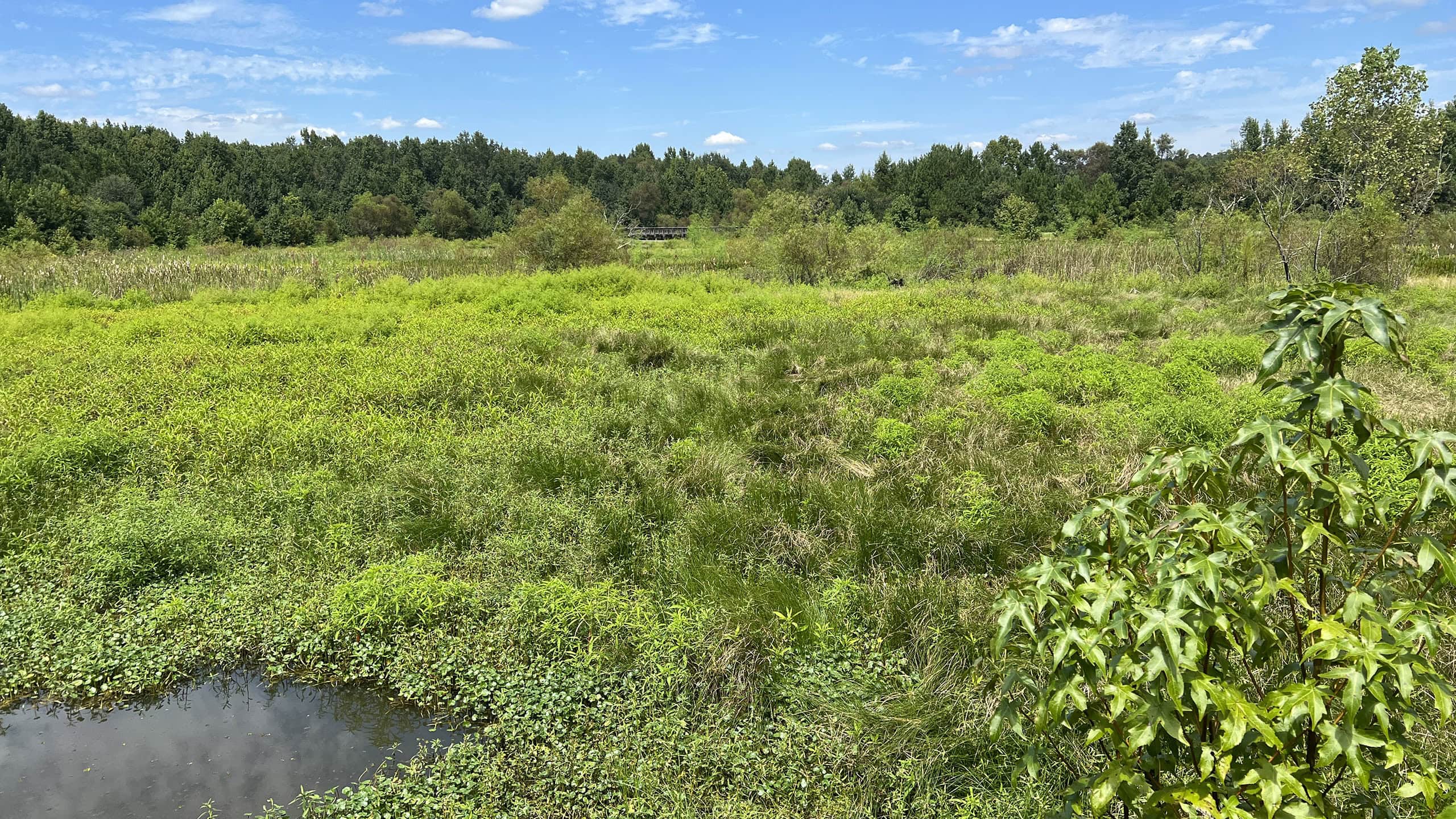
Stepping onto the levee, observers are instantly struck by the rich visual gradient of the prairie basin. Dominated by varying heights of marsh grasses, sedges, and emergent aquatic plants, the landscape shifts in texture and hue as the eye sweeps toward the far shore. There, dense clusters of willows, woody shrubs, and a stalwart line of perimeter trees frame the horizon.

Roughly 0.1 miles into the clockwise trek, the trail intersects its first major engineering and ecological feature: a wooden boardwalk spanning a convergence zone. Here, a concrete spillway manages the overflow, directing excess water from a neighboring willow-dominated marsh directly into the main body of the prairie. This controlled hydrological exchange is critical for regulating water volume during seasonal rains, preventing flash-flooding while maximizing the filtration time of the runoff.
Beyond the first boardwalk, the trail curves past a strategically positioned wooden bench. This resting point offers sweeping, unobstructed views across the breadth of the prairie basin before the trail transitions into a more enclosed, grassy corridor flanked by stands of native pines.

Wildlife, Waterways, and the Second Boardwalk
At approximately the 0.3-mile mark, hikers encounter the second boardwalk. This structure features a more prominent concrete spillway, discharging water from an adjacent willow marsh into a secondary pooling zone.
Below the overhanging scrim of marginal vegetation along the prairie’s rim, these open-water pools serve as thriving micro-habitats. The protected waters frequently attract an array of wading birds, including great blue herons and egrets, alongside waterfowl such as American coots, common gallinules, and various duck species. The juxtaposition of open water, emergent marsh grasses, and dense woody thickets creates an ideal foraging and nesting ground for local avian populations.

Continuing past the pond, the trail leads through a straightaway that bends sharply toward the eastern edge of the preserve. Here, the landscape takes on a softer palette: clumps of tall marsh grass edge the wetland boundary, while clusters of red maples along the rim display vibrant new seasonal growth. By rounding this eastern curve, hikers complete the initial 0.5-mile loop, arriving back at the shaded comfort of the picnic pavilion.
Extending the Journey: To Lake Jackson and Meginnis Arm
For visitors seeking a more thorough exploration, the adventure does not end at the 0.5-mile mark. An additional 0.2-mile stroll can be appended to the excursion by following the paved walkway inside the fenced perimeter of Parwez Alam Park, looping past the playground, and exiting toward the public kiosk at Fuller Landing.

Located within the Lake Jackson Aquatic Preserve, Fuller Landing features a concrete boat ramp that pushes out toward Meginnis Arm. However, what greets visitors at the end of the ramp is entirely dependent on regional rainfall and lake cycles. Lake Jackson is renowned for its periodic drying events—natural phenomena where the lake drains through subterranean limestone sinkholes. Consequently, the view from the boat ramp can dramatically shift from a broad expanse of open water to a sweeping, grassy marshland expanse, underscoring the dynamic, ever-changing nature of Leon County’s hydrological systems.
Supporting Context & Metrics
Hydrological Mechanics: How the Prairie Cleans Stormwater
To fully appreciate Okeeheepkee Prairie, one must understand its function within Tallahassee’s urban watershed. As suburban development expanded across the northern sector of the county, increased impervious surfaces—roofs, roads, and parking lots—accelerated stormwater runoff. Unfiltered runoff typically carries heavy loads of urban pollutants, including nitrogen, phosphorus, heavy oils, and particulate matter, directly into natural water bodies.

The Okeeheepkee Prairie Preserve acts as a natural retention and treatment facility:
- Inflow Interception: Stormwater from surrounding neighborhoods is channeled through a network of municipal drains into local holding areas.
- Settling Ponds: Before water enters the main prairie basin, it passes through intermediary marshes that act as settling ponds. Here, velocity drops, allowing heavy sediments and suspended solids to drop out of the water column.
- Biological Filtration: As water slowly diffuses through the dense vegetation of the prairie—comprising cattails, sedges, and willows—plants and associated microbial communities absorb excess nutrients like nitrogen and phosphorus. This biological uptake prevents these compounds from triggering eutrophication downstream.
- Controlled Discharge: The purified water is gradually released through engineered spillways and wetlands into Meginnis Arm, ultimately feeding into the northern basin of Lake Jackson.
WATER TREATMENT LIFECYCLE AT OKEEHEEPKEE:
[Urban Runoff] ➔ [Settling Ponds/Marshes] ➔ [Sediment Deposition]
➔ [Biological Uptake (Plants/Microbes)] ➔ [Controlled Spillway Release] ➔ [Meginnis Arm / Lake Jackson]
Trail Specifications & Visitor Guidelines
| Metric / Parameter | Detail |
|---|---|
| Trail Length | 0.5-mile primary loop (+0.2-mile extension to Lake Jackson) |
| Surface Type | Graveled levee, wooden boardwalks, paved park walkways |
| Accessibility | Generally flat, but levee surfaces may present uneven footing |
| Amenities | Picnic shelter, nature playground, information kiosks (Restrooms: None on-site) |
| Land Management | Leon County Division of Parks and Recreation |
| Contact Number | 850-606-1470 |
| Wildlife Advisory | Alligators inhabit the water systems; leashed dogs are permitted, but caution is strictly advised near the water’s edge. |
Official Statements & Management Perspectives
Local environmental planners and Leon County officials have consistently highlighted Okeeheepkee Prairie Preserve as a model for blending civil infrastructure with passive public recreation.

"Parks like Okeeheepkee prove that municipal infrastructure does not have to be an eyesore of concrete and chain-link fencing," noted a representative from the Leon County Division of Parks and Recreation. "By restoring and protecting these natural floodplains, we achieve dual goals: safeguarding our regional water quality against the pressures of urban growth while providing families with accessible, educational green spaces right in their backyards."
Conservationists emphasize that the preserve serves as an outdoor classroom for the community. The integration of the nature playground at Parwez Alam Park introduces children to natural textures and environmental concepts at an early age, fostering a stewardship mindset that aligns with the county’s broader conservation objectives. Furthermore, the site’s proximity to other regional natural assets—such as the Lake Jackson Mounds Archaeological State Park, Elinor Klapp-Phipps Park, and the Maclay Gardens Ravine Trail—cements its status as a critical node in Tallahassee’s interconnected green infrastructure network.

Future Outlook & Conservation Challenges
Looking ahead, the long-term sustainability of the Okeeheepkee Prairie Preserve relies on adaptive management and continuous watershed monitoring. As urban density in northern Tallahassee continues to evolve, the volume and velocity of stormwater inputs into the preserve will require careful regulation.
Key focus areas for future management include:

- Sediment Removal and Maintenance: Periodic dredging or management of the settling ponds and concrete spillways will be necessary to ensure the wetlands do not become overwhelmed by accumulated urban silt.
- Invasive Species Management: Like many Florida wetland preserves, Okeeheepkee is vulnerable to the encroachment of invasive plant species. Ongoing monitoring and targeted removal efforts will be vital to preserving the native botanical diversity that underpins the marsh’s filtration capacity.
- Climate Resiliency: With shifting precipitation patterns and increasingly severe storm events, engineered retention systems must be evaluated for their capacity to handle peak flooding loads without compromising surrounding residential subdivisions.
By balancing ecological restoration with community access, Okeeheepkee Prairie Preserve remains a shining example of how modern municipalities can harmonize urban development with the preservation of Florida’s fragile natural landscapes.

0 Comments