

Executive Overview
Amidst the sprawling, asphalt-heavy expanse of modern urban Delray Beach, Florida, lies a resilient 25-acre vestige of prehistoric Florida: the Delray Oaks Natural Area. Managed by Palm Beach County, this protected sanctuary acts as an ecological time capsule, offering a vivid window into a coastal landscape once completely dominated by dense canopies of ancient trees rather than concrete architecture and commercial development.
Far more than a simple neighborhood walking path, Delray Oaks is an intact, mature xeric hammock anchored by towering, gnarled live oaks, cabbage palms, and an intricate understory native to the Atlantic Coastal Ridge. This carefully maintained natural area balances rigorous conservation mandates with public accessibility. It features a unique blend of fully paved, ADA-accessible pathways and rustic, yellow-blazed footpaths that weave through delicate ecosystems, culminating in an elevated observation deck overlooking a seasonal strand swamp.

For urban dwellers, conservationists, and nature enthusiasts alike, Delray Oaks Natural Area presents an intimate masterclass in South Florida’s pre-development ecology. This report provides a detailed chronological examination of the trail system, contextualizes its ecological and infrastructural metrics, reviews the official data governing its management, and explores the broader outlook for urban green space preservation in rapidly developing Palm Beach County.
Detailed Chronology of the Trail Experience
Navigating Delray Oaks Natural Area is an immersive journey that transitions from open urban margins into deeply shaded, ancient microclimates. The preserve offers a compact yet diverse 0.8-mile trail network that seamlessly merges accessible infrastructure with traditional wilderness paths.

The Trailhead and Initial Ascent
The expedition begins at the shaded parking area located off SW 29th Street. Visitors are greeted by a large informational kiosk providing ecological maps, interpretive guidelines, and safety notices, flanked immediately by stands of taller-than-average wild coffee (Psychotria nervosa).
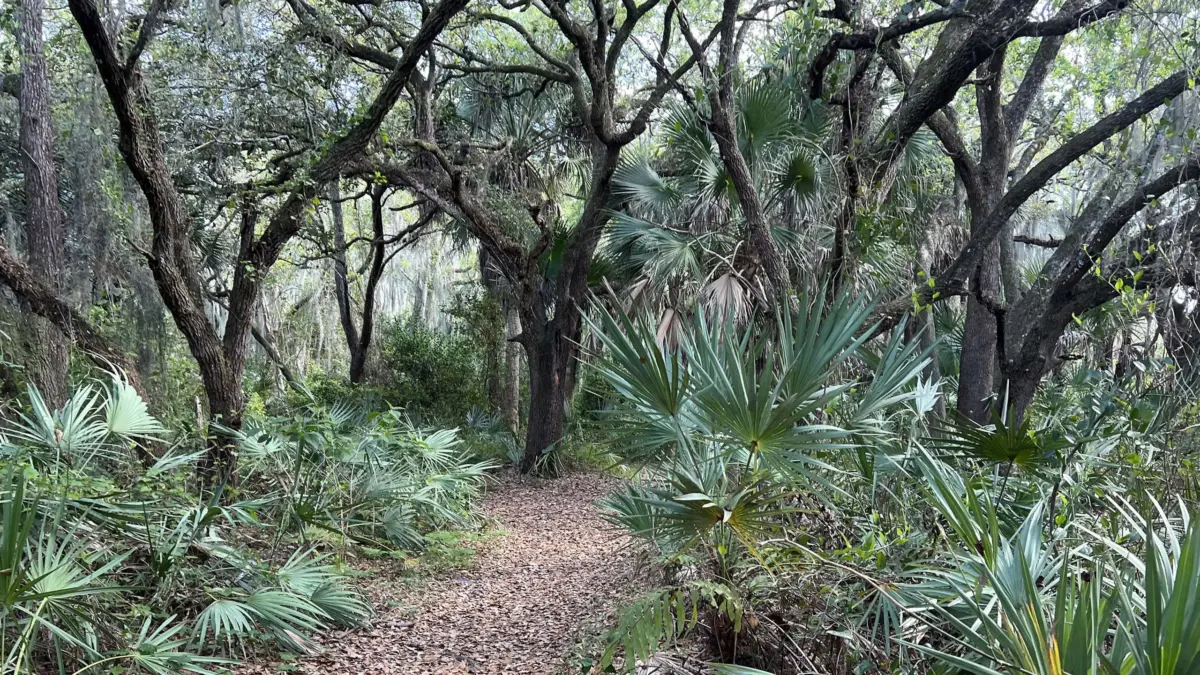
Passing through a rustic gap in the split-rail fence, hikers step onto a ribbon of smooth concrete. Massive, multi-centennial live oaks (Quercus virginiana) immediately loom overhead, their sweeping branches stretching across the path to form natural, cathedral-like arches. The sudden shift in ambient temperature and light is palpable as a dense canopy of interwoven limbs blocks out the glaring South Florida sun.

Moving past a stand of native cabbage palms (Sabal palmetto), the path passes interpretive signage detailing ongoing conservation efforts, specifically the eradication of invasive ferns that threaten the native undergrowth.
Venturing onto the Yellow-Blazed Footpath
Roughly one-tenth of a mile into the walk, a broad, leafy opening on the left marks the intersection with the quarter-mile yellow-blazed footpath. Marked by a post bearing a distinct yellow circle, the dirt-and-leaf-litter trail invites visitors deeper into the xeric hammock.

Here, the landscape changes texture. The path winds beneath live oaks heavily draped in sweeping veils of Spanish moss (Tillandsia usneoides). The corridor is tightly hemmed in by wild coffee, massive sword ferns (Nephrolepis exaltata), and carpets of marsh ferns thriving in localized damp pockets. In sun-drenched clearings, clusters of American beautyberry (Callicarpa americana) burst with vibrant purple berries, contrasting sharply with the deep green understory.
As hikers navigate the divergence in the path, the forest floor gradually dries, yielding to bracken fern and patches of smilax. A confirmation blaze post guides the trail around a gentle curve, opening into a wide clearing where larger live oaks stretch skyward. A wooden bench sits nestled in this shady alcove, flanked by blazed posts, offering a quiet space for reflection.

The Urban Interface and Return Loop
Beyond the clearing, the footpath narrows as it cuts through a tall wall of saw palmetto (Serenoa repens). Emerging abruptly into harsh daylight, the trail hits an abrupt boundary marker: a security fence immediately abutting a residential condo complex. This stark visual serves as an environmental reminder of the pressures of urban encroachment, marking a slice of woodland carved away before the remaining parcel was granted official preservation status.
The trail parallels this property boundary before turning back into the protective embrace of the oak canopy. Following a T-junction marked by encouraging handwritten directions ("Almost There") on a yellow blaze, hikers complete the quarter-mile loop, re-joining the initial concrete sidewalk.

The Strand Swamp and Overlook
Turning left onto the accessible sidewalk, visitors re-enter the deep preserve. The pathway curves past more oak archways where Spanish moss sways rhythmically in the coastal breeze. The terrain gently undulates over ancient, stabilized sand dunes, flanked by silvery-blue saw palmettos that catch filtered shafts of sunlight.
The final stretch of the trail is framed by a split-rail fence that curves gracefully above a noticeable drop-off into a seasonal strand swamp. This deep swale—a watery depression cradled between ancient dunes—features tangled vines, lush ferns, and rich organic muck that holds water during the rainy season.

The journey culminates at a sturdy wooden observation deck extending out over the swale. Totaling precisely 0.5 miles along the main accessible route (and 0.8 miles when incorporating the interior footpath loop), this scenic overlook provides a peaceful vantage point to observe the complex interplay of upland and wetland habitats before returning to the trailhead.
Supporting Context & Metrics
Understanding the ecological and logistical framework of Delray Oaks Natural Area requires an examination of its core operational statistics and geographic data.

Vital Statistics & Site Metrics
- Official Name: Delray Oaks Natural Area
- Land Manager: Palm Beach County (Environmental Resources Management Department)
- Total Acreage: 25 acres
- Total Trail Length: 0.8 miles cumulative (0.5-mile accessible sidewalk loop + 0.25-mile interior yellow-blazed footpath)
- Geographic Location: Delray Beach, Palm Beach County, Florida
- Trailhead Coordinates: 26.427132, -80.092739
- Physical Address: 2021 SW 29th Street, Delray Beach, FL 33445
- Admission Fees: Free to the public
- Operating Hours: Open daily from sunrise to sunset
- Amenities: Trailhead kiosk, interpretive signage, wooden observation deck, benches. (Note: Restrooms are not available on-site).
- Restrictions: No pets allowed; staying on marked trails is strictly enforced to protect native flora.
Ecological Context
Delray Oaks protects a classic xeric hammock ecosystem situated on the Atlantic Coastal Ridge. Xeric hammocks are elevated, well-drained forested areas that rarely flood, historically protected from natural wildfires by surrounding wetlands and sparse ground cover. They are characterized by a dense, closed-canopy tree layer—predominantly live oaks—that suppresses understory growth through heavy shade, though adapted shade-tolerant shrubs like wild coffee and beautyberry thrive below.
Adjacent to the upland hammock is the strand swamp ecosystem. These linear, shallow wetland depressions flow slowly during periods of heavy seasonal rainfall, acting as natural filtration systems and vital breeding grounds for amphibians, wading birds, and resident wildlife.

Official Statements and Management Perspectives
The preservation and ongoing maintenance of urban natural areas like Delray Oaks represent a collaborative effort between municipal authorities, county environmental divisions, and local conservationists.
Palm Beach County Environmental Resources Management (ERM) oversees the site, ensuring that public access does not compromise the ecological integrity of the parcel. County land managers emphasize that properties like Delray Oaks serve a dual purpose: acting as biological reservoirs for native South Florida species while providing accessible environmental education spaces for nearby residential communities.

In conservation literature regarding South Florida’s rapidly dwindling green spaces, naturalists and authors—such as renowned Florida trail expert Sandra Friend—frequently highlight the significance of these pocket preserves. In guides celebrating Sunshine State biodiversity, analysts note that urban preserves are critical buffers against the "heat island" effect, stormwater runoff, and habitat fragmentation. By maintaining sites like Delray Oaks, county agencies provide a living laboratory where the public can witness firsthand the pre-urbanized landscape of coastal Palm Beach County.
Future Outlook
As Palm Beach County continues to experience rapid population growth and intense real estate development, the long-term outlook for small, urban natural areas hinges on proactive management, active community stewardship, and strict regulatory protection.

Challenges and Mitigation
The primary threat facing Delray Oaks Natural Area is edge effect degradation. Because the 25-acre parcel is tightly bordered by residential developments, roadways, and commercial properties, it is vulnerable to invasive non-native plant species, stormwater pollution runoff, and trespassing.
To combat these pressures, Palm Beach County ERM routinely deploys ecological restoration teams to manually remove aggressive invasive plants—such as the invasive ferns and non-native vines noted along the trails—while actively replanting native understory species. Furthermore, strict municipal ordinances prohibiting pets and motorized vehicles help preserve ground-nesting birds, reptiles, and sensitive soil compositions.

The Role of Pocket Preserves in Urban Planning
Looking ahead, municipal planners increasingly view parcels like Delray Oaks not merely as recreational parks, but as essential pieces of municipal green infrastructure. These natural areas play an invaluable role in urban stormwater management, groundwater recharge, and urban carbon sequestration.
For the residents of Delray Beach, Delray Oaks Natural Area stands as a testament to successful urban conservation. It proves that dense development and ecological preservation can coexist, offering generations of future visitors a quiet sanctuary to step beneath ancient oak branches and experience Florida as it once was.

0 Comments