

Executive Overview
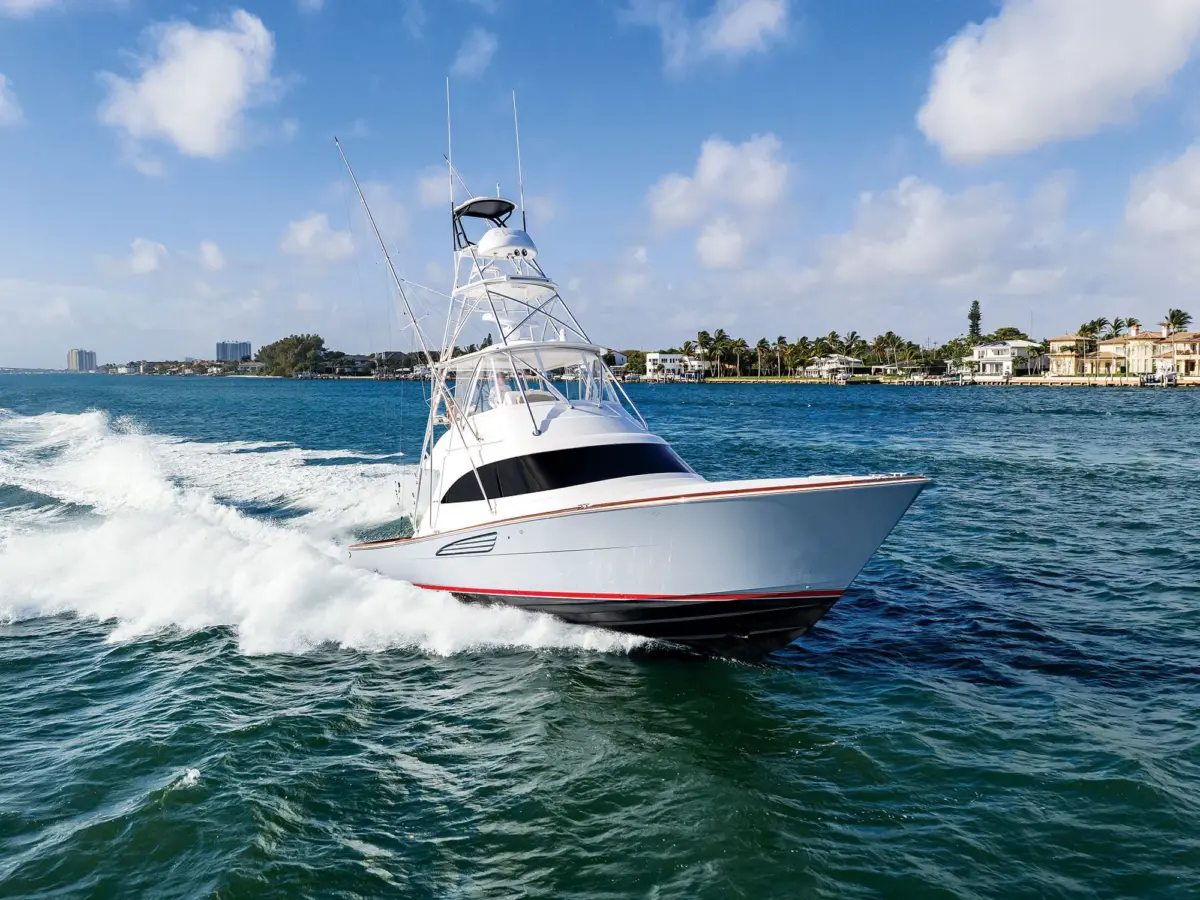
For more than six decades, the Viking Yacht Company has occupied an unassailable position at the pinnacle of elite sportfishing boat construction. Operating out of its sprawling New Gretna, New Jersey facilities, this family-owned and operated builder has systematically redefined what offshore anglers should expect from a tournament-tier machine. The debut of the Viking 50 Billfish marks a profound evolution in the company’s specialized sportfisherman lineup. Designed from the keel up to fulfill a singular, uncompromising mission—hunting apex pelagic species like marlin with ruthless efficiency—the 50 Billfish successfully bridges the gap between classic aesthetic styling, modern high-output power, and world-class cruising comfort.
Hull number one, custom-configured for an experienced tournament angler whose home waters will be the demanding seas of Hawaii, sets a high-water mark for the series. Yet, the true genius of the platform lies in its adaptability. While engineered to perform as a pure, hard-core fishboat, it refuses to sacrifice livability. Beneath its classic exterior lines and unblemished gelcoat lies a sophisticated interplay of advanced composite materials, computational fluid dynamics (CFD), and elite engineering.
From its massive 170-square-foot cockpit to its climate-controlled, gloss-walnut interior, the Viking 50 Billfish is a masterclass in modern marine architecture. This comprehensive review examines every facet of the vessel—from its structural composition and mechanical systems to its sea-trial performance metrics—to understand why this New Jersey heavyweight remains the gold standard in contemporary sportfishing.
Detailed Chronology and Design Evolution
The genesis of the 50 Billfish can be traced directly to the lineage of the highly successful Viking 50 series, yet it would be a mistake to view this model as merely a cosmetic variant. Viking’s naval architects and engineers approached the 50 Billfish with a blank slate regarding its operational mission, resulting in a distinct hull design optimized specifically for the unique demands of serious billfishing.
Hull Construction and Engineering Architecture
The foundation of the 50 Billfish is built upon a state-of-the-art, resin-infused composite hull structure. Viking utilizes engineered E-glass laminates combined with strategic carbon fiber reinforcements to optimize the strength-to-weight ratio. The core materials provide exceptional structural integrity without introducing unnecessary deadweight.
The hull bottom features a computational-fluid-dynamic (CFD) designed running surface. This advanced hydrodynamic profiling is engineered to achieve two critical objectives: maximizing operating efficiency across a broad RPM range and leaving a remarkably clean, flat trolling wake. For tournament captains pulling a spread of artificial lures and live baits, a clean wake is paramount; it allows teasers and baits to run true without being masked or disrupted by turbulent white water. Furthermore, the transom features a gentle crown specifically designed to deflect and push away water when backing down hard on a fish, keeping the cockpit dry and responsive during intense wire-man maneuvers.
Deck Layout and the 170-Square-Foot Cockpit
Stepping aboard the 50 Billfish reveals an expansive, clutter-free 170-square-foot cockpit designed by people who clearly understand the chaotic reality of a multiple-angler hookup.
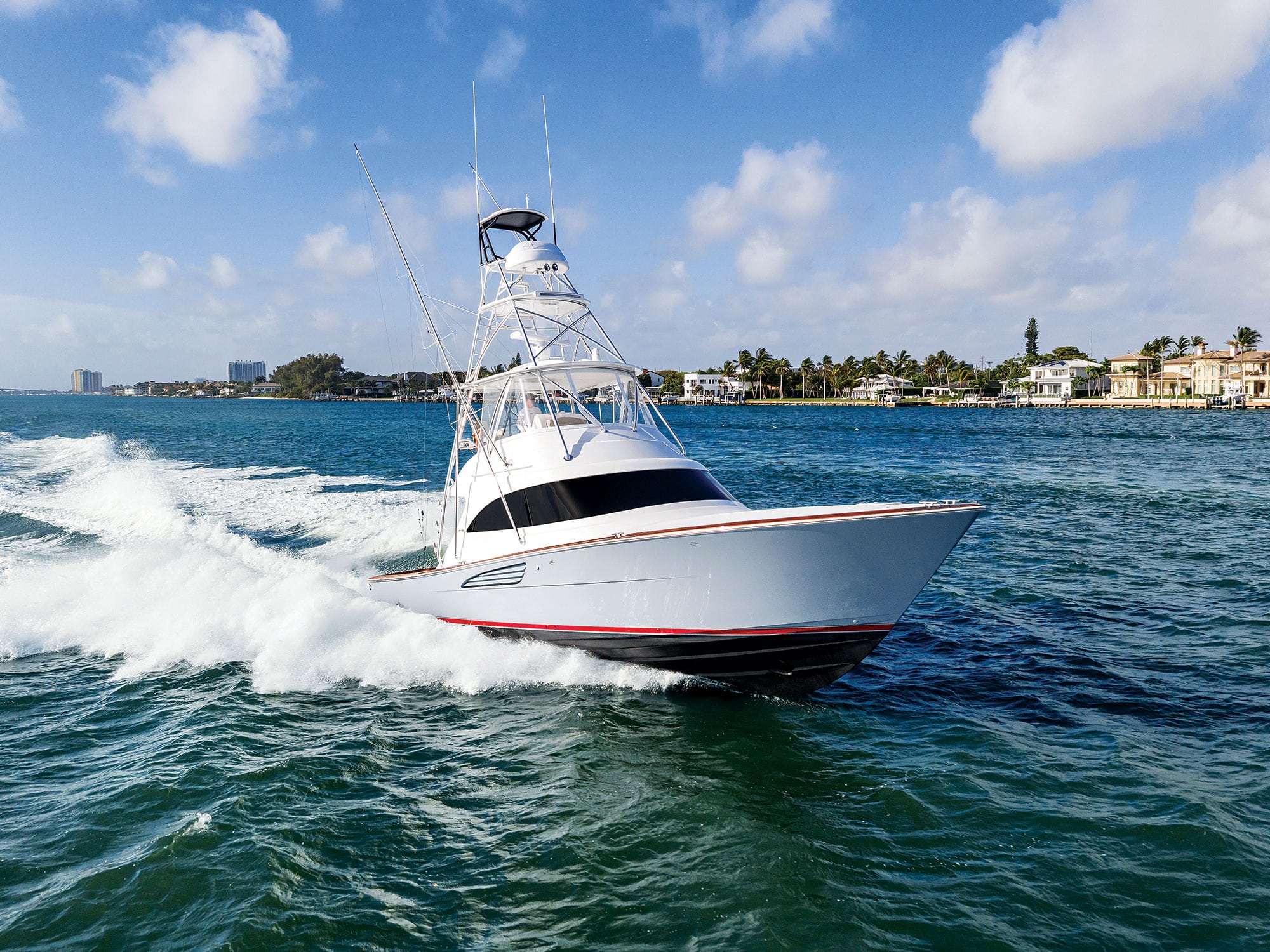
The ergonomics of the working space are immediately apparent. The rounded coamings offer ergonomic comfort when leaning out to wire a fish, and the 39-inch dimension from the waterline to the covering boards optimizes the height for quick, safe releases. While a molded, non-slip fiberglass sole comes standard, hull number one was specified with custom teak cockpit sole and cover boards, lending a traditional yacht-finish appearance.
An outward-opening transom door incorporates an integrated lift gate, facilitating the safe boating of oversized game fish. Practicality is woven into every square inch of the deck layout:
- Electrical Integration: Beneath the port and starboard coamings, Viking has installed dedicated 30-amp 12-volt DC and 30-amp 24-volt DC outlets to power modern electric deep-drop reels.
- Fish Storage: Port and starboard insulated tuna-sized fish wells feature split lids supported by heavy-duty gas struts for safe, effortless operation in heavy seas.
- Rod and Gear Management: Standard gunwale rod holders are complemented by an additional six holders positioned strategically on the cabin-side haunches.
The split mezzanine design aft of the salon door serves as the social and operational hub of the cockpit. To port, an L-shaped lounge provides comfortable viewing of the spread, flanked by a Garmin 8612 multi-function display (MFD) and a Fusion stereo system. Undermounted mezzanine boxes house dedicated freezer and refrigeration space alongside ample tackle and gear stowage. Meanwhile, a step-box cooler positioned directly outside the salon sliding door ensures the crew stays refreshed without ever needing to leave the pit.
Supporting Context & Metrics: Systems, Propulsion, and Performance
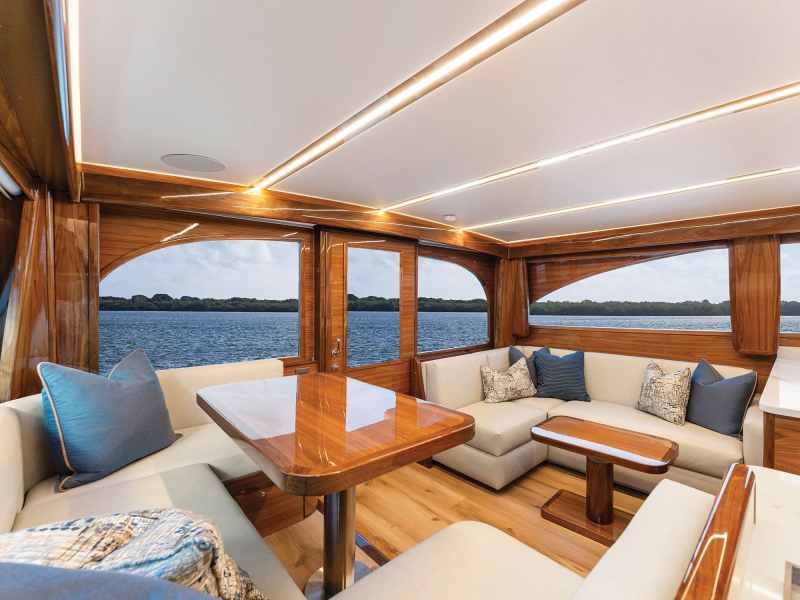
To power a 64,306-pound tournament machine requires serious, reliable muscle. The engine room and mechanical systems of the Viking 50 Billfish reflect an uncompromising commitment to redundancy, serviceability, and high-performance endurance.
The Engine Room and Mechanical Infrastructure
Access to the snow-white Awlgrip engine room is granted via a centerline hatch integrated into the mezzanine. Upon descent, technicians and owners are greeted with 63 inches of headroom along the centerline, tapering down to 36 inches forward.
At the heart of the propulsion system sit twin MAN V8-1200 CRM diesel inboards, each pumping out a formidable 1,200 horsepower. Abaft the port engine resides a 21.5 kW Onan generator, supplying ample electrical independence for all shipboard systems. Serviceability is a standout feature: all seacocks and sea strainers are clearly labeled and readily accessible, minimizing downtime during routine maintenance routines. Forward of the main engines, a secondary hatch conceals an Electrosea ElectroStrainer system, engineered to actively combat barnacles and marine growth in raw-water lines.
The port and starboard machinery platforms host an array of high-grade auxiliary equipment:
- Water and Climate Systems: A Grundfos water pump, water manifolds, and multiple Dometic air conditioning units serve the salon, staterooms, and a dedicated Eskimo ice maker.
- Power Management: Dual Asea DBT isolation transformers protect the vessel’s electrical grid from shore-power irregularities.
- Freshwater Production: A Spot Zero watermaker ensures spot-free washdowns and crystal-clear onboard water.
- Stabilization: A factory-installed Seakeeper SK10 gyro stabilizer is housed securely in the lazarette, accessible via a deep-guttered, overboard-draining centerline hatch.
Command Station and Electronics Suite
The flybridge serves as the primary command center, offering unobstructed 360-degree visibility. Outfitted with Release Marine helm and companion chairs, comfortable guest lounge seating, and a faux-teak finished helm pod with single-lever electronic controls, the bridge balances operational utility with refined aesthetics.
Viking’s wholly owned subsidiary, Atlantic Marine Electronics (AME), outfitted the helm flanking boxes with a comprehensive suite of tactical controls: dual Icom VHFs, Lenco trim tab displays, ZF backup controls, bow thruster actuation, and Seakeeper interface screens. Below the pod sits a Furuno CSH8L sonar control box, while engine displays nest neatly beneath a raised pod housing twin 22-inch Garmin 9222 MFDs.
The fiberglass hardtop is custom-scalloped to accommodate a Garmin 8616 MFD, a Garmin autopilot, a Garmin TD 50 temperature gauge, and auxiliary gear. Crowning the electronics package is a commercial-grade Furuno 25kW radar spinning a 6.5-foot open-array antenna. Furthermore, Palm Beach Towers—another Viking subsidiary—crafted a custom five-foot-gap tuna tower equipped with a 53-inch sport-style control box featuring a Garmin 8612 MFD, Icom command mic, ZF levers, and integrated cup holders.
Sea Trial Performance and Fuel Economics
During rigorous sea trials conducted off the coast of Palm Beach, Florida, with full fuel (1,200 gallons) and freshwater (180 gallons) tanks, the Viking 50 Billfish demonstrated exceptional performance parameters.
| RPM | Speed (MPH) | Fuel Burn (GPH) | Range (Miles, 10% Reserve) |
|---|---|---|---|
| 1,800 RPM | ~35 MPH | 80.5 GPH | 510 Miles |
| 2,000 RPM | ~38 MPH | 102 GPH | 437 Miles |
| WOT | ~44 MPH | — | — |
The computational-fluid-dynamic hull form proved its worth immediately. Even at high cruise speeds, the acoustic insulation and the natural dampening effect of ocean water rushing past the hull successfully kept machinery noise to a minimum. The resulting range figures provide offshore anglers with the operational radius required for extended canyon runs or remote island expeditions.
Official Statements and Interior Accommodations
While the DNA of the 50 Billfish is undeniably that of a hardcore tournament contender, stepping inside the cabin reveals an interior environment optimized for multi-day comfort and luxurious relaxation.
Capitalizing on the boat’s generous 17-foot, 1-inch beam, the climate-controlled salon features horizontal-grain gloss-walnut joinery that exudes warmth and sophistication. Entered through an electric sliding glass door from the cockpit, the open-concept living space is designed for effortless socializing.
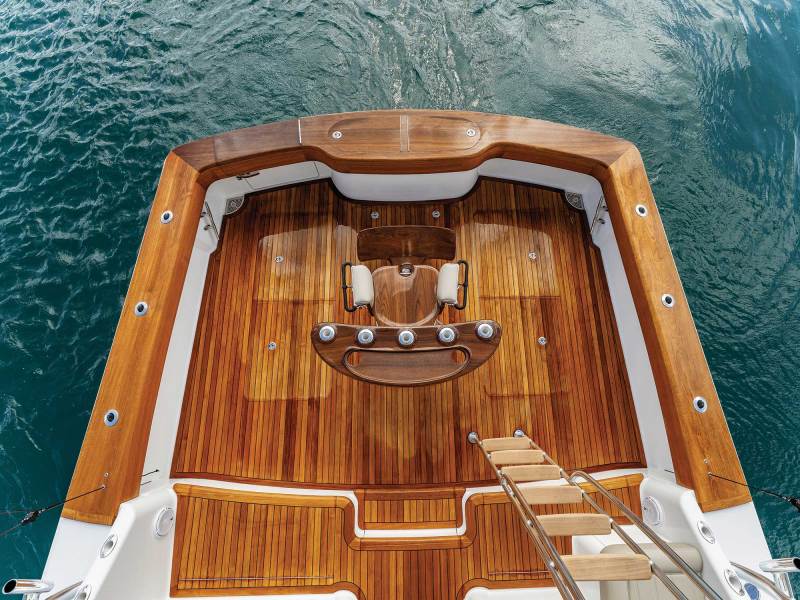
To port, an L-shaped lounge surrounds a high-low cocktail table, directly facing a four-seat dinette to starboard. The dinette is elevated above the Amtico flooring to accommodate a clever slide-out tackle tray capable of securely stowing up to six custom rods and reels. Forward of the salon, the split galley is appointed with manufactured stone countertops, under-counter refrigeration, advanced cooking appliances, a stainless-steel sink, and an integrated ice maker.
Accommodation layouts can be tailored to owner preferences, offering configurations of either two or three staterooms, paired with two well-appointed heads featuring full-size stall showers. In the two-stateroom version evaluated during sea trials, the elimination of a third cabin frees up monumental space for a dedicated tackle and rod storage center, cementing the boat’s utilitarian focus.
Future Outlook and Market Impact
The introduction of the Viking 50 Billfish arrives at a time when discerning sportfishing enthusiasts increasingly demand vessels that refuse to compromise. Modern owners want the rugged capability and fishability of a tournament-winning convertible combined with the refined handling, speed, and interior luxury typically reserved for much larger mega-yachts.
By leveraging 62 years of institutional boatbuilding knowledge, Viking Yacht Company has once again proven its mastery over the sportfishing sector. The 50 Billfish fills a strategic niche in the builder’s portfolio, offering a manageable, owner-operator-friendly platform that punches far above its weight class.
As hull number one prepares for active deployment in the challenging waters of Hawaii, and subsequent hulls roll out of the New Jersey production lines, the Viking 50 Billfish is poised to dominate tournament leaderboards across the globe. For elite anglers seeking a vessel that marries timeless styling with devastating fishing efficiency, the 50 Billfish establishes a formidable new benchmark for the entire industry.

0 Comments