

Executive Overview
Tucked away between the vestiges of former marshlands and the dynamic expanse of the Lake Worth Lagoon lies a precious ecological time capsule: the Lantana Scrub Natural Area. Spanning a modest yet vital sliver of preserved land in Palm Beach County, Florida, this half-mile sanctuary offers an intimate window into a vanishing landscape. Once characteristic of South Florida’s high coastal ridges, ancient sand dunes now host a fragile assemblage of endemic flora and fauna uniquely adapted to hyper-drained, nutrient-poor white sands.

Managed by Palm Beach County, Lantana Scrub serves as a living laboratory and a quiet refuge for hikers, naturalists, and conservationists alike. Despite its proximity to heavily urbanized corridors, stepping past the trailhead kiosk transports visitors into a distinct world dominated by sand pines, silver saw palmettos, and a shifting calendar of native wildflowers. As regional development continues to pressure urban wildlands, sites like Lantana Scrub underscore the urgent importance of municipal conservation, habitat restoration, and passive public engagement.

Detailed Chronology: Navigating the Lantana Scrub Trail
The journey through Lantana Scrub begins on the southwestern side of the property, located at 1259 Southwinds Drive in Lantana, Florida. Accessible daily from sunrise to sunset, the preserve features a streamlined infrastructure designed to balance public access with strict habitat protection—notably prohibiting pets and bicycles to safeguard vulnerable ground-nesting species and fragile flora.

The Trailhead and Initial Ascent
Arriving at the southwestern trailhead via Southwinds Drive, visitors encounter a designated parking area adjacent to the property’s primary access point. Passing through a secure gap in the perimeter fence, hikers are greeted by an informational kiosk. This station provides vital context regarding the rare plant and animal communities protected within the boundaries of the preserve, alongside a detailed map of the loop.

To the left of the kiosk, a well-defined pathway invites entry into the canopy. Navigational markers—wooden posts emblazoned with a distinctive yellow circle—guide the traveler along the route. The initial 0.1 miles of the hike head northward along a wide corridor originally cleared as a firebreak. This open stretch is flanked by native grasses, cabbage palms, and diminutive scrub oaks draped in clinging love vine. According to land management reports, ongoing ecological restoration efforts are actively targeting this corridor to re-establish a more authentic, densely integrated scrub community.

Deep into the Sand Pine Canopy
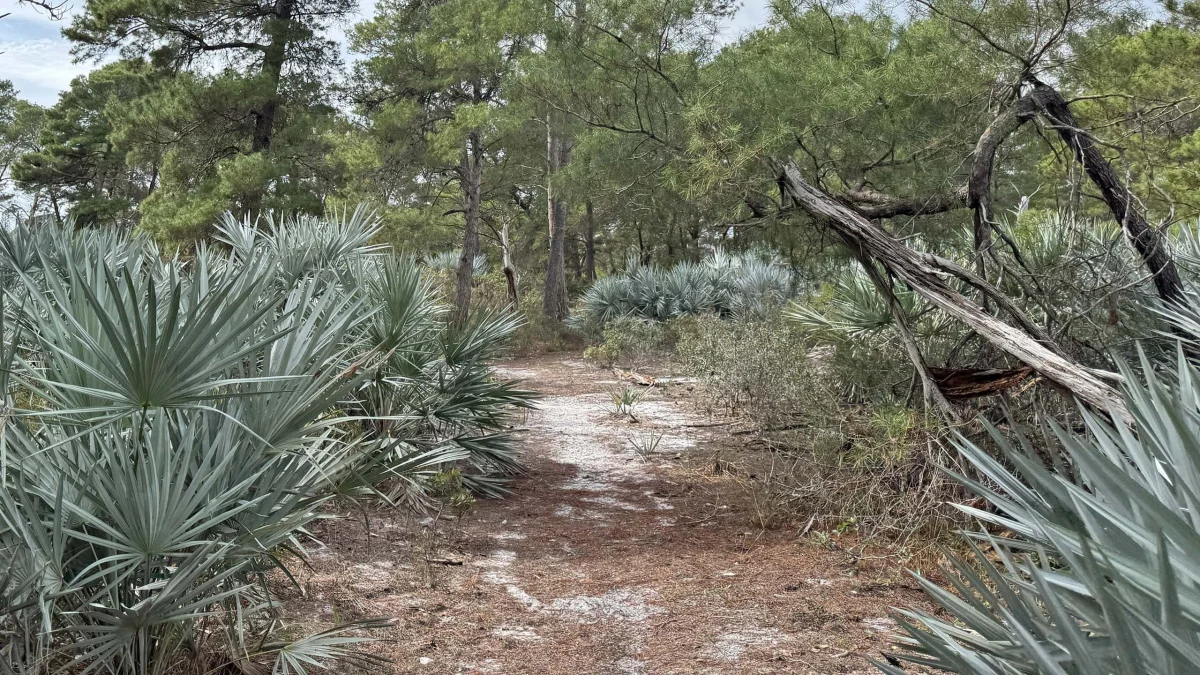
As the trail cuts deeper northward into the interior of the preserve, the landscape shifts dramatically. A towering overstory of sand pines (Pinus clausa) rises above the dense, shrubby underbrush, casting dappled shade across a stark, white-sand floor strewn with pine needles. Here, the ground layer is carpeted with resilient sand spikemoss, delicate silkgrass, and endemic palafox.

The trail gradually arcs eastward, transitioning from the wide firebreak into a narrower, more intimate footpath flanked by dense scrub. At this juncture, the biological diversity of the ancient dune becomes sharply apparent. Depending on the season, the forest floor erupts in seasonal color: the vivid purple blossoms of largeflower false rosemary (Conradina grandiflora) emerge in the spring, while vibrant yellow coastal honeycombhead (Balduina angustifolia) dominates the understory in the fall.

The Heart of the Preserve
Crossing the eastern half of the loop at approximately the 0.3-mile mark, hikers traverse the most pristine and undisturbed section of the natural area. Here, broad swaths of silver saw palmettos (Serenoa repens) provide a striking silvery-green contrast against the darker, verdant foliage of the surrounding scrub oaks. Where the overstory canopy thickens sufficiently, massive airplants (Tillandsia species) anchor themselves securely to the crooked, weathered branches of ancient trees.

Curving southward, the trail briefly re-aligns with a secondary firebreak before turning back toward the west. This final leg of the journey weaves once more through the heart of the sand pine forest. The air grows fragrant with the pungent, aromatic scent of Florida rosemary (Ceratiola ericoides) bushes, which dot the forest floor alongside resilient clusters of gopher apple (Licania michauxii) and patches of sage-tinted deer moss.

At approximately the 0.5-mile mark, the loop gracefully emerges from the shadows of the woods, terminating precisely where it began at the trailhead kiosk.

Supporting Context & Metrics: Ecological and Geographical Data
Understanding Lantana Scrub requires examining the broader environmental architecture of coastal Palm Beach County. The property’s existence is inextricably linked to the Atlantic Coastal Ridge, an ancient dune system formed during previous epochs when sea levels were significantly higher.

Key Site Metrics
- Location: Lantana, Florida
- Total Trail Length: 0.5-mile loop
- Trailhead Coordinates: 26.592639, -80.063194
- Physical Address: 1259 Southwinds Dr., Lantana, FL 33462
- Admission Fees: Free to the public
- Operating Hours: Open daily from sunrise to sunset
- Amenities: No restrooms on-site; parking available at the southwestern trailhead
- Restrictions: No pets, no bicycles, no motorized vehicles
- Land Manager: Palm Beach County Environmental Resources Management (ERM)
- Contact Number: 561-233-2400
Access Points
While the primary trailhead and vehicular parking are situated on the southwestern side via Southwinds Drive, the property also incorporates two secondary walk-thru pedestrian gates located at the northeastern and southeastern corners. These auxiliary gates seamlessly connect local pedestrian traffic from surrounding neighborhoods directly into the preserve’s trail network.

Ecological Significance of Florida Scrub
Florida scrub is recognized globally as one of North America’s most endangered and threatened ecosystems. Characterized by well-drained, nutrient-deficient sandy soils, extreme solar radiation, and frequent fire cycles, scrub environments host an exceptionally high concentration of endemic species found nowhere else on Earth. At Lantana Scrub, plants such as the sand spikemoss, Florida rosemary, and coastal honeycombhead have evolved specialized physiological adaptations—such as waxy leaves, deep taproots, and drought-resistance mechanisms—to survive these harsh conditions.

Official Statements and Management Perspectives
The preservation and ongoing maintenance of parcels like Lantana Scrub reflect a concerted municipal strategy spearheaded by Palm Beach County’s Environmental Resources Management (ERM) division.

County conservation officials emphasize that managing urban natural areas requires a delicate balance between active ecological restoration and public access. "In densely populated coastal counties like Palm Beach, natural areas function as vital ecological stepping stones," notes a regional conservation representative. "Even a half-mile preserve like Lantana Scrub acts as a crucial refuge for resident pollinators, migratory birds, and native plant genotypes that would otherwise be entirely displaced by commercial and residential development."

Furthermore, land managers stress the importance of controlled fire regimes and mechanical thinning in maintaining the health of sand pine scrub. Without periodic ecological disturbances—mimicked through targeted restoration efforts—scrub habitats naturally undergo succession, transitioning into dense hardwood forests that crowd out the sun-loving, rare endemic species dependent on open, sandy spaces. The ongoing clearance of invasive species and the careful management of firebreaks at Lantana Scrub directly support the survival of these specialized biological communities.

Future Outlook: Preservation in an Urbanizing Landscape
As South Florida faces relentless demographic expansion and infrastructural densification, the long-term viability of pocket preserves like Lantana Scrub depends entirely on proactive stewardship and community engagement.

The future outlook for the natural area centers on enhanced habitat restoration protocols, continued monitoring of rare vegetative populations, and educational outreach designed to foster a deeper public appreciation for native Florida ecosystems. Regional planning initiatives increasingly recognize that urban green spaces are not merely recreational amenities, but essential infrastructure that provides ecosystem services, including localized temperature moderation, stormwater filtration, and urban biodiversity retention.

For local residents and visitors, Lantana Scrub Natural Area stands as a powerful reminder of what the South Florida coastline looked like prior to widespread development. By maintaining strict preservation policies—such as prohibiting pets and bicycles to protect fragile ground structures—Palm Beach County ensures that this diminutive yet ecologically rich sanctuary will endure for generations to come, offering a quiet, immersive window into the primordial heart of the Sunshine State.

0 Comments