

Executive Overview
Nestled within the densely developed fabric of Southeast Florida lies an ecological time capsule: the Lantana Scrub Natural Area. Spanning a modest yet vital sliver of preserved land, this 0.5-mile sanctuary is situated on ancient, undulating sand dunes wedged historically between former marshlands and the dynamic estuarine waters of the Lake Worth Lagoon. Managed by Palm Beach County, this protected habitat offers an immersive, albeit brief, journey into a vanishing Florida landscape—the sand pine scrub ecosystem of the Atlantic Coastal Ridge.
While urban sprawl continues to redefine much of South Florida’s coastal municipalities, properties like Lantana Scrub serve as critical ecological strongholds. They protect permeable soils, maintain native biodiversity, and provide living classrooms for naturalists, conservationists, and the public. This comprehensive report explores the geographical significance, botanical composition, trail mechanics, and preservation management strategies defining the Lantana Scrub Natural Area, offering an authoritative look at how local land stewardship preserves the Sunshine State’s prehistoric roots.

Detailed Chronology: Navigating the 0.5-Mile Sanctuary
The Trailhead and Initial Approach
The journey into Lantana Scrub begins at its southwestern entrance, accessible via a dedicated parking area at 1259 Southwinds Dr., Lantana (GPS: 26.592639, -80.063194). Visitors are welcomed by an interpretive kiosk positioned strategically at a gap in the perimeter fence. This informational hub introduces hikers to the rare and endemic flora and fauna that call the preserve home, setting an educational tone before a single step is taken on the sand.
Upon passing through the trailhead walk-thru, hikers encounter a pathway directing them toward the northern corridor. The route is clearly blazed with yellow circles painted on wooden posts, a navigational aid crucial for keeping visitors on track within the densely vegetated sanctuary.

Entering the Northern Corridor and Restoration Zones
The initial leg of the loop heads north along a wide firebreak corridor. Here, the landscape is characterized by a mix of:
- Scattered grasses
- Resilient cabbage palms (Sabal palmetto)
- Diminutive scrub oaks draped intricately in love vine (Cassytha filiformis)
Active land management and restoration efforts are visibly underway along this stretch. Palm Beach County environmental teams routinely work to suppress invasive exotic species and reintroduce native fire-regime dynamics, aiming to return this portion of the preserve to its historical, pre-development ecological balance.

Transition to Deep Scrub and Unique Botanicals
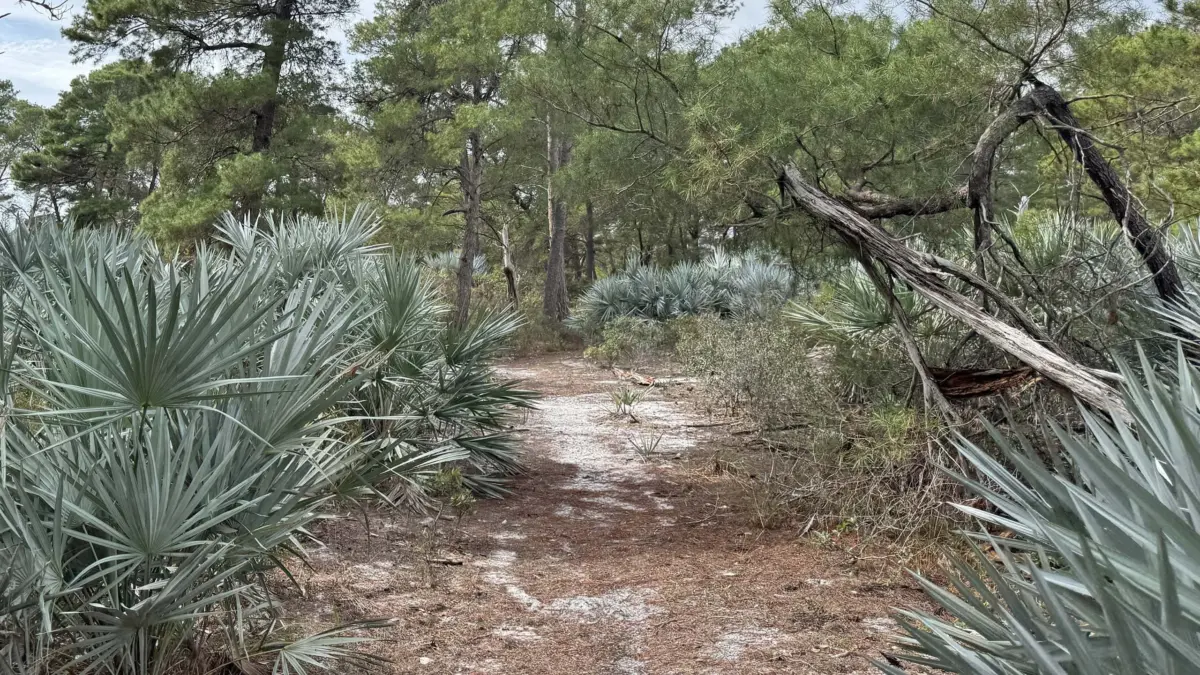
As the trail progresses northward and bends eastward, the corridor narrows, and the canopy rises. Towering sand pines (Pinus clausa) loom over a dense, shrubby underbrush, casting a dappled, shifting shade across the stark, bleached-white quartz sands characteristic of ancient coastal dunes.
Beneath the canopy, the ground is carpeted by a fascinating assemblage of highly specialized flora:

- Sand Spikemoss (Selaginella arenicola): Forms dense, spiky green turf directly on the glaring white sand.
- Silkgrass (Pityopsis graminifolia): Adds fine, grassy textures to the understory.
- Palafox (Palafoxia spp.): Introduces delicate seasonal blooms.
Phenological shifts bring different species into the spotlight throughout the year. Spring hikers are greeted by the striking, purple blossoms of largeflower false rosemary (Conradina grandiflora), while autumn transforms the forest floor with the vibrant, daisy-like yellow blooms of coastal honeycombhead (Balduina angustifolia).
The Heart of the Preserve: Palmettos and Airplants
At approximately the 0.1-mile mark, the trail departs the wide firebreak, transitioning via a narrow footpath directly into the dense, untamed heart of the scrub.

Here, expansive swaths of silver saw palmettos (Serenoa repens) create a vivid color contrast against the varying emerald and jade hues of the surrounding vegetation. Their silvery-blue fronds capture and reflect the intense Florida sunlight, creating a luminous glow beneath the canopy. Where the overhead pine and oak canopy thickens to cast substantial shade, epiphytic large airplants (Tillandsia species) cling tenaciously to the crooked, gnarled branches of aging trees, absorbing moisture and nutrients directly from the humid coastal air.
The Southern Curve and Return
At roughly 0.3 miles, the loop executes a southward turn, briefly aligning with a secondary internal firebreak before curving back toward the west through the sand pine forest.

This final stretch highlights some of the scrub’s most iconic and resilient woody species:
- Florida Rosemary (Ceratiola ericoides): Pungent, needle-leaved bushes that emit a distinct, resinous aroma when brushed against.
- Gopher Apple (Licania michauxii): Low-growing woody shrubs forming dense mats that serve as vital food sources for local wildlife.
- Deer Moss (Cladonia species): Pale, sage-tinted lichen patches clinging to the sand alongside the trail.
As the odometer ticks toward the 0.5-mile mark, the trail breaks out of the dense canopy, seamlessly looping back to the trailhead kiosk where the journey began.

Supporting Context & Metrics: Ecological and Logistical Data
Operational Specifications
To ensure a safe and organized visit, Palm Beach County enforces strict access guidelines for the property:
- Location: Lantana, Florida (Palm Beach County)
- Total Trail Length: 0.5-mile loop
- Street Address: 1259 Southwinds Dr, Lantana, FL 33462
- Coordinates: 26.592639, -80.063194
- Operating Hours: Open daily from sunrise to sunset
- Admission Fees: Free to the public
- Amenities: None (No restrooms or potable water available on-site)
- Restrictions: Pets and bicycles are strictly prohibited to protect fragile ground-nesting wildlife and native vegetation.
- Land Management Agency: Palm Beach County Environmental Resources Management (ERM)
- Contact Number: 561-233-2400
Driving Directions
For those traveling via regional arteries, accessing the Lantana Scrub Natural Area is straightforward:

- From Interstate 95, take the exit for Lantana and head east on W. Lantana Blvd.
- Make a left turn onto Andrew Redding Rd.
- Proceed for approximately 0.4 miles, then make a right turn onto Southwinds Dr.
- Continue to the terminus of the road, where the designated parking lot and trailhead kiosk are located.
Ecosystem Significance: The Atlantic Coastal Ridge
The geological foundation of Lantana Scrub rests upon the Atlantic Coastal Ridge, a Pleistocene-era dune system that once formed a continuous elevated barrier of well-drained, sandy soils along Florida’s southeastern coastline.
Scrub habitats are among the most endangered ecosystems in Florida. Subjected to intense solar radiation, extreme drainage, and nutrient-poor sandy soils, plants and animals found here must possess specialized adaptations—such as waxy leaves, deep taproots, and drought dormancy—to survive. Preserving tracts like Lantana Scrub safeguards these evolutionary adaptations and provides a refuge for species that cannot tolerate the damp, nutrient-rich conditions of nearby marshes or mangrove fringes.

Official Statements and Land Management Perspectives
Local environmental officials and conservation leaders have long emphasized the disproportionate ecological value of small urban preserves. While major state parks and national preserves capture public headlines, pocket sanctuaries like Lantana Scrub play an outsized role in urban biodiversity corridors.
According to Palm Beach County Environmental Resources Management (ERM) representatives, active management protocols—including controlled burns, mechanical thinning, and aggressive exotic plant removal—are non-negotiable tools in maintaining the health of these isolated parcels. Without human intervention, natural wildfire cycles that historically cleared out encroaching hardwoods and stimulated seed germination are suppressed by surrounding urban development. Consequently, land managers must artificially simulate these ecological resets to prevent scrub habitats from succeeding into closed-canopy hardwood hammocks, which would choke out light-dependent endemic species like the sand spikemoss and false rosemary.

Outdoor educators and trail advocates, such as Florida Trail Association leaders and regional hiking chroniclers, frequently point to Lantana Scrub as an ideal entry point for environmental education. The compact 0.5-mile layout allows casual visitors, families, and school groups to experience a pristine native ecosystem without the physical demands of backcountry wilderness treks, fostering a localized ethic of conservation and land stewardship.
Future Outlook: Preservation in a Developing Landscape
As Southeast Florida’s population continues to densify, the pressures facing urban natural areas will only intensify. Runoff from adjacent development, invasive species creep, and the impacts of a changing climate—including shifting rainfall patterns and rising temperatures—pose ongoing challenges for county land managers.

However, the outlook for Lantana Scrub Natural Area remains secure under the administrative umbrella of Palm Beach County ERM. Ongoing commitments to biological monitoring, community science initiatives, and targeted habitat restoration ensure that this ancient dune remnant will endure. Future enhancements may include expanded educational programming and improved partnerships with local schools to leverage the site as an outdoor laboratory.
Ultimately, Lantana Scrub stands as a testament to the power of deliberate conservation. In just half a mile of trail, visitors are offered a profound encounter with Florida’s deep ecological past, proving that even the smallest parcels of protected land hold immense value in safeguarding our natural heritage for generations to come.

0 Comments