

Executive Overview
In an era dominated by digital navigation, satellite tracking, and the relentless creep of suburban development, the act of stepping into the wilderness has become an increasingly counter-cultural experience. For writer and attorney Rob Rogers, a simple trek into the Little Big Econ State Forest in Central Florida is not merely an escape from the hum of modern life; it is an expedition across centuries. Armed with a printed paper map rather than a smartphone, Rogers trades the electronic shackles of the twenty-first century for a vivid, sensory-rich encounter with the ghosts of Florida’s past.
This deep-dive feature explores Rogers’ meditative and historical trek through the state forest, examining the layers of human and natural history embedded in the landscape. From the cattle ranches of the mid-twentieth century and the brutal turpentine camps of the Jim Crow era, to the paddle-wheel steamboats of the nineteenth century, the skirmishes of the Second Seminole War, and the ancient pre-Columbian settlements of the Timucua, the Little Big Econ serves as an open-air museum. Through Rogers’ journey, the essay reflects on a broader cultural question: In a state defined by theme parks, strip malls, and asphalt, what does it truly mean to connect with the land, and how can we preserve the memory of those who walked these paths long before us?
Detailed Chronology: A Step-by-Step Descent Into the Past
The Departure: Shedding the Digital Age
The journey begins at the trailhead of the Little Big Econ State Forest. Before taking his first step, Rogers engages in a deliberate ritual: locking his car door, securing his backpack straps, and unfolding a physical paper map. While hiking applications and digital GPS route-finders populate modern devices, Rogers opts for tactile cartography.

"It’s a popular route that appears on all the hiking apps, so I’m sure I could find my way using only the electronic ball and chain that shackle me to the modern world," Rogers notes. "But on hikes like these, I like to travel back in time. A paper map reminds me of my Boy Scout days and helps me disconnect from the present, before my mind’s eye locks onto the history I never had the chance to learn in school."
As he steps past the initial gate, a grazing bull eyes him suspiciously. This mundane encounter serves as an immediate historical touchstone, recalling the agricultural era that preceded state preservation efforts. As modern real estate developers cast covetous eyes on remaining tracts of green space, local ranchers—struggling with volatile markets—frequently choose to donate their family plots to land preservation initiatives, sparing them from the bulldozer’s blade. Yet, the encroachment of suburban sprawl remains palpable at the forest’s edge.
The Northward Turn: Turpentine Camps and Iron Teeth
Turning north onto the River Trail, Rogers descends into a dense canopy of slender live oaks. These trees are the second- and third-generation descendants of ancient timber giants that fell more than a century ago beneath the serrated iron teeth of industrial loggers.

The forest here whispers of forced labor and industrial exploitation. In the distance, Rogers hears the phantom songs of Depression-era victims of Jim Crow-era laws. Imprisoned for petty offenses, these men were sentenced to backcountry hard labor in turpentine and lumber camps—a legally sanctioned system of forced servitude that effectively replaced chattel slavery after its formal abolition.
This landscape was once industrialized to feed the insatiable demands of the Gilded Age. The phantom whistle of a Florida East Coast Railway train echoes through the trees, summoning memories of a long-gone depot built to haul away centuries-old virgin timber.
The Econlockhatchee River: Steamboats and Fog
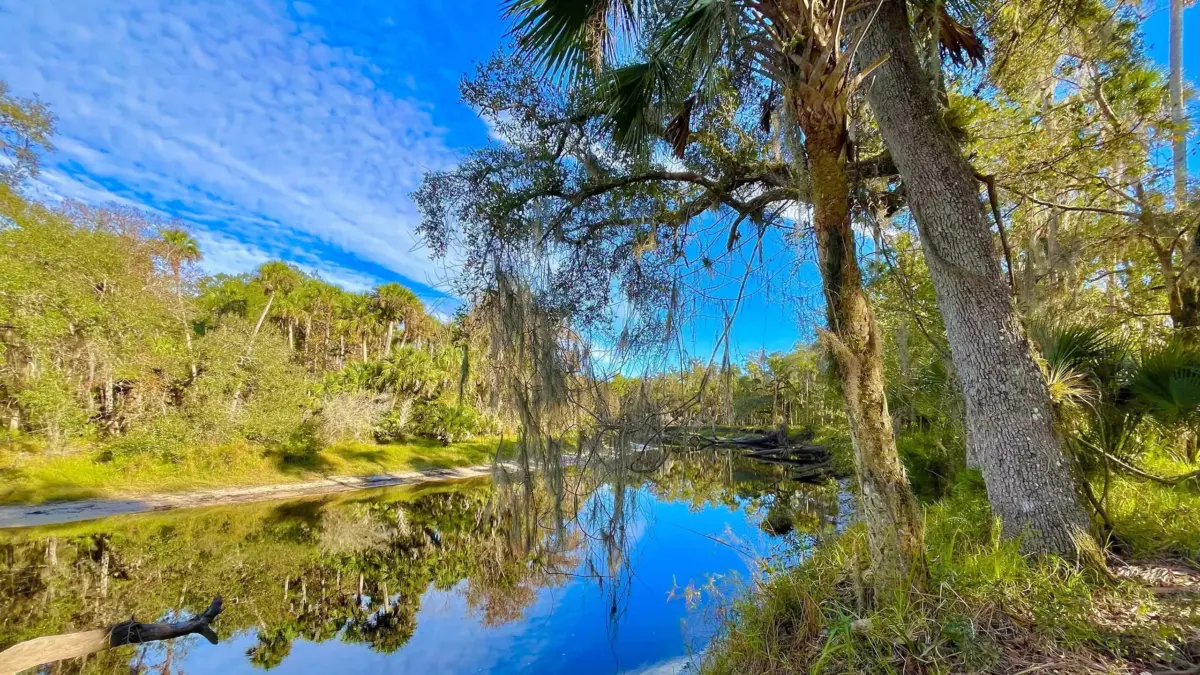
Further along the trail, Rogers reaches the Econlockhatchee River, a winding tributary that functions in the nineteenth-century imagination much like an early superhighway. Long before rails and locomotives "civilized" Central Florida, this river carried tourists, winter residents, and frontier traders deep into the heart of the peninsula.

Because it is the dry season, the river bluffs and sandy banks remain unsubmerged. Weaving along the southern shore through dense thickets of cypress and sable palm toward the St. Johns River, Rogers experiences a sensory hallucination of the past:
"As I gaze ahead, an overloaded nineteenth-century paddle wheeler emerges from the foggy mist, its boiler and chimney belching clouds of ash as it moves upriver past alligators sunning themselves on the sandy beaches."
The Second Seminole War: Shadows in the Palmettos
Pushing deeper into the haze downriver, the atmosphere shifts from pastoral tranquility to sudden tension. A sharp rustling sound—too heavy for a deer or wild hog—breaks the silence.

Rogers turns just in time to imagine the fleeting form of a native warrior sprinting into the dense forest before dissolving into phantom shouts and gunfire. This is the shadow of the Second Seminole War, an ambush on military reinforcements straying too far from the vulnerable supply road connecting Forts Mellon and Christmas. Crouching low among the saw palmettos, Rogers listens as the distant echoes of conflict eventually fade back into the calling of hawks.
The Timucua Village: A Lost World
The trail ultimately leads to the site of an ancient Timucua fishing village near Culpepper Bend. Here, the ground is littered with piles of discarded freshwater shells, and the imaginary scent of roasted fish cuts through the air, mingling with a cacophony of foreign, sixteenth-century dialects.
Though the physical inhabitants vanished centuries ago—wiped out not merely by direct conflict, but by virgin-soil epidemics of European pathogens brought by early explorers—their presence endures. In this quiet clearing, the low-frequency hum of fuel-injected engines and the towering presence of modern electrical transmission lines vanish, replaced entirely by the ancestral spirits of Florida’s first peoples.

Supporting Context & Metrics: The Landscape of Conservation in Florida
To fully appreciate Rogers’ narrative, one must understand the unique ecological and historical pressures shaping Central Florida’s remaining green spaces.
| Metric / Indicator | Contextual Data |
|---|---|
| State Forest Acreage | Florida manages over 1.1 million acres across 38 state forests, balancing public recreation, timber management, and wildlife conservation. |
| Development Pressure | Central Florida (specifically the Orlando metropolitan area) routinely ranks among the fastest-growing regions in the United States, converting thousands of acres of agricultural and natural land annually. |
| The Timucua Nation | Prior to European contact in the 1500s, the Timucua people inhabited roughly 30,000 square miles of North and Central Florida, numbering in the tens of thousands before disease decimated their population. |
| The Turpentine Industry | During the late 19th and early 20th centuries, Florida was a leading producer of naval stores (turpentine and rosin), heavily relying on convict-lease labor systems that mirrored post-bellum forced servitude. |
Preservation initiatives like the Little Big Econ State Forest protect not only endangered Florida scrub jays, gopher tortoises, and black bears, but also act as cultural repositories. Without these protected corridors, the tangible links to Florida’s indigenous, colonial, and industrial heritage would be entirely paved over by strip malls and master-planned communities.
Official Statements & Expert Perspectives
While personal essays like Rogers’ capture the emotional resonance of the wilderness, historical and environmental experts emphasize the critical importance of public lands in maintaining historical continuity.

"When we protect a natural area like the Little Big Econ, we aren’t just saving trees and water; we are preserving the historical archive of the soil," notes a regional cultural resource manager. "Every layer of earth holds the footprint of ranching families, timber barons, enslaved and imprisoned laborers, and indigenous nations. Once that land is converted to asphalt, that library is permanently closed."
Historians specializing in the Florida frontier have similarly highlighted the value of experiential history. Traditional classrooms often skim over the complexities of the Second Seminole War and the convict-lease turpentine camps due to time constraints. Consequently, writers and naturalists who immerse themselves in these landscapes play an vital role in translating academic history into public consciousness.
Future Outlook: Protecting the Stories Beneath Our Feet
As Central Florida’s population continues to surge toward unprecedented numbers, the friction between urban expansion and environmental preservation will only intensify. The future of spaces like the Little Big Econ State Forest depends heavily on active civic engagement, continued state land-acquisition funding (such as the Florida Forever program), and a cultural shift in how residents view their home state.

For Rogers, the journey concludes with a return to the present. Pulling the crumpled paper map from his pocket, he views it no longer as a mere navigational tool, but as a key to unlocking hidden dimensions of the landscape.
"It’s more than just a collection of squiggly lines and cross-hatched smears," Rogers reflects. "It leads me to the forgotten treasures that have not yet been buried by asphalt and concrete. I look forward with youthful delight to my next chance to search for more."
Ultimately, the essay issues a quiet challenge to modern society: To truly understand where we are going, we must occasionally put down our digital devices, step off the paved sidewalks, and wander into the quiet, untamed spaces where the echoes of Florida’s complex past still linger beneath the oak canopy.

0 Comments