

By Derrick Conover
Published: November 21, 2025 | Last Updated: November 21, 2025
Categories: Agriculture, Crops, Horticulture
Tags: Agriculture, SV Ag Update
Executive Overview
For small- and medium-scale agricultural producers across North Florida, diversifying crop yields has transitioned from a localized strategy to an economic necessity. Amidst shifting consumer preferences, land-use pressures, and fluctuating market demands, blueberries have emerged as one of the most promising and financially viable specialty crops in the region.
Columbia County, anchored by its unique environmental profile—featuring mild winters, naturally acidic sandy soils, and deeply engaged local markets—is exceptionally well-positioned to support robust blueberry production. Whether an agronomist is looking to establish a modest, single-acre U-pick operation or scale up an existing enterprise, the foundational elements for success are already embedded within the local ecosystem.
This guide provides an authoritative, in-depth blueprint for regional growers. Drawing on horticultural best practices and local climatic data, we explore why blueberries thrive in North Florida, how to select the optimal cultivar for your specific operational goals, and the nuanced mechanical, irrigation, and management strategies required to secure a healthy, high-yielding harvest year after year.
Detailed Chronology & Establishment Phases
Establishing a successful commercial or boutique blueberry patch is a multi-stage logistical endeavor. Ryping the rewards of a high-value specialty crop requires careful adherence to a timeline that bridges pre-planting site preparation with long-term orchard maintenance.
Phase 1: Pre-Planting Assessment and Soil Preparation (Months 1–6 Prior to Planting)
Before a single plant is ordered, prospective growers must conduct exhaustive soil testing. Although Columbia County naturally features the sandy, acidic conditions that ericaceous (acid-loving) plants demand, verifying the precise soil profile is critical.
- pH Management: The ideal soil pH window for blueberries sits strictly between 4.5 and 5.5. If soil tests reveal a pH higher than this range, elemental sulfur must be incorporated well in advance of planting to allow sufficient time for chemical breakdown and soil acidification.
- Drainage and Bed Formation: Blueberries possess delicate, shallow root systems that are highly susceptible to root rot (Phytophthora and other pathogens) if subjected to waterlogged conditions. Growers must evaluate site drainage and construct raised beds where necessary to enhance root-zone oxygenation.
Phase 2: Design, Layout, and Cultivar Selection (Months 3–4 Prior to Planting)
Deciding between Southern Highbush and Rabbiteye varieties dictates the entire operational framework of the farm, including plant spacing, labor requirements, and market entry timing.
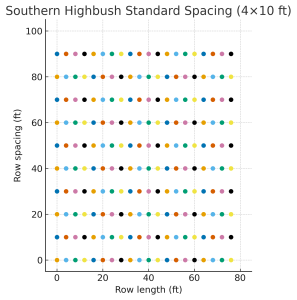
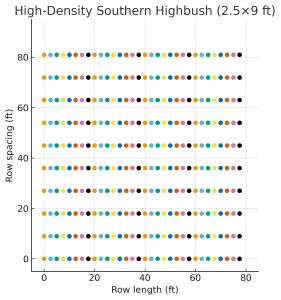
- Standard vs. High-Density Layouts: Standard configurations allow for ease of equipment passage and lower initial plant density, whereas high-density Southern Highbush systems maximize early yields per acre through intensive management.
- Infrastructure Integration: This phase requires finalizing the layout for microjet or drip irrigation systems, ensuring that water lines, pressure regulators, and fertigation injection units are installed prior to planting the rootstock.
Phase 3: Planting and Crop Establishment (Late Winter / Early Spring)
The window for planting containerized or bare-root blueberry plants typically aligns with the late winter dormant period, giving root systems time to acclimate before the high-stress spring flush and fruit development stages begin.
- Mulching: Because blueberry roots are shallow and lack root hairs, a heavy layer of organic mulch (such as aged pine bark or pine needles) must be applied immediately after planting. This retains essential soil moisture, moderates root-zone temperatures, and continuously contributes to soil acidity.
Phase 4: Production, Harvesting, and Post-Season Care (Year 1 and Beyond)
- First-Year Bloom Removal: To encourage structural vegetative growth, professional growers routinely remove flower buds during the first year. This encourages the plant to channel its energy into establishing a robust root and canopy system rather than premature fruit production.
- Ongoing Management: Subsequent years transition into annual pruning cycles, targeted fertilization programs (fertigation), and proactive pest management to protect developing berries from seasonal pressures.
Supporting Context & Agronomic Metrics
Understanding the scientific and economic parameters that govern blueberry production in Columbia County helps growers optimize their capital investments and mitigate operational risks.
Why Blueberries Thrive in North Florida
The regional climate and geography of Columbia County align closely with the biological requirements of modern blueberry cultivars:
- Natural Soil Acidity: Much of the county is characterized by sandy soils that naturally hover within the 4.5 to 5.5 pH range. This minimizes the intensive chemical interventions required in other regions to alter soil chemistry.
- Chill Hour Accumulation: Columbia County generally receives between 300 and 500 chill hours annually. This accumulation window is ideal for low-chill Southern Highbush cultivars and safely within the upper parameters for Rabbiteye varieties. Consistent chill hours ensure uniform winter dormancy break and synchronized spring blooming, reducing the risk of frost damage to erratic blooms.
- High Local Demand and Market Proximity: Proximity to community hubs—such as the Lake City Farmers Market—coupled with the surging popularity of agritourism and U-pick operations, guarantees a receptive consumer base. Blueberries enjoy strong brand recognition as a health food staple, ensuring far more reliable price stability and market velocity than esoteric or lesser-known specialty fruits.
- Economic Scalability: Under professional management, a single acre of land can sustainably support anywhere from 600 to 1,500 blueberry plants, depending entirely on the chosen spacing geometry and production system. This makes the crop exceptionally friendly to beginning growers who wish to pilot a one-acre block before committing to large-scale acreage expansion.
Variety Selection: Southern Highbush vs. Rabbiteye
Choosing the right cultivar depends heavily on your target harvest window, capital expenditure limits, and irrigation infrastructure.
1. Southern Highbush Blueberries
- Operational Niche: Best suited for early-season fruit production, allowing growers to capture significantly higher market prices before the national supply glut hits.
- Exemplary Cultivars: ‘Emerald’, ‘Jewel’, ‘Meadowlark’, and ‘Suziblue’.
- Standard Spacing Matrix: Typically planted at 3 to 4 feet between plants within rows, with 10 to 12 feet between rows (approx. 1,000–1,450 plants per acre).
- Agronomic Profile: Highly responsive to intensive inputs, early-maturing, and commands premium market returns; however, they have lower natural disease tolerance and demand pristine irrigation and frost protection infrastructure.
2. High-Density Southern Highbush Systems
- Operational Niche: Designed for high-intensity, high-yield commercial production on impeccably managed, fully irrigated acreage.
- Spacing Matrix: 2.5 feet within rows by 9 feet between rows.
- Agronomic Profile: Yields extraordinary early harvests, but strictly requires rigorous weed suppression, precision fertigation, and absolute management discipline to prevent canopy crowding and disease outbreaks.
3. Rabbiteye Blueberries (Vaccinium virgatum)
- Operational Niche: The premier choice for low-input growers, organic operations, or peripheral sites lacking comprehensive irrigation infrastructure.
- Exemplary Cultivars: ‘Climax’, ‘Brightwell’, and ‘Powderblue’.
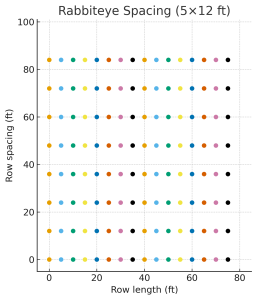
- Standard Spacing Matrix: Typically spaced 5 feet within rows by 10 to 12 feet between rows (approx. 725–900 plants per acre).
- Agronomic Profile: Exceptionally vigorous, highly resilient, and capable of surviving on natural rainfall once fully established. They produce fruit later in the season, extending the local harvest window, though per-pound market prices are generally lower than early-season Southern Highbush.
Irrigation Considerations
Columbia County experiences characteristically unpredictable dry springs, making reliable water delivery systems non-negotiable for commercial success.
- Microjet and Drip Infrastructure: Drip and microjet irrigation systems are strongly recommended—particularly for Southern Highbush blocks. While established Rabbiteye varieties can endure periods of drought using natural rainfall, modern climatic shifts and unpredictable precipitation patterns make supplemental irrigation indispensable for maintaining fruit size and plant vigor.
- Fertigation Efficiency: Drip systems do more than deliver moisture; they enable precision fertigation. By dissolving water-soluble fertilizers directly into the irrigation stream, growers can feed the shallow root zone precisely when nutrient demand peaks, drastically reducing waste and maximizing fertilizer uptake efficiency.
Official Perspectives & Extension Insights
Agricultural specialists and extension agents emphasize that while the profit potential of blueberries in North Florida is substantial, success is fundamentally tethered to risk management and proactive planning.
Local horticultural advisors frequently note that beginning producers often underestimate the labor requirements associated with harvest-season management and pruning. Extension guidance continually stresses that soil preparation cannot be rushed. Attempting to force alkaline soils into an acidic state after planting is significantly more difficult, costly, and less effective than pre-planting amendment strategies.
Furthermore, university-backed horticultural trials underscore the importance of cross-pollination, particularly in Rabbiteye blocks. Planting multiple compatible cultivars that bloom simultaneously is vital for maximizing fruit set, berry size, and overall orchard profitability. Growers are consistently encouraged to consult local University of Florida IFAS extension offices for up-to-date soil testing services, pest-alert bulletins, and localized spray guides tailored specifically to North Florida agroecosystems.
Future Outlook
The agricultural landscape of Columbia County is shifting toward diversified, high-value specialty crops capable of generating strong returns on smaller land parcels. As consumer demand for locally sourced, fresh-market produce continues its upward trajectory, regional blueberry growers are uniquely positioned to capture a lucrative market share.
Future advancements in frost-mitigation technology, drought-tolerant cultivar breeding, and automated irrigation management will only serve to lower the barrier to entry for prospective producers. Moreover, the growth of agritourism—highlighted by the popularity of U-pick orchards—creates synergistic revenue streams that extend far beyond raw fruit sales.
By coupling meticulous site preparation with informed cultivar selection, efficient drip irrigation, and disciplined orchard management, Columbia County growers can transform a modest plot of land into a dependable, highly profitable agricultural enterprise poised for long-term sustainability.

0 Comments