

By Derrick Conover
Published: November 21, 2025
Categories: Agriculture, Crops, Horticulture
Executive Overview
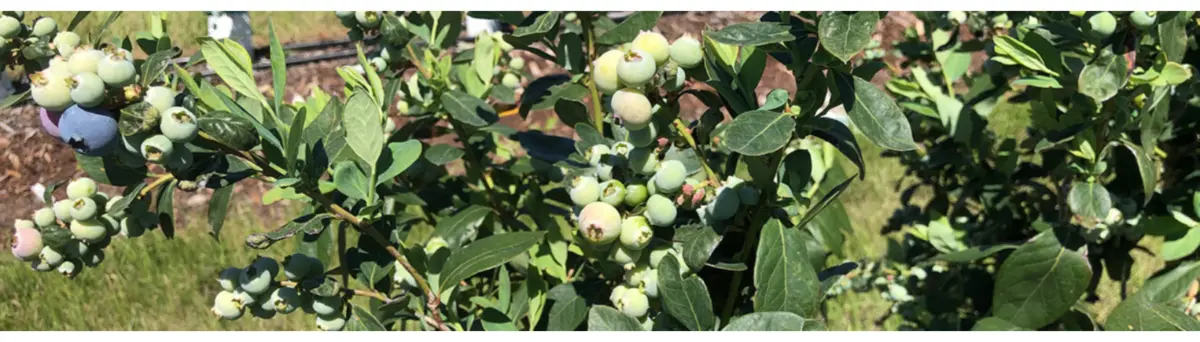
In recent years, blueberries have emerged as one of the most promising and lucrative specialty crops across North Florida. For small- and medium-scale agricultural producers looking to diversify their operations, maximize yield per acre, and tap into robust local and regional markets, the blueberry plant represents an extraordinary opportunity. Thanks to a convergence of favorable environmental conditions—including naturally acidic soils, mild winters, and dependable local demand—Columbia County is exceptionally well-positioned to support profitable commercial blueberry production.
Whether an aspiring farmer is planting a single experimental acre or an established grower is looking to expand an existing enterprise, success in this sector requires precision, foresight, and adherence to proven horticultural practices. This comprehensive guide breaks down the core components of blueberry cultivation in North Florida, offering actionable insights into soil chemistry, climate compatibility, variety selection, planting density, irrigation engineering, and pest management. By aligning farm management practices with the unique agronomic profile of Columbia County, growers can establish healthy, highly productive patches capable of yielding sustainable economic returns for decades.
Detailed Chronology & Strategic Planning for New Growers
Entering the blueberry market cannot be rushed; establishing a commercially viable berry farm requires a carefully sequenced timeline ranging from initial soil testing to the first commercial harvest.
Phase 1: Soil Assessment and Site Preparation (12 to 18 Months Prior to Planting)
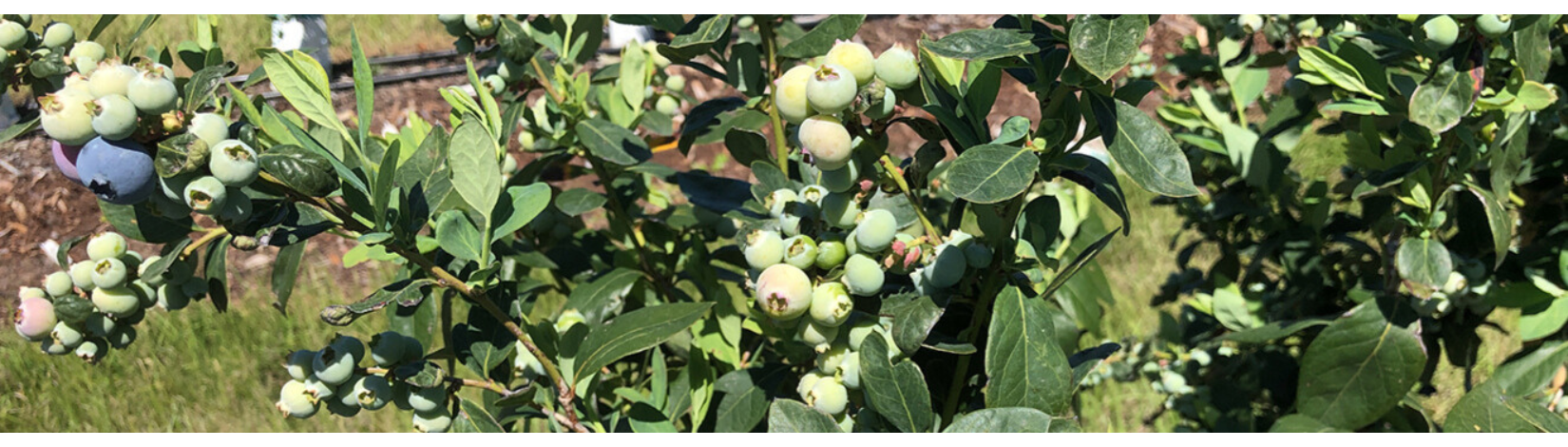
Long before a single plant touches the dirt, prospective growers must focus intensely on soil composition. Because blueberries are exceptionally sensitive to sub-optimal soil conditions, the process begins with comprehensive soil sampling. Columbia County naturally features the sandy, highly porous soils that blueberries favor, but verifying and adjusting the soil chemistry is paramount.
- Target pH Range: Blueberries thrive in strongly acidic environments, ideally with a soil pH ranging between 4.5 and 5.5.
- Corrections: If the pH is too high, elemental sulfur must be incorporated months in advance to allow adequate time for chemical breakdown and soil acidification. Conversely, organic matter—such as peat moss or aged pine bark—should be tilled into the planting beds to enhance moisture retention and improve microbial activity in the sandy substrate.
Phase 2: Infrastructure and Irrigation Setup (6 to 12 Months Prior)
Water management is the single most critical factor determining the survival and productivity of a blueberry patch. Because North Florida frequently experiences unpredictable dry spells during the critical spring growing and fruiting seasons, designing a robust irrigation system must happen before planting. Drip or microjet irrigation infrastructure must be mapped, tested, and integrated with fertigation capabilities (the delivery of water-soluble fertilizers through the irrigation system) to ensure precise nutrient management from day one.
Phase 3: Selection and Planting (Late Fall to Early Winter)
The ideal planting window in North Florida runs from late autumn through early winter. Planting during this cooler period allows the root systems to establish and acclimate without the thermal stress associated with Florida’s intense summer heat. Depending on the chosen variety, planting geometry, and operational scale, growers typically establish between 600 and 1,500 plants per acre. Most beginning growers in Columbia County strategically start with a manageable one-acre plot, allowing them to refine their management techniques before scaling up to larger commercial acreage.
Phase 4: Establishment, Pruning, and First Harvest (Years 1 to 3)
During the first two years, the primary objective is vegetative growth rather than fruit production. Growers routinely remove flower buds during the initial seasons to force the plant to direct its energy into root development and structural framework. By year three, a well-managed patch will yield its first commercially viable harvest, setting the stage for peak production cycles in subsequent years.
Supporting Context & Agronomic Metrics
Understanding the scientific and environmental parameters that make North Florida an ideal home for blueberries helps demystify why certain varieties thrive while others fail.
Climate Compatibility: Chill Hours and Dormancy
Fruit trees and perennial berry crops require a specific accumulation of cold temperatures—measured as "chill hours" (hours between 32°F and 45°F)—to break winter dormancy and trigger uniform spring flowering.
- Columbia County Profile: The region generally receives between 300 and 500 chill hours annually.
- Agronomic Impact: This thermal window is absolute perfection for low-chill Southern Highbush cultivars and comfortably within the ideal range for Rabbiteye varieties. Consistent chill hour accumulation ensures uniform bud break, predictable bloom timing, and synchronized fruit ripening, which greatly simplifies harvest logistics and labor management.
Market Dynamics and Economic Viability
Beyond agronomics, blueberries score exceptionally high on economic resilience. Consumers instantly recognize and value fresh, locally grown blueberries, positioning them as a staple commodity rather than a risky novelty fruit.
- Direct-to-Consumer Channels: Growers in Columbia County have immediate access to robust local pathways, ranging from the bustling Lake City Farmers Market to highly popular regional U-pick operations.
- Pricing Power: Early-season varieties, in particular, command premium market prices before massive volumes from other parts of the country flood the broader supply chain.
Variety Selection: Matching Cultivars to Production Goals
Choosing the right blueberry variety is arguably the most consequential decision a grower will make. Cultivars are generally divided into two main categories suited for North Florida, alongside intensive production layouts:
1. Southern Highbush Blueberries (Vaccinium corymbosum hybrids)
- Best For: Early-season fruit production and capturing higher market prices.
- Popular Cultivars: ‘Emerald’, ‘Jewel’, ‘Meadowlark’, and ‘Suziblue’.
- Agronomic Profile: These varieties are bred specifically to thrive in mild-winter climates while producing large, premium-quality berries early in the calendar year. However, they possess shallower root systems, making them less tolerant of drought and root diseases. They demand meticulous management of soil moisture, weed suppression, and fertility.
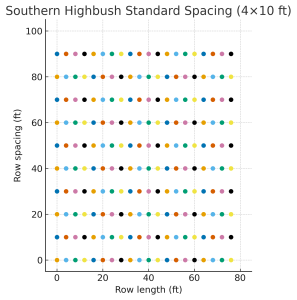
- Recommended Spacing (Standard Layout): Typically planted at 3 to 4 feet between plants within rows, with 10 to 12 feet between rows, ensuring adequate airflow and machinery access.
2. High-Density Southern Highbush Systems
- Best For: Intensive, high-yield commercial production on tightly managed, fully irrigated acreage.
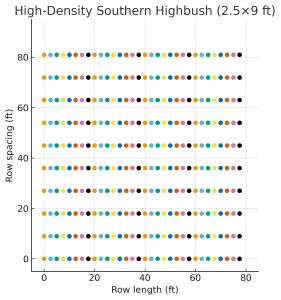
- Spacing: 2.5 feet × 9 feet.
- Operational Requirements: This specialized system maximizes plant populations per acre to accelerate early-season, high-volume yields. However, it leaves zero room for error; success is entirely contingent upon flawless, automated irrigation, aggressive weed control, and precise nutrient delivery.
3. Rabbiteye Blueberries (Vaccinium virgatum)
- Best For: Low-input agricultural operations or sites lacking sophisticated irrigation infrastructure.
- Popular Cultivars: ‘Climax’, ‘Brightwell’, and ‘Powderblue’.
- Agronomic Profile: Native to the American Southeast, Rabbiteyes are exceptionally vigorous, rugged, and resilient. They feature deeper root systems that make them remarkably tolerant of temporary dry spells and local soil variations. They fruit later in the season than Southern Highbush and offer heavy yields of sweet, flavorful berries.
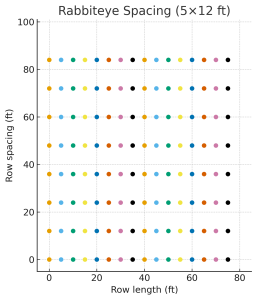
- Recommended Spacing: Typically spaced 5 to 6 feet apart within rows, with 12 to 14 feet between rows to accommodate their naturally large, multi-stemmed bush architecture.
Irrigation Considerations and Water Management
Water is the lifeblood of a successful berry operation. In Columbia County, where spring precipitation can be notoriously erratic and dry spells can jeopardize fruit sizing, relying solely on natural rainfall is a gamble no commercial grower should take.
For Southern Highbush varieties, microjet or drip irrigation systems are strongly recommended. Drip irrigation delivers water and nutrients directly to the root zone with high efficiency, minimizing weed growth in row middles and preventing foliar diseases. Furthermore, drip systems enable seamless fertigation, ensuring that nitrogen, phosphorus, potassium, and micronutrients are applied precisely when the plant demands them during vegetative flushes and fruit development.
While Rabbiteye blueberries possess greater drought tolerance and can occasionally survive on natural rainfall once deeply established, installing dedicated irrigation lines remains standard best practice. Given the shifting precipitation patterns and weather volatility observed across North Florida over recent growing seasons, supplemental irrigation guarantees consistent fruit size, prevents premature berry drop, and protects overall plant health.
Future Outlook: Building a Sustainable Berry Enterprise
As consumer demand for locally sourced, nutrient-dense food continues its steady upward trajectory, the future for specialty crop growers in North Florida remains exceptionally bright. Blueberries offer an attractive value proposition: they bridge the gap between small-scale farming lifestyle enterprises and scalable commercial agribusiness.
Long-term success, however, is never accidental. It is the direct result of deliberate planning, rigorous soil management, meticulous variety selection, and proactive irrigation engineering. By respecting the biological requirements of the blueberry plant and leveraging the natural advantages of Columbia County’s climate and soil, agricultural producers can build resilient, highly profitable farming operations capable of thriving for generations to come.
Whether expanding an existing agricultural portfolio or breaking ground on a first-time venture, growers who commit to best management practices will find that North Florida blueberries are not just a promising crop—they are a harvest of opportunity.

0 Comments