

By Derrick Conover
Published: March 18, 2026
Category: Agriculture / Crops
Executive Overview
Agricultural producers across Columbia County and the broader North Florida region are navigating a treacherous meteorological tightrope this spring. Following what agricultural extension agents hope will be the final cold front of the season, local farmers are grappling with a punishing convergence of late-season temperature swings and persistent drought conditions. This volatile combination arrives at the most sensitive juncture of the annual production cycle—a precarious window when perennial fruit trees are breaking dormancy, blossoms are pushing forward, and spring row crops are either being planted or trying to emerge from cool soils.
The timing could hardly be worse. As crops transition from winter dormancy into active growth, their natural physiological defenses against freezing temperatures plummet. While a mid-winter freeze often leaves dormant plants unscathed, a spring frost on active tissue can devastate reproductive organs, stunt early vegetative development, and obliterate yield potentials in a matter of hours. Compounding this thermal stress, North Florida’s ongoing drought acts as an invisible multiplier, stripping fields of their natural thermal buffers and leaving crops uniquely vulnerable to both root shock and pathogen infiltration.
For commercial growers of peaches, blueberries, watermelons, sweet corn, and specialty vegetables, the margin for error has evaporated. Managing this complex, multi-layered weather event requires a synthesis of vigilant monitoring, strategic soil moisture management, and rapid tactical responses. In a season defined by environmental extremes, the difference between a profitable harvest and a catastrophic loss rests entirely on proactive, data-driven field management.
Detailed Chronology: The Anatomy of a Spring Weather Shock
To understand the severity of the recent agricultural stress in Columbia County, one must examine the precise timeline of physiological vulnerability that unfolds when a late-season cold front collides with spring agricultural operations.
Phase 1: The Transition from Dormancy to Bloom
During the dead of winter, perennial fruit crops like blueberries and peaches enter a state of deep endodormancy. Cellular activity slows, water content in sensitive tissues is reduced, and biochemical protectants accumulate, allowing these plants to withstand sub-freezing temperatures with minimal to no structural damage.
However, as warming trends take hold in late winter and early spring, chilling hour requirements are met, and trees begin to perceive lengthening days and rising ambient temperatures. Sap begins to flow, buds swell, and the plant breaks dormancy. It is during this rapid physiological awakening that cold tolerance declines precipitously. The transition from a hardy dormant state to a delicate, blooming state occurs over just a few weeks, creating a high-risk window where fields are exceptionally exposed to erratic weather patterns.
Phase 2: The Frost Event and Reproductive Failure
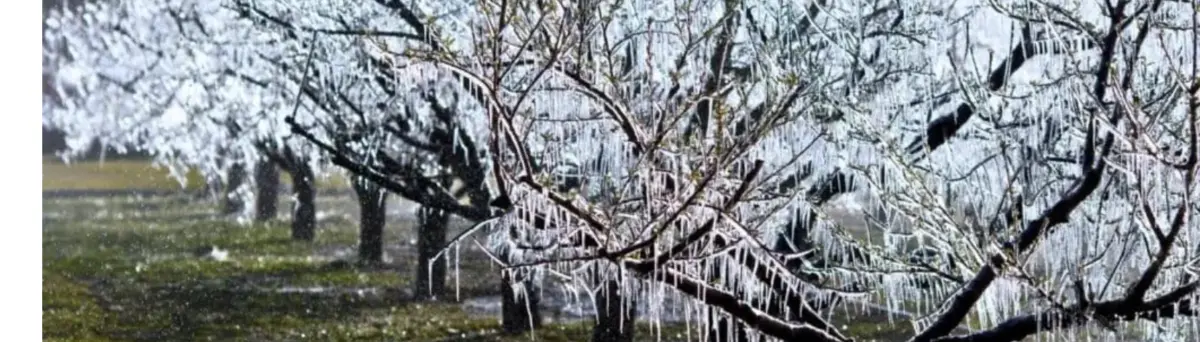
When a late-season cold front sweeps through Columbia County during this vulnerable transition, the immediate threat is directed squarely at the crop’s reproductive infrastructure. Once flowers are open and cross-pollination mechanisms are underway, even a light frost—temperatures dipping below 32°F for as little as 30 minutes—can rupture cell walls in the pistils, stamens, and developing ovaries.
The damage is frequently insidious. In many cases, frost injury is not immediately visible to the naked eye. Growers inspecting their orchards the morning after a freeze may find blossoms that appear entirely normal, deceptively intact against the morning dew. Yet, beneath the petal surface, the internal reproductive tissues have been irreversibly oxidized. Days later, these flowers fail to set fruit, resulting in erratic fruit drop or, in severe frost scenarios, total crop failure.
Furthermore, cold weather introduces a secondary biological bottleneck: the suppression of pollinator activity. Managed honeybees and native pollinators alike become sluggish, disoriented, and far less active when ambient temperatures drop, or when cold fronts bring overcast skies and brisk winds. Because the flowering window for crops like blueberries is already tightly compressed, a multi-day cold snap robs growers of essential pollination hours, guaranteeing sub-optimal fruit set even if the flowers themselves escape direct frost crystallization.
Phase 3: Systemic Physiological Sluggishness
Beyond overt blossom damage, the broader physiological impact of a cold front lingers long after temperatures return to seasonal norms. Late-season cold events trigger a systemic slowdown in overall tree metabolism.
Key delayed-response symptoms include:
- Delayed Leaf-Out: Canopy development is stalled, reducing the photosynthetic surface area needed to drive early-season growth.
- Extended Bloom Periods: Rather than a synchronized, uniform bloom, cold stress can cause staggered flowering. This prolongs the window of vulnerability, exposing late-emerging blossoms to subsequent, unexpected frost events.
- Stalled Fruit Development: Cell division rates plummet in cooler ambient temperatures, delaying the sizing and maturity schedule of early fruit crops.
Crucially, this cycle of thermal stress drains the tree’s vital carbohydrate reserves. Instead of channeling sugars toward early fruit sizing and vigorous canopy expansion, the plant must expend precious energy reserves on cellular repair and recovery. This energetic deficit not only compromises the current season’s yield volume and market quality but can also induce biennial bearing tendencies, depressing productivity well into the following agricultural year.
Supporting Context & Metrics: Row Crops and the Soil-Moisture Crisis
While perennial orchards fight to protect their blossoms, North Florida row crop producers face an entirely different—yet equally formidable—set of physiological hurdles. Spring-planted commodities such as watermelon, sweet corn, and various tender vegetables are governed by the strict thresholds of soil and air temperatures during germination and early vegetative development.

The Row Crop Vulnerability Matrix
For warm-season crops, cold soils are an immediate inhibitor of uniform establishment. When spring temperatures hover below optimal thresholds, seed germination stalls. This creates erratic, uneven stands where some seeds emerge weeks ahead of others. In specialized production systems like commercial watermelon cultivation, uniformity is the absolute bedrock of efficient management. Uneven stands complicate nutrient timing, complicate pesticide application schedules, and result in staggered harvests that drive up labor costs and disrupt market delivery schedules.
The hazards extend deep into the soil microbiome and plant pathology:
- Damping-Off and Seedling Diseases: Cold, wet soil conditions slow plant growth while simultaneously favoring opportunistic soil-borne pathogens such as Pythium, Rhizoctonia, and Fusarium. These pathogens rapidly attack weakened, slow-growing hypocotyls, dramatically increasing the incidence of damping-off and catastrophic early-season stand loss.
- Foliar and Stem Injury: For crops that have already emerged or been established via field transplants, sub-freezing air temperatures cause direct foliar necrosis (leaf burn), stem splitting, and cellular collapse.
- Transplant Shock Proliferation: Mechanically or manually transplanted vegetables are exceptionally susceptible. Cold surrounding air and chilly root-zone temperatures arrest root hair regeneration, plunging the plant into prolonged transplant shock. This physiological standstill leaves young plants defenseless against opportunistic soil pests and secondary bacterial infections that readily colonize weakened plant tissues.
How Drought Conditions Intensify Cold Damage
To fully appreciate the severity of Columbia County’s agricultural stress, one must view these cold events through the compounding lens of the ongoing Florida drought. While drought and frost are frequently categorized as distinct meteorological hazards, their physical impacts are deeply intertwined at both the microclimate and plant-physiological levels.
[Dry Soil Conditions]
       │
       ├─► Reduced Heat Capacity (Fails to absorb/retain daytime solar energy)
       │
       ├─► Rapid Nighttime Heat Loss (Temperatures drop precipitously after sunset)
       │
       └─► Severe Near-Ground Frost Formation (Intensifies localized crop damage)
The primary mechanism linking these two stressors is the fundamental thermodynamic property of soil moisture. Moist soils act as a massive thermal reservoir; they absorb and store significant amounts of solar radiation during daylight hours and slowly radiate that heat back upward into the canopy microclimate during the night, buffering crops against sudden, destructive temperature drops.
In stark contrast, dry soils possess a drastically lower heat capacity. Without moisture to absorb and hold thermal energy, dry ground heats up rapidly by day and bleeds heat away even faster after sunset. Consequently, under identical ambient air temperatures, a dry field will experience significantly colder near-ground temperatures than an irrigated or naturally moist field. This localized differential is often the deciding factor between a minor surface frost and devastating, tissue-rupturing ice crystal formation.
For North Florida growers, this dynamic elevates drought from a baseline agricultural inconvenience to a primary risk multiplier for frost damage.
Official Statements and Industry Guidance
Agricultural extension specialists and regional crop advisors have mobilized to provide actionable guidance to Columbia County producers as they assess the fallout from the latest cold front.
In a recent advisory briefing distributed to the agricultural community, local extension leadership underscored the critical nature of proactive orchard and field management during climate anomalies of this scale. "When temperature swings coincide with active physiological transitions like bud break and early germination, the margin for error disappears entirely," agricultural authorities noted. "Growers cannot afford to treat frost risk and drought stress as isolated phenomena. They are two halves of the same production hazard."
Extension specialists have issued a series of core management recommendations designed to mitigate ongoing risks:
- Pre-Event Irrigation Management: Where water allocation permits, growers are strongly encouraged to utilize strategic irrigation prior to forecasted cold events. Applying water to dry soils increases thermal mass, enhances soil heat retention, and raises near-ground minimum temperatures by several critical degrees. Furthermore, well-hydrated plant tissues maintain higher cellular turgor pressure, rendering them inherently more resilient to transient cold stress.
- Precision Planting Adjustments: For row crop producers, advisors recommend delaying direct seeding or transplanting operations until soil temperatures consistently clear biological minimums, rather than relying strictly on calendar dates. Utilizing soil thermometers at a 4-inch depth provides the objective data required to avoid cold-soil damping-off traps.
- Enhanced Monitoring Protocols: Producers are urged to deploy localized microclimate data loggers across varying elevations and soil types within their operations, acknowledging that micro-topography and soil moisture variations create distinct risk zones within the exact same farm boundary.
Future Outlook: Resilience in an Era of Weather Volatility
As Columbia County agriculturalists look toward the remainder of the spring season and the horizon of future production cycles, the overarching narrative is one of structural adaptation. The increasing frequency of erratic late-season cold fronts, bookended by prolonged regional dry spells, signals a broader shift in regional weather patterns that demands forward-looking farm management strategies.
The traditional agricultural calendar—long relied upon by multi-generational farming families in North Florida—is increasingly being challenged by unseasonal volatility. To remain competitive and economically viable, local producers are accelerating their adoption of climate-resilient farming practices. This includes investing in modern, high-efficiency micro-irrigation infrastructure capable of dual-purpose execution: drought mitigation during dry spells and targeted frost protection during sudden thermal drops.
Furthermore, plant breeding and varietal selection are taking center stage. Horticulturalists are placing a premium on procuring fruit tree cultivars with higher chill-hour requirements and later bloom dates, naturally shifting the vulnerable flowering window past the historical risk period for late-season northern cold fronts. Similarly, row crop producers are evaluating hybrid vigor traits that offer enhanced cold-soil emergence speeds and superior early-season root architecture.
Ultimately, navigating the squeeze between persistent drought and unexpected spring freezes requires relentless vigilance. As the current crop cycle progresses through its critical development phases, Columbia County growers who successfully balance soil moisture management, microclimate monitoring, and adaptive agronomic timing will be best positioned to weather the storm—securing both the current harvest and the long-term viability of North Florida agriculture.

0 Comments