

By Jay Capasso (UF/IFAS Extension), Jason Mallard (UGA Cooperative Extension), and Phillip Edwards (UGA Cooperative Extension)
Published: December 4, 2024 | Updated: September 9, 2025
Executive Overview
Agricultural irrigation remains one of the single most important capital and operational inputs for maximizing crop yield, protecting against environmental volatility, and securing the global food supply. However, as water resource constraints tighten and input costs continue to fluctuate, modern growers face mounting pressure to transition from general watering practices to precision resource management. To truly optimize water use, agricultural operations must master two distinct yet interconnected agronomic metrics: Distribution Uniformity (DU) and Irrigation Efficiency.
While these terms are frequently used interchangeably in casual agricultural dialogue, they measure fundamentally different performance indicators of an irrigation system. Distribution Uniformity evaluates how evenly water is dispersed across a designated field, whereas Irrigation Efficiency quantifies the proportion of applied water that is beneficially utilized by the crop—primarily meeting evapotranspiration (ET) demands.
In regions rich in agricultural activity, such as the Suwannee Valley in Florida and across the state lines into Georgia, regional extension services have ramped up efforts to educate producers on these metrics. Through specialized programs, mobile irrigation laboratories, and advanced soil moisture monitoring, growers are being equipped to diagnose inefficiencies, lower energy consumption, curtail fertilizer leaching, and ultimately protect their bottom lines. This comprehensive report breaks down the mechanics of DU and efficiency, explores the multifaceted factors that degrade system performance, and outlines actionable resources available to agricultural producers in the Southeast.
Detailed Chronology: The Evolution of Modern Irrigation Assessment
The journey toward modern irrigation optimization has evolved from a matter of guesswork to a high-tech science driven by regional conservation initiatives and cooperative extension breakthroughs.
The Shift from Volume to Precision
Historically, agricultural irrigation was evaluated strictly on volume: how many acre-inches of water were pumped from an aquifer or surface water source and delivered to a field over a given season. If crops looked green and yields were acceptable, the system was considered successful.
However, escalating environmental regulations, prolonged regional droughts, and rising electricity costs associated with pumping groundwater forced a paradigm shift. Researchers and extension agents realized that total volume told only half the story. A pivot system might dump two inches of water across a field, but if half of that field received three inches and the other half received one inch, the average was deeply misleading. The under-watered zones suffered from drought stress and stunted yields, while the over-watered zones suffered from nutrient leaching, root asphyxiation, and wasted energy.
The Rise of Mobile Irrigation Labs
Recognizing this operational blind spot, agricultural institutions across Florida and Georgia began formalizing evaluation protocols. In Florida, the establishment and expansion of Mobile Irrigation Labs (MILs)—bolstered by partnerships with the Florida Department of Agriculture and Consumer Services (FDACS) and regional water management districts—provided growers with on-site, no-cost professional evaluations.
Parallel to this, the University of Georgia (UGA) Cooperative Extension developed rigorous field assessment protocols for center pivot and linear move systems. Over the decades, these diagnostic efforts transitioned from simple visual inspections to data-driven audits utilizing the catch-can method, pressure profiling, and flow-rate analyses.
Integration of Soil Moisture Sensing Technology
In recent years, the timeline of irrigation management crossed into the digital age with the widespread adoption of soil moisture sensors. Rather than relying solely on historical weather data or generic scheduling charts, growers began integrating real-time telemetry from the root zone. This evolution created a symbiotic relationship between system performance evaluation and smart scheduling: sensors could now verify whether an irrigation event successfully replenished the root zone without pushing water past it. Yet, as extension specialists soon discovered, deploying these sensors without first evaluating Distribution Uniformity introduced a new set of data errors, anchoring the necessity of holistic system audits.
Supporting Context & Metrics: Understanding DU and Efficiency
To operationalize water conservation and yield optimization on the farm, growers must master the mathematical and practical definitions of Distribution Uniformity and Irrigation Efficiency.
Decoding Distribution Uniformity (DU)
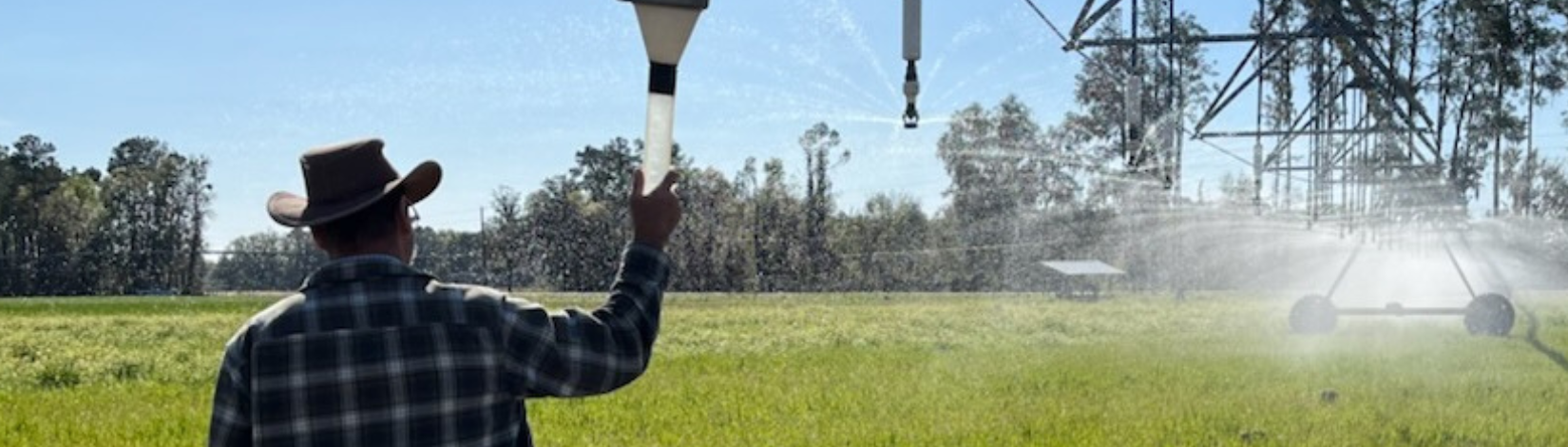
Distribution Uniformity measures the spatial consistency of water application across a management zone or field. For overhead systems such as center pivots and linear moves, achieving a DU of 90% is considered an achievable and highly desirable benchmark. A 90% DU means that 90% of the field receives water in a uniform, predictable manner, drastically reducing localized dry spots and over-saturated zones.
The industry-standard metric for calculating DU is the catch-can method. This physical test involves placing a grid of catch containers across the span of the field underneath the path of the irrigation system. Once a test run is completed, the volume of water in each container is measured. The standard mathematical expression for lower-quartile distribution uniformity is:
$$textDU = left( fractextAverage depth of water collected in the lowest 25% of containerstextTotal average depth of water applied over the entire field right) times 100$$
The Ripple Effects of Good DU
Maintaining a high Distribution Uniformity yields benefits that extend far beyond mere water conservation:
- Maximized Yield Potential: Every plant receives its precise baseline water requirement, eliminating growth variability and harvest bottlenecks caused by uneven maturity rates.
- Optimized Fertigation: Many modern farms inject liquid fertilizers directly through their overhead irrigation systems (fertigation). When DU is high, nutrients are distributed with equal uniformity, ensuring uniform crop uptake and preventing localized nutrient deficiencies or toxicities.
- Energy and Cost Savings: Pumping water requires immense energy. A uniform system eliminates the temptation—or the necessity—to over-irrigate the entire field just to ensure the dry spots get enough moisture, directly slashing diesel and electricity utility bills.
Anatomy of Inefficiency: What Factors Impact DU?
Even the most expensive, state-of-the-art center pivot can experience a rapid decline in Distribution Uniformity due to physical wear, environmental interference, and operational oversight. Key factors include:
- Flow Rate Variability and Pressure Differences: Friction losses within pipes, changes in field elevation, and fluctuating source pressure alter the volume of water pushed through individual sprinklers.
- Pressure Regulator Malfunctions: Pressure regulators maintain a consistent operating pressure across the system. When these regulators fail or wear out, downstream sprinklers experience erratic flow rates, disrupting spray patterns and increasing mechanical wear.
- Nozzle Wear and Clogging: Sediment, mineral scale, and biological growth can clog nozzles, while abrasive irrigation water gradually erodes nozzle orifices, enlarging them and distorting application depths.
- Improper Spacing and System Design: Errors during initial engineering—such as incorrect sprinkler spacing or mismatched drop-hose lengths—create permanent dead zones or overlap anomalies.
- End Gun Misalignment: End guns project water far beyond the main span of the pivot to cover corners. If improperly aligned or timed, their spray arcs can heavily overlap areas already saturated by standard overhead sprinklers, ruining uniformity.
- Environmental Disruptions: High ambient winds distort the trajectories of sprinkler droplets, blowing them off target. Additionally, tall canopy crops can physically obstruct spray patterns if drop tubes are improperly hung.
- Operational Practices and Edge Effects: Transitional inconsistencies during system startup and shutdown, combined with pipe diameter mismatches, create temporary unevenness. Furthermore, edge effects—where outer sprinklers overlap field boundaries—frequently skew boundary uniformity.
Irrigation Efficiency: The Broader Equation
While DU evaluates where and how evenly water goes, Irrigation Efficiency evaluates how much of that water is actually put to productive use by the crop. The formula is expressed as:
$$textEfficiency = fractextWater Beneficially UsedtextTotal Water Applied$$
In the Southeastern United States, "beneficial use" almost exclusively translates to meeting crop evapotranspiration (ET) demands—the combined total of water transpired by the crop canopy and evaporated from the soil surface. Unlike arid Western production regions, where irrigation water must frequently perform the secondary beneficial duty of leaching accumulated soil salts out of the root zone, Southeastern growers rarely face severe soil salinity challenges. However, minor beneficial uses can occasionally include targeted climate control (such as crop cooling or frost protection) or intentionally triggering weed germination so those weeds can be systematically managed before crop emergence.
Measuring irrigation efficiency in real-world settings is notoriously difficult because it requires tracking precise volumetric movement into the crop root zone. This is where soil moisture sensors bridge the gap, helping agronomists monitor exactly how much applied water successfully infiltrates and stays within the active root profile.
Official Statements and Expert Insights
To contextualize these principles within regional agriculture, extension authorities emphasize that farm-level diagnostics are no longer optional—they are core components of risk management.
"Achieving a 90% distribution uniformity is not just an engineering ideal; it is a direct lever for profitability," notes Jay Capasso of the UF/IFAS Extension. "When growers inject liquid fertilizers or manage expensive inputs, uneven water distribution translates directly into uneven crop stands, variable maturity, and lost revenue. Diagnostic tools give producers the data they need to plug those hidden leaks."
The cooperative extension networks across Florida and Georgia continually stress that identifying system faults requires professional auditing rather than visual guesswork. Jason Mallard and Phillip Edwards of the UGA Cooperative Extension point out that minor pressure drops or worn-out regulators often go entirely unnoticed by farm managers standing at the pivot point.
Furthermore, institutional backing transforms these audits from diagnostic exercises into affordable infrastructure upgrades. According to state extension guidelines, once an official evaluation highlights specific mechanical failures, growers enrolled in regulatory compliance and conservation programs can often access crucial financial assistance.
Future Outlook: Technology, Cost-Share, and Sustainable Farming
Looking ahead, the intersection of precision agriculture and water resource management points toward automated, real-time feedback loops between irrigation hardware and sub-surface sensors. As water tables face increasing competition from municipal growth and industrial uses, agricultural producers in Florida, Georgia, and the broader Southeast will encounter stricter accountability standards.
The Role of Soil Moisture Sensors in Advanced Management
The future of efficient irrigation relies heavily on intelligent sensor networks. However, extension specialists issue a critical warning regarding sensor deployment: placement dictates data integrity.
If a soil moisture sensor is inadvertently installed in an area of the field with poor Distribution Uniformity—such as a chronically under-watered high spot or an over-saturated depression—the telemetry transmitted to the grower’s smartphone or dashboard will be fundamentally skewed. The grower might base their next irrigation run on a faulty reading, exacerbating field variability. Therefore, coupling a comprehensive DU evaluation with strategic, representative sensor placement is an indispensable prerequisite for precision irrigation management.
Accessing Regional Resources and Financial Assistance
Growers do not have to navigate these upgrades alone. Robust institutional frameworks exist to support agricultural producers seeking to audit and upgrade their systems:
- In Florida: Mobile Irrigation Labs offer specialized, on-farm evaluations for center pivot and linear move systems. Growers who identify inefficiencies can explore agricultural cost-share opportunities through the Florida Department of Agriculture and Consumer Services (FDACS) or local water management districts, provided they are enrolled in the FDACS Best Management Practices (BMP) program. More information can be accessed via the official FDACS Mobile Irrigation Labs portal.
- In Georgia: The UGA Cooperative Extension provides comprehensive system evaluations for agricultural clients. Producers looking to replace worn nozzles, upgrade pressure regulators, or overhaul deficient pivot spans can tap into financial and technical assistance programs administered through the USDA Natural Resources Conservation Service (NRCS).
Conclusion
Ultimately, mastering Distribution Uniformity and Irrigation Efficiency transforms an irrigation system from a simple water-delivery pipe into a precision management instrument. By embracing professional evaluations, understanding the mechanical and environmental variables that degrade uniformity, and pairing audit data with smart soil moisture monitoring, growers can secure higher yields, conserve vital regional aquifers, and fortify their operations against the economic and environmental uncertainties of tomorrow.

0 Comments