

By Jay Capasso (UF/IFAS Extension), Jason Mallard (UGA Cooperative Extension), and Phillip Edwards (UGA Cooperative Extension)
Published: December 4, 2024 | Updated: September 9, 2025
Executive Overview
Water is arguably the most critical variable in agricultural production, serving as the lifeblood that dictates whether a crop achieves its maximum genetic yield potential or falls victim to environmental stress. However, as water scarcity, regulatory pressures, and input costs continue to rise, agricultural producers face mounting pressure to do more with less. Maximizing crop yield is no longer just a matter of applying enough water; it requires precision, accountability, and a profound understanding of how water moves through an irrigation system and into the soil profile.
To truly optimize on-farm water management, agricultural producers must master two distinct yet interconnected performance metrics: Distribution Uniformity (DU) and Irrigation Efficiency. While these terms are frequently used interchangeably in casual agricultural conversations, they measure entirely different aspects of an irrigation operation. DU evaluates the physical consistency of water application across a field, ensuring that every acre receives an equal share. Irrigation efficiency, on the other hand, measures how effectively the applied water is utilized by the crop to meet its physiological demands.
For growers operating in the Southeast—particularly across Florida’s Suwannee Valley and the agricultural heartlands of Georgia—mastering these concepts is essential for long-term farm profitability and environmental stewardship. Modern center pivot and linear overhead irrigation systems are capable of achieving high levels of performance, but mechanical wear, environmental factors, and operational oversights frequently degrade system efficiency. Fortunately, regional resources such as mobile irrigation labs in Florida and comprehensive evaluations by the UGA Cooperative Extension offer growers the diagnostic tools needed to identify inefficiencies, upgrade hardware through cost-share programs, and ultimately protect their bottom lines.
Detailed Chronology: The Evolution of On-Farm Irrigation Diagnostics
The approach to agricultural water management has undergone a profound transformation over the past several decades. Historically, irrigation scheduling was treated as an art rather than a science, relying heavily on visual cues, historical calendar schedules, or rough estimates of soil wetness. If crops looked stressed, systems were turned on; if it rained, they were turned off. Little attention was paid to the micro-variations occurring across a field or the mechanical nuances of how water was being discharged from overhead sprinklers.
The Shift Toward Precision Agriculture
As computational power advanced and sensor technology matured in the late 20th and early 21st centuries, agricultural extension services began recognizing massive discrepancies in water application depths across standard center pivot systems. Researchers noted that two adjacent fields could receive the exact same gross volume of pumped water, yet one field would exhibit localized drought stress while the other suffered from nutrient leaching due to over-saturation.
This realization catalyzed the development of standardized field diagnostic protocols, most notably the catch can method. By systematically placing collection containers at predetermined intervals beneath operating center pivot and linear move systems, researchers and extension agents could map out the spatial distribution of applied water.
Institutional Intervention: Mobile Irrigation Labs
Recognizing that individual growers rarely possessed the specialized equipment or time to conduct comprehensive catch-can audits, land-grant universities and state agencies stepped in. In Florida, the establishment of Mobile Irrigation Labs (MILs) provided a crucial bridge between academic research and commercial farming operations. These mobile units traveled directly to farms to perform professional evaluations of center pivot and linear move systems.
Concurrently, the University of Georgia (UGA) Cooperative Extension instituted similar diagnostic programs across Georgia’s agricultural sectors. Over time, these programs evolved from simple performance checks into comprehensive audits that integrated soil moisture monitoring, nutrient management tracking, and energy efficiency assessments.
Modern Integration with Cost-Share Programs
In recent years, the diagnostic data gathered by mobile irrigation labs and extension services has been directly linked to state and federal financial assistance frameworks. Programs managed through the Florida Department of Agriculture and Consumer Services (FDACS) Best Management Practices (BMP) enrollment, as well as USDA Natural Resources Conservation Service (NRCS) initiatives in Georgia, now rely on formal irrigation evaluations to qualify growers for agricultural cost-share grants. This evolution has transformed irrigation auditing from an optional advisory service into a gateway for modernizing aging infrastructure and ensuring regional water security.
Supporting Context & Metrics: DU vs. Irrigation Efficiency
To successfully troubleshoot and upgrade an irrigation system, growers must look past gross water application volumes and analyze the specific mechanics of DU and efficiency.
+-------------------------------------------------------------------------+
|                      IRRIGATION PERFORMANCE METRICS                     |
+-----------------------------------+-------------------------------------+
|      DISTRIBUTION UNIFORMITY      |        IRRIGATION EFFICIENCY        |
+-----------------------------------+-------------------------------------+
| • Measures spatial evenness       | • Measures crop utilization         |
| • Target: 90% for pivots/linears  | • Formula: Beneficially Used /      |
| • Calculated via Catch Can method |   Total Applied                     |
| • Focuses on mechanical delivery  | • Focuses on root-zone availability |
+-----------------------------------+-------------------------------------+
Unpacking Distribution Uniformity (DU)
Distribution uniformity evaluates how evenly water is spread across a field during an irrigation event. For modern center pivot and linear overhead irrigation systems, achieving a DU of 90% is entirely feasible and serves as the benchmark for a well-maintained system. A 90% DU means that 90% of the field is receiving water in a uniform, predictable manner, dramatically reducing localized dry spots and mitigating the risk of over-irrigation.
The gold standard for calculating DU in the field is the catch can method. This procedure involves the following steps:
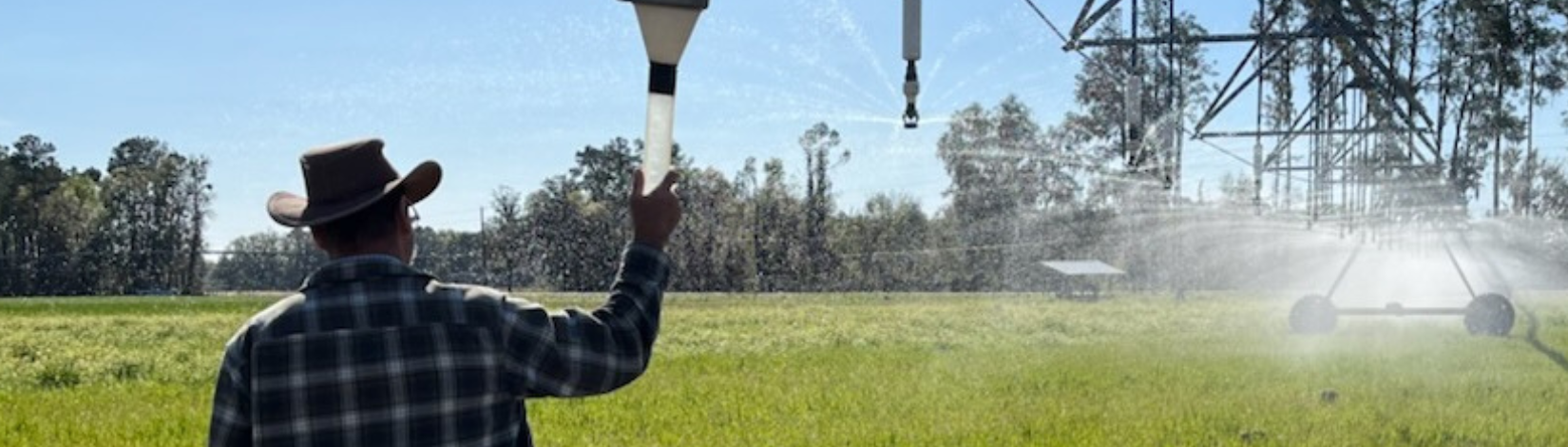
- Array Deployment: A grid of catch cans is placed in a radial or linear pattern beneath the path of the overhead sprinkler system.
- System Operation: The irrigation system is run over the sensor array at standard operating speed and pressure.
- Data Collection: The depth of water collected in each individual can is measured and recorded.
- Mathematical Analysis: The average depth of the lowest 25% of all measurements is calculated and divided by the total average depth of water applied across the entire field.
When a high DU is maintained, several immediate benefits follow:
- Uniform Crop Development: Plants emerge, grow, and mature at consistent rates, simplifying harvest logistics and maximizing marketable yields.
- Optimized Fertigation: Many producers inject liquid fertilizers directly through their irrigation systems. High DU ensures that nutrients are distributed evenly alongside water, resulting in uniform plant uptake and eliminating spatial nutrient deficiencies or toxicities.
- Resource Conservation: Eliminating areas of over-application prevents wasteful deep percolation, saving both water and the energy required to pump it.
The Anatomy of DU Inefficiencies
Achieving and maintaining a 90% DU is challenging because numerous mechanical and environmental factors constantly threaten system uniformity:
- Flow Rate Variability: Differences in field elevation, friction losses within aging pipelines, and localized pressure drops can cause sprinklers to discharge inconsistent volumes of water.
- Pressure Regulator Malfunctions: Pressure regulators are designed to maintain a constant discharge pressure despite elevation changes. When they fail or wear out, sprinkler spray patterns distort, leading to overlapping wet zones or dry gaps.
- Nozzle Wear and Clogging: Over time, abrasive sediments and mineral deposits erode sprinkler nozzles, enlarging their orifices. Conversely, biological growth or particulate matter can clog nozzles, completely shutting off flow in specific areas.
- End Gun Misalignment: End guns cover the corners of fields that pivots cannot physically reach. If improperly timed or aligned, their high-volume streams can double-water areas already saturated by standard overhead sprinklers.
- Environmental Disruption: High winds distort sprinkler spray trajectories, blowing water away from targeted arcs. Additionally, tall canopy crops can physically intercept and block water streams before they reach the soil surface.
- Operational Anomalies: Inconsistent application rates during system startup and shutdown phases, combined with improper pipe diameter transitions, introduce systemic flow variations.
- Edge Effects: The outer perimeters of fields often experience unnatural overlap dynamics as sprinklers wrap around corners or shut off near property boundaries.
Defining Irrigation Efficiency
While DU measures where the water goes physically, irrigation efficiency measures how well the water is utilized by the crop. The foundational equation is expressed as:
$$textIrrigation Efficiency = fractextWater Beneficially UsedtextTotal Water Applied$$
For agricultural operations throughout the Southeast, "beneficial use" almost exclusively translates to meeting crop evapotranspiration (ET)—the combination of water transpired by the plant canopy and evaporated from the soil surface. Unlike arid western regions, where irrigation water must frequently serve the secondary beneficial purpose of leaching toxic salts out of the root zone, Southeastern growers rarely face severe soil salinity crises. In rare instances, beneficial use may also include climate control (such as freeze protection) or targeted weed germination intended to be managed subsequently.
Measuring irrigation efficiency accurately is notoriously difficult because it requires knowing precisely how much pumped water successfully penetrates the soil profile and is absorbed by the crop’s root system. This is where modern soil moisture monitoring technologies become indispensable.
Official Statements & Expert Guidance
Agricultural extension specialists emphasize that technology is only as good as its implementation. According to Jay Capasso of the UF/IFAS Extension, Jason Mallard, and Phillip Edwards of the UGA Cooperative Extension, integrating hardware solutions—such as soil moisture sensors—with rigorous system evaluations is the key to closing the loop on on-farm water management.
"Soil moisture sensors are invaluable instruments for gauging the true efficiency of your irrigation scheduling," the extension specialists note. "However, placing these sensors in representative areas of the field is an absolute prerequisite. If a grower inadvertently places a soil moisture probe in an area with poor distribution uniformity, the data collected will be fundamentally skewed. It will fail to reflect the true water dynamics of the broader field, leading to flawed scheduling decisions and wasted resources."
Experts also stress that growers do not have to navigate these technical evaluations alone. Institutional frameworks are explicitly designed to support commercial producers in diagnosing and upgrading their infrastructure:
- Florida Resources: Growers operating in Florida can leverage Mobile Irrigation Labs to conduct comprehensive, professional assessments of center pivot and linear move systems. Identifying structural faults through these labs opens doors to agricultural cost-share opportunities managed via the Florida Department of Agriculture and Consumer Services (FDACS) Best Management Practices (BMP) program. More information can be accessed directly through the FDACS Mobile Irrigation Labs Portal.
- Georgia Resources: In Georgia, agricultural producers have direct access to system evaluations performed by the UGA Cooperative Extension. These evaluations pinpoint mechanical and hydraulic bottlenecks, allowing growers to leverage financial and technical assistance programs administered through the USDA Natural Resources Conservation Service (NRCS).
Future Outlook: The Next Generation of Water Management
As agriculture faces the dual pressures of a changing climate and intensifying regulatory scrutiny, the margins for error in irrigation management will continue to shrink. The future of farm-level water stewardship lies in the convergence of high-resolution spatial auditing, real-time sensor telemetry, and automated variable-rate irrigation (VRI) systems.
We are rapidly moving toward an era where mobile irrigation labs will not only provide static, one-time catch-can evaluations, but will integrate directly with digital twin models of agricultural fields. By combining real-time ET data, hyper-local weather forecasting, continuous soil moisture telemetry, and automated pressure feedback loops, growers will be able to dynamically adjust pivot speeds and nozzle discharge rates on the fly.
For producers in Florida, Georgia, and across the broader Southeastern United States, the roadmap is clear. By taking advantage of existing extension resources, participating in mobile irrigation lab evaluations, and utilizing cost-share programs to upgrade aging pressure regulators, nozzles, and structural components, growers can safeguard their operations against water scarcity. Investing in Distribution Uniformity and Irrigation Efficiency is no longer just an agronomic best practice—it is the ultimate safeguard for the economic and environmental sustainability of modern farming.

0 Comments